
The High Cost of Short-Term Thinking
Introduction – Don’t Get Stuck in the Short-Term
I’m increasingly concerned that more business leaders have slipped into short-term thinking. After years of volatility and nonstop disruption, many seem almost shell-shocked. Instead of committing to a steady long-term direction, they pivot at the slightest pressure—reacting, trimming, tightening, and hoping that will somehow be enough. Yes, leaders must respond to market realities. But responding is not the same as reacting, and cutting costs is not the same as being strategic.
There is a fundamental difference between expenses that merely reduce costs and investments that generate revenue. Forgetting that difference is how organizations slowly undermine their own potential.
One of the most damaging cuts leaders make—especially right now—is reducing training and professional development. And ironically, they’re doing it at the exact moment when the need for training has never been greater. We’re living through a major paradox: AI should make organizations more productive and less dependent on labor, yet the people who remain—the key people—are becoming more essential than ever. You risk falling behind if your employees lack the necessary training to navigate the rapidly evolving AI and technology landscape. With this level of change, why wouldn’t you want your people operating at their highest capability?
Strategic Buyers Understand This
This is where strategic buyers and thoughtful family office investors set themselves apart. They’re not building a flimsy structure they hope to flip. They’re building something sturdy—something dependable. They know that long-term enterprise value comes from investing in people, strengthening capabilities, and developing internal talent. They’re preparing the business not just for the next year, but for the next decade.
They invest in:
-
Leadership and talent development
-
Scalable capabilities
-
Systems and processes that last
-
Cultures that attract and retain strong people
They understand a simple truth: sustainable value is created by building, not stripping.
The Healthy Tree Principle
If you’re a business owner, keep this in mind—especially when times get tight:
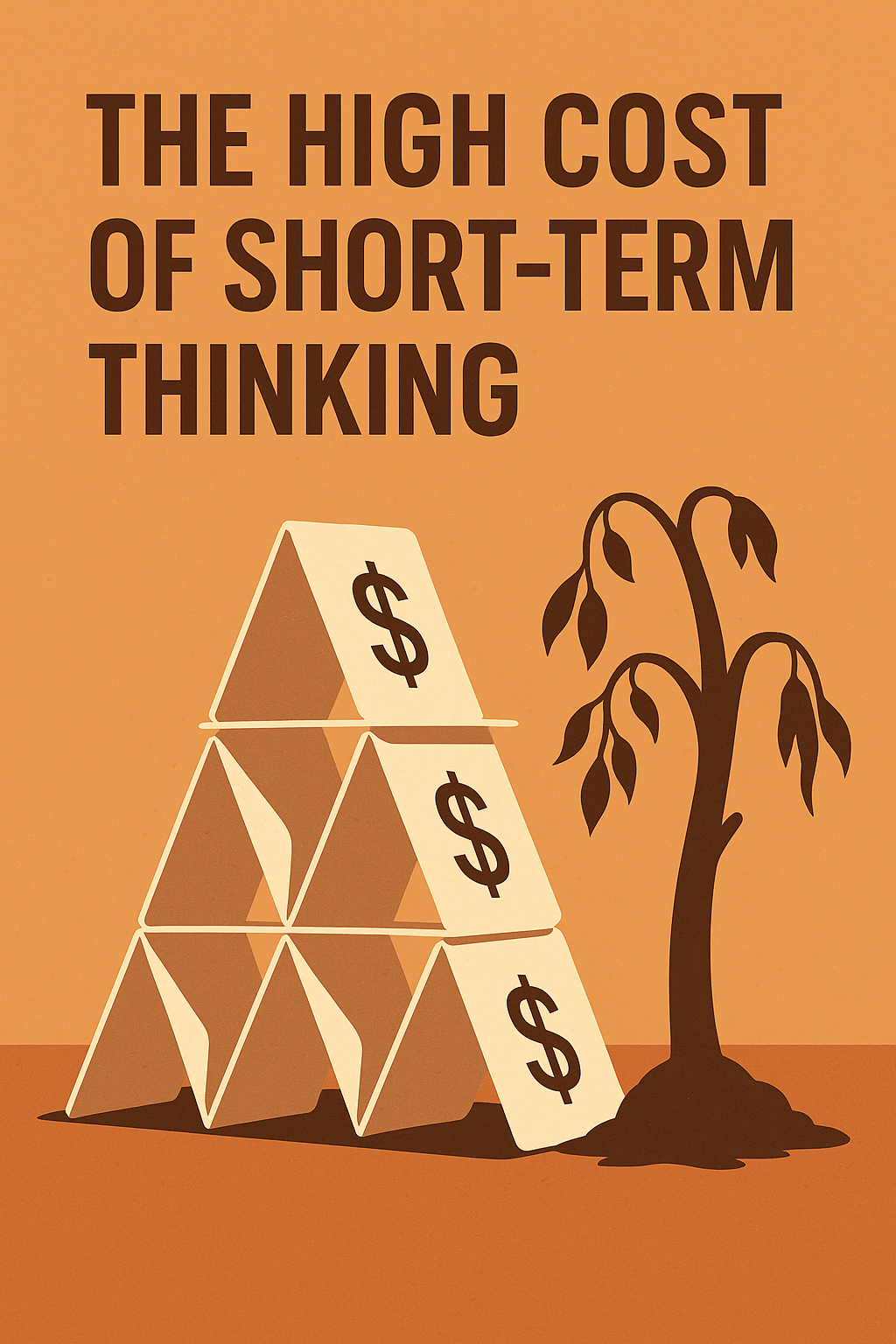
If all you ever do is cut, eventually you end up with a sick tree.
Pruning is healthy. Necessary, even. But pruning alone never grows anything. A tree needs to be fertilized, watered, and strengthened if you expect it to produce fruit.
Organizations work the same way.
- Training is fertilizer.
- Professional development is sunlight.
- Leadership growth is water.
- Skill-building is nutrients.
When you starve these areas, the decline doesn’t appear immediately—but the roots weaken. And by the time you finally notice the symptoms, the damage is already well underway.
The Private Equity Paradox
Private equity firms often claim to be strategic thinkers, but most operate within a 3-5 year window. There’s an early push, a period of optimization and stressing capacity, and then—right before selling—the inevitable slash-and-tighten phase. The goal is simple: boost the bottom line fast. Make your money and run.
But that approach becomes a house of cards if you assume talent is infinitely replaceable, business models are fungible, and your timeline changes. It can also backfire if your debt situation becomes too burdensome. Not everyone falls forward.
If you choose to believe people can endure unlimited pressure or instantly adapt to anything thrown at them, then you’d better be pouring resources into their development or be prepared to constantly replace them. Otherwise, the entire system eventually buckles under the weight of unrealistic expectations. If you are going to gamble, try to stack the odds in your favor.
Business Is Not Just Math
Too many leaders forget this:
Business is not just math. It’s math and people.
The right people in the right roles—with the right training, support, and mindset—ultimately drive performance. And the training needed today isn’t just about hard skills. It includes:
-
Communication
-
Emotional intelligence
-
Leadership fundamentals
-
Decision-making
-
Adaptability
-
Customer experience
-
Collaboration
And let’s be clear:
If your people aren’t interested in training and development, get new people. Too many people want to be rewarded for only doing the basic requirements of their job. They also often wrongfully assume experience is a proxy for knowledge. You never look backwards to move forward.
Everyone has life-balance challenges. Everyone is stretched. But choosing not to learn because you are too busy is not a valid excuse—not in this environment. Learning is part of the job. If someone won’t grow, they eventually become an anchor on the organization (at all levels).
At the end of the day, the companies that win will be those with the most skilled leaders and managers—the ones who have the latest thinking at their fingertips and can navigate complexity with confidence. The organizations that cut training, underinvest in people, or hold onto employees who resist learning will be the first casualties when things get tough.
A World Overreacting
From my vantage point, I’m watching leaders and investors overreact. They’re tightening too quickly, focusing too narrowly on the next cash flow moment or the next board meeting. But the more you obsess about the short term, the more exposed you become in the long term. And trust me, not everyone ends up with a successful exit or a saleable business.
No organization can run at a sprint forever. Pressure builds. Systems strain. People burn out. Without places to rest, learn, and grow, individual capacity shrinks—and organizational capacity shrinks right along with it.
If You’re Only Focused on the Short Term…
Let me be blunt:
If your only focus is on how much you and a small group of people can extract right now or in the short term, then this message isn’t for you.
But understand this: actions have consequences.
An over-leveraged business eventually has to pay the bill. Multiples built on inflated multiples eventually collapse. And if you’re already moving downstream—already taking smaller deals or minority positions—the last thing you should be doing is underinvesting in the one capability that will help you survive the terrain: your people.
- You can’t spreadsheet your way through uncertainty.
- You can’t model your way out of complexity.
- You need capability, judgment, resilience, and leadership.
Those things are built through investment—never through neglect.
A Final Word for Leadership Teams, PE Owners, and Family Offices
Don’t mortgage the future. Don’t assume your people can absorb endless pressure. And don’t confuse short-term gains with long-term stability.
Now is the time to double down on:
-
Strategic capability-building
-
Long-term investment in people
-
Developing leaders at every level
-
Training teams to work with AI, not fear it
-
Keeping only those who are committed to learning
-
Strengthening the roots so the tree grows stronger—not weaker
Your long-term success will rise or fall on the strength of your people.
It always has.
It always will.
And the leaders who understand this—and then act on it—are the ones who win the long game.
