
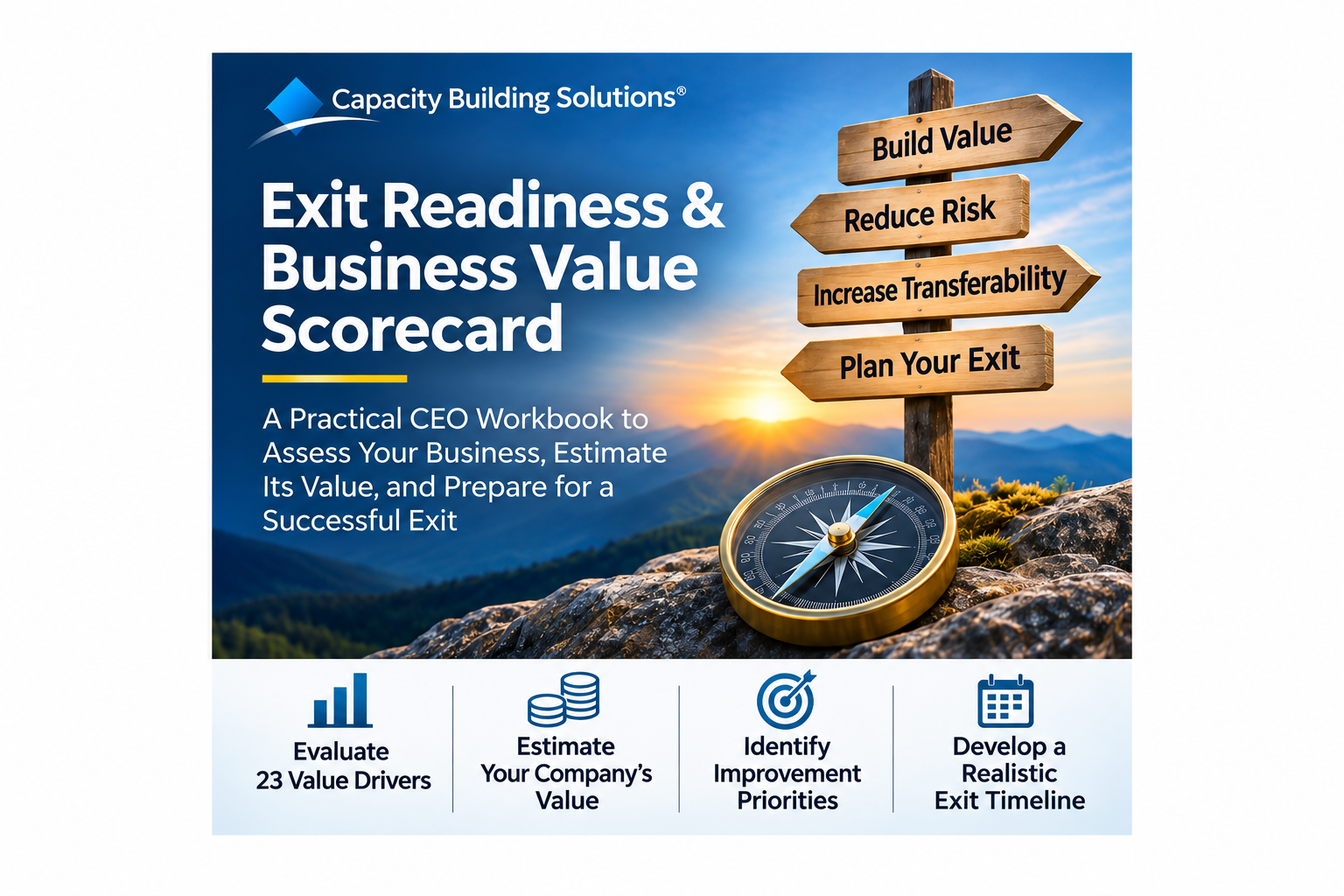
Exit Readiness & Business Value Scorecard: Understand What Your Business Is Worth and How Prepared You Are to Exit
Building a successful business is one thing. Building a valuable, transferable business is another.
Most business owners spend years, sometimes decades, building their companies. They invest considerable time, energy, financial resources, and personal sacrifice into growing revenue, serving customers, developing employees, and navigating the inevitable challenges of running a business.
Yet surprisingly few take the time to step back and objectively assess what their company is actually worth, what makes it attractive to a potential buyer, or how prepared they are to eventually transition out of the business.
For many owners, their company represents their largest financial asset. It may also represent a significant part of their personal identity, professional purpose, and long-term financial security. Despite its importance, understanding and intentionally managing business value often takes a back seat to the demands of daily operations.
That can become an expensive oversight.
A profitable business is not automatically a highly valuable business. And a valuable business is not necessarily one that can be easily sold or successfully transferred.
Buyers look beyond revenue and profitability. They want to understand the quality and sustainability of earnings, the predictability of future revenue, the strength of the management team, the concentration of customer relationships, the reliability of operating systems, and the company’s ability to succeed without its current owner.
They also look for risks. Every significant uncertainty can influence what a buyer is willing to pay, how a transaction is structured, and whether a deal happens at all.
The earlier you understand these factors, the more time you have to strengthen your position.
Why Business Exit Readiness Matters Long Before You Plan to Sell
One of the most common mistakes business owners make is waiting until they are ready to leave before seriously considering their exit strategy.
By that point, some of the most important opportunities to improve business value may already be limited by time.
Building a strong leadership team, diversifying customer relationships, improving recurring revenue, documenting operating processes, strengthening financial reporting, and reducing dependence on the owner rarely happen overnight.
These improvements take deliberate effort. More importantly, they need time to produce consistent, measurable results.
A potential buyer will want evidence that the business can continue performing well after ownership changes. A strong quarter or an unusually profitable year may generate interest, but several years of reliable financial performance, predictable operations, and demonstrated management capability can provide much greater confidence.
Business exit readiness is not simply about preparing a company for sale. It is about building a stronger, more resilient, and more valuable organization today.
Even if you have no immediate intention of selling, the same factors that make a business attractive to buyers can improve its performance, reduce operational risk, and give you greater freedom as an owner.
The goal is to create options rather than circumstances that force your decisions.
Introducing the Exit Readiness & Business Value Scorecard
The Exit Readiness & Business Value Scorecard is a practical, 20-page, fillable CEO workbook designed to help business owners take a disciplined look at their company’s value, transferability, and overall preparedness for an eventual exit.
Rather than relying on assumptions about what your business might be worth, the scorecard walks you through a structured evaluation of the factors that influence how potential buyers assess a company.
It also encourages you to consider an equally important question: Are you personally ready for what comes after the business?
The assessment combines business value drivers, financial estimates, owner readiness, improvement priorities, and exit timing into one planning framework.
The objective is not to predict an exact selling price. It is to help you better understand your current position, recognize the issues that may affect your company’s value, and identify the actions that deserve your attention.
What You Will Learn from This Scorecard
1. How Your Business Measures Up Against 23 Important Value Drivers
A business’s value is influenced by more than its financial statements. Buyers assess the overall quality of the company, the risks associated with owning it, and the likelihood that its performance will continue after a transaction.
The scorecard evaluates 23 value drivers across four critical areas:
Financial Quality
How reliable are your financial results? Are earnings sustainable? Does profitability translate into cash flow? Can your financial reporting withstand the scrutiny of a potential buyer?
Strong financial quality begins with accurate, timely reporting and a clear understanding of normalized earnings, operating margins, cash conversion, and historical performance.
Revenue Defensibility
How predictable and sustainable is your revenue? Are you overly dependent on a handful of customers? Do you have recurring revenue, strong retention, pricing power, and meaningful competitive advantages?
Buyers place considerable importance on understanding whether today’s revenue is likely to continue tomorrow.
Transferability
Can your business operate effectively without you?
This may be one of the most important and uncomfortable questions an owner can ask.
A company that depends heavily on its owner for customer relationships, major decisions, technical knowledge, or daily operations carries additional risk for a buyer.
The scorecard examines management depth, documented processes, succession coverage, customer relationships, and the degree to which the organization can operate independently.
Sale and Exit Readiness
How prepared is your business for an actual transaction?
This includes understanding potential buyers, maintaining organized records, obtaining independent perspectives on business value, understanding likely deal structures, and managing the company with a longer-term value creation mindset.
Your responses generate a weighted value-readiness score and identify areas requiring attention.
The scorecard also highlights critical weaknesses that could limit your readiness, even when your overall score appears relatively strong.
2. What Your Business Might Be Worth
Many owners have a number in mind when they think about selling their company. Unfortunately, that number is not always grounded in how businesses are actually valued.
The scorecard introduces a practical framework based on adjusted EBITDA and valuation multiples.
It helps you examine your earnings, consider supportable adjustments, enter an appropriate multiple range, and develop an illustrative estimate of enterprise value.
It also helps you think about the relationship between two important drivers of business value:
- Earnings: How much sustainable profit the business generates.
- The valuation multiple: What a buyer may be willing to pay for those earnings based on the company’s quality, growth potential, transferability, and perceived risk.
Improving earnings can increase value. Reducing risk and improving the quality of the business may also strengthen the multiple a buyer is willing to consider.
Understanding both sides of this equation is essential.
The workbook also helps estimate potential net proceeds after debt, taxes, and transaction fees, allowing you to compare your estimated outcome with the amount you hope to receive.
These figures are intended for planning purposes and should be reviewed with qualified financial and valuation professionals.
3. Whether Your Business Value Aligns with Your Personal Financial Goals
There is an important difference between what a company sells for and what its owner ultimately receives.
Debt obligations, taxes, transaction expenses, deal structure, and other considerations can materially affect the proceeds available after a sale.
An owner might celebrate an attractive selling price only to discover that the amount remaining does not fully support their long-term financial goals.
The scorecard encourages you to work backward from the financial outcome you want.
What amount of money do you need after the transaction? How does that compare with your current estimated proceeds? What additional earnings or valuation improvement might be required to close the gap?
These are important questions to address while you still have time to influence the answers.
4. Whether You Are Personally Ready to Leave the Business
Exit planning is not exclusively a financial or operational exercise.
For many entrepreneurs, the business has been a central part of their lives for years. It provides structure, purpose, relationships, professional identity, and a sense of accomplishment.
Walking away from that responsibility can be more complicated than expected.
The scorecard includes a separate owner-readiness assessment covering both financial and personal considerations.
It asks you to reflect on whether you have a clear personal financial plan, whether your family and partners are aligned with your goals, whether you are comfortable transferring authority, and whether you have a meaningful vision for the next stage of your life.
It also examines your ability to evaluate offers objectively and maintain the energy required to navigate a potentially lengthy transition process.
Your business may be ready to sell before you are ready to leave.
Recognizing that difference early can help prevent rushed decisions, unnecessary conflict, or disappointment after a transaction.
5. Which Improvements Could Have the Greatest Impact on Business Value
Knowing where your business falls short is useful. Knowing what to do about it is far more valuable.
The scorecard moves beyond assessment by helping you identify up to five specific value-building priorities.
These might include strengthening your leadership team, reducing customer concentration, improving operating margins, increasing recurring revenue, documenting critical processes, or improving financial reporting.
For each priority, you can define the action required, assign responsibility, establish timing, track progress, and estimate the potential financial impact where appropriate.
Some improvements increase earnings directly. Others reduce risk, improve transferability, or strengthen buyer confidence.
Both types of improvement matter.
The purpose is to move from a general desire to increase business value to a focused, accountable action plan.
6. Whether Your Desired Exit Timeline Is Realistic
An effective exit strategy requires more than selecting a date.
The time needed to prepare a company depends on its current condition, the magnitude of its weaknesses, and the improvements required to make it more attractive to potential buyers.
The scorecard uses a four-phase framework:
Phase 1 — Establish the Foundation: Improve financial credibility, operational clarity, and the fundamentals required for sustainable performance.
Phase 2 — Strengthen the Engines: Focus on earnings quality, cash flow, revenue predictability, and operating performance.
Phase 3 — Build Transferability: Reduce dependence on the owner, strengthen management capabilities, and address risks that could affect a transaction.
Phase 4 — Position and Realize: Prepare the company for the market, organize transaction-related information, and approach the exit process from a position of strength.
Based on your assessment results and intended exit date, the workbook estimates how much preparation time may be needed and whether your current timeline provides sufficient flexibility.
This can help you recognize when your expectations and your company’s readiness may not be aligned.
Who Should Use This Scorecard?
This resource is particularly useful for:
- Business owners considering an exit within the next three to five years who want to understand where they stand and what needs to improve.
- CEOs focused on long-term enterprise value who want a more disciplined way to evaluate the business beyond annual revenue and profit.
- Owners who feel too involved in daily operations and want to build a company that can succeed without their constant presence.
- Entrepreneurs preparing for succession or ownership transition who need to strengthen leadership, systems, and organizational independence.
- Business leaders who want to understand the gap between their financial goals and potential sale proceeds.
- Owners who are not planning to sell anytime soon but recognize that building a more transferable business creates flexibility and long-term financial security.
You do not need to have an immediate exit plan to benefit from the assessment.
In fact, completing it well before a transaction is being considered may provide the greatest opportunity to make meaningful improvements.
How to Get the Most from the Workbook
Set aside approximately 45 to 60 minutes to complete the assessment.
Have your most recent 12 months of financial statements available, including your income statement and balance sheet.
Approach the questions as a potential buyer would, rather than rating the company based solely on your own familiarity with its strengths.
Be willing to acknowledge weaknesses. An accurate assessment provides a much better starting point for improvement than an overly optimistic one.
The fillable PDF includes automatic scoring and calculations when completed in Adobe Acrobat Reader. A completed example is also provided to demonstrate how the assessment, valuation estimates, improvement priorities, and exit timeline fit together.
Once you finish, consider reviewing your results with your leadership team, CPA, financial advisor, business coach, or other trusted advisors.
Pay particular attention to the lowest-scoring areas and any critical red flags. These are often the issues that deserve the most immediate attention.
Revisit the scorecard every six to twelve months to assess progress and adjust your priorities as circumstances change.
A Final Thought: Build a Business That Gives You Choices
One of the greatest benefits of intentionally building business value is that it creates choices.
You may ultimately decide to sell to a strategic buyer, transition ownership to your management team, pursue a family succession plan, bring in an investment partner, or continue owning the company while stepping away from daily responsibilities.
Regardless of the direction you choose, a financially sound, well-managed, transferable business puts you in a stronger position.
The alternative is allowing circumstances, fatigue, market conditions, or unexpected events to determine when and how you exit.
The best time to start preparing for an eventual exit is when you still have the time, energy, and flexibility to build the business you want to leave behind.
The Exit Readiness & Business Value Scorecard provides a practical starting point for that process.
Download the free, fillable Exit Readiness & Business Value Scorecard and take the first step toward understanding your company’s value, strengthening its future, and preparing for a successful transition on your terms.
This scorecard is a planning and discussion tool, not a formal business valuation. Review financial assumptions and transaction considerations with qualified professional advisors.