
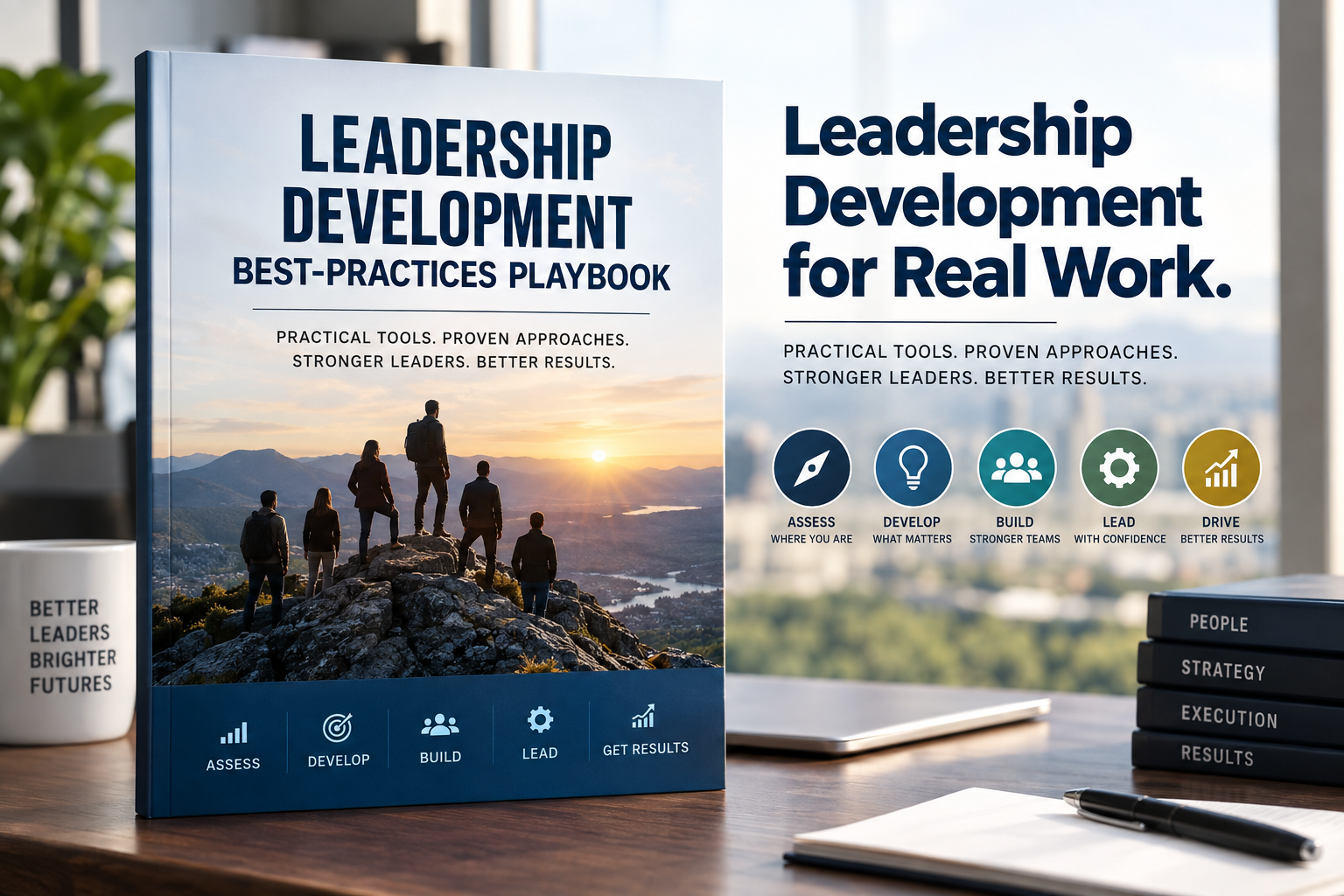
Leadership Development Best Practices: A Practical Playbook for Building Stronger Leaders
Leadership development should improve the way people lead the business. It should help leaders make better decisions, develop stronger teams, build capability in others, work effectively across functions, and produce better business results.
Too often, leadership development is treated as a class, a personality assessment, or a collection of good ideas. Those things can help, but they are not enough by themselves.
Effective leadership development best practices connect development to the needs of the business and the demands of the leader’s role. Leaders need opportunities to practice new behaviors through real work, receive useful feedback and coaching, reflect on what they are learning, and measure whether anything is actually changing.
That is why I developed the Leadership Development Best-Practices Playbook.
This 70-page playbook provides CEOs, business owners, executives, mid-level managers, emerging leaders, and the people who develop them with a practical, evidence-informed approach to building leadership capability.
It is especially designed for small and mid-sized organizations that want a credible leadership development framework without creating an overly complicated program or corporate university.
The operating principle is straightforward:
Diagnose before you prescribe. Develop through the work. Measure what changes. Hold the standard.
Start With the Leadership Development Priorities That Matter Most
Most leaders can identify something they could improve in almost every area of leadership. That does not mean they should try to improve everything at once.
The playbook begins with an Initial Leadership Assessment designed to help identify the one or two areas that could make the greatest difference in the leader’s current role and in the business.
The assessment looks at seven important areas:
- Leading yourself
- Leading and developing people
- Getting results through the team
- Understanding the business and thinking strategically
- Working with leadership peers and leading across the company
- Leading change and building the future
- Leading with artificial intelligence
The objective is not to produce a long list of weaknesses. It is to identify where focused leadership development can create the greatest leverage.
Define What Good Leadership Looks Like
One of the challenges with leadership development is that organizations often expect leaders to improve without clearly defining what good leadership looks like.
The playbook establishes a practical leadership standard built around ten capabilities:
- Self-leadership and character
- Strategic thinking and judgment
- Business and financial acumen
- Direction and alignment
- Communication and influence
- Execution and accountability
- Talent leadership and coaching
- Team and culture leadership
- Change, learning, and innovation
- Enterprise leadership and peer collaboration
These capabilities provide a common language for assessing leaders, identifying development priorities, coaching managers, planning development assignments, and strengthening the organization’s leadership bench.
The playbook also introduces a T-shaped leadership expectation: leaders should have depth in their primary area of responsibility while developing enough knowledge across the business to ask informed questions, understand interdependencies, and make better enterprise decisions.
Turn Leadership Assessment Into Real Development
Assessment by itself does not develop anyone.
The playbook includes a more detailed Leadership Capability Assessment that can be completed by the leader and the leader’s boss. For higher-level roles, focused 360-degree feedback can also be added to understand how peers and direct reports experience the leader’s behavior.
The important part is what happens next.
Rather than focusing on a total score, the process helps leaders identify one or two high-leverage development priorities supported by actual examples and business evidence.
From there, development moves into the work.
The playbook’s professional development framework follows seven stages:
Align → Diagnose → Focus → Practice → Reflect → Measure → Sustain
The goal is to connect leadership development to real assignments, feedback, coaching, formal learning, and reflection rather than separating development from the work leaders are already responsible for doing.
Create an Individual Leadership Development Plan
The playbook includes an Individual Development Plan (IDP) process for turning leadership insight into focused action.
Instead of broad goals such as “be more strategic,” “delegate more,” or “improve communication,” leaders define the observable behaviors that should change.
Each development plan connects those behaviors to a real business or role priority and identifies:
the development goal, why it matters now, strengths to leverage, potential obstacles or derailers, a stretch assignment, learning resources, coaching support, leading indicators, outcome measures, feedback partners, and 30-, 60-, and 90-day actions.
The result is a six-to-twelve-month development plan built around one or two meaningful priorities rather than a long list of competencies.
Develop Leaders Through Real Work
One of the central ideas behind the playbook is that the business itself should become an important part of the leadership classroom.
Leaders grow by doing consequential work: leading a strategic initiative, improving a broken process, developing another manager, handling a difficult conversation, making an important decision, leading across functions, implementing change, or taking responsibility for an unfamiliar business challenge.
The playbook helps organizations use stretch assignments, coaching, feedback, and reflection to turn those experiences into deliberate leadership development.
The assignment still needs to produce a business result. But it can also be intentionally designed to build the leadership capability the individual needs next.
Build Strategic Thinking and Business Acumen
Strong leadership requires more than managing a department well.
Mid-level and senior leaders increasingly need to understand how the whole business works and how decisions in one area affect customers, people, operations, cash, capacity, technology, risk, and results elsewhere.
The playbook includes tools for developing strategic thinking, business and financial acumen, functional fluency, and enterprise leadership.
The objective is not to make every leader an expert in every function. It is to help leaders understand enough about the business to follow the logic, interpret important measures, recognize interdependencies, ask better questions, and know when deeper expertise is required.
Help Leaders Use Artificial Intelligence Responsibly
Artificial intelligence is becoming part of ordinary managerial work, which means AI leadership is becoming part of leadership development.
The playbook includes a dedicated Leading With Artificial Intelligence section built around five capabilities:
Use. Judge. Protect. Redesign. Lead.
Leaders learn how to identify appropriate AI opportunities, provide useful context and instructions, critically evaluate AI-generated work, protect confidential and sensitive information, redesign workflows, and lead responsible adoption.
The playbook also includes an AI readiness assessment, a 30-day development path, practical guardrails, value-measurement guidance, and an AI Leadership Use-Case and Decision Canvas.
The principle remains straightforward: AI may assist the work, but the leader still owns the outcome.
Give CEOs and Business Owners a Leadership Development Framework
Leadership development cannot become solely the responsibility of HR.
For organizations that want to build a stronger leadership bench, the playbook includes a dedicated CEO and Business-Owner Implementation Guide.
It provides a step-by-step approach for connecting leadership development to strategy, establishing leadership standards, choosing an initial cohort, establishing governance, creating baseline assessments, approving focused development plans, involving each participant’s boss, establishing a coaching cadence, removing organizational barriers, and evaluating results.
There is also a 90-day implementation checklist to help turn the framework into an operating process rather than another initiative that loses momentum after launch.
The CEO’s involvement matters. When senior leaders connect development to strategy, participate visibly, provide meaningful assignments, ask about progress, and hold managers accountable for developing people, leadership development becomes part of how the company operates.
Measure Whether Leadership Development Is Working
Attendance is not evidence that leadership improved.
The playbook provides a four-level leadership development scorecard that asks:
Is the leader doing the work?
Are other people seeing different leadership behavior?
Is the team or operating system improving?
Did the leadership change contribute to an important business result?
The objective is not to pretend leadership development is the only reason a business result changed. It is to establish a credible chain between improved leadership behavior, stronger team or operating conditions, and meaningful business outcomes.
Practical Leadership Development Tools You Can Use Immediately
This is not just a leadership development guide to read. It includes 15 field tools designed for real leadership situations.
Among them are an Individual Development Plan, Quarterly Progress Review, Stakeholder Pulse, Leadership One-on-One Agenda, Delegation Contract, Coaching Conversation, Feedback Planner, Difficult Conversation Planner, Decision Quality Checklist, Stretch Assignment Charter, After-Action Review, Monthly Learning Log, Talent Review Card, Enterprise Initiative and Peer Collaboration Charter, and AI Leadership Use-Case and Decision Canvas.
Use the tool when it helps improve a conversation, decision, assignment, or leadership moment. Then return to the work.
Where Should You Start?
You do not need to read all 70 pages from beginning to end.
In fact, I recommend that you don’t.
Start with the Initial Leadership Assessment.
Identify the one or two areas that could make the greatest difference in your role or business right now. Then go to the sections and tools that address those priorities.
If you are a CEO or business owner, use the implementation section to think about what stronger leadership needs to make possible for your business and how you can build that capability across your organization.
If you are developing yourself, start with one priority, one real assignment, and a regular feedback and coaching rhythm.
Leadership development does not need to be complicated. But it does need to change something.
The standard is not participation. The standard is visible growth that improves the work, strengthens the team, and produces better results.