
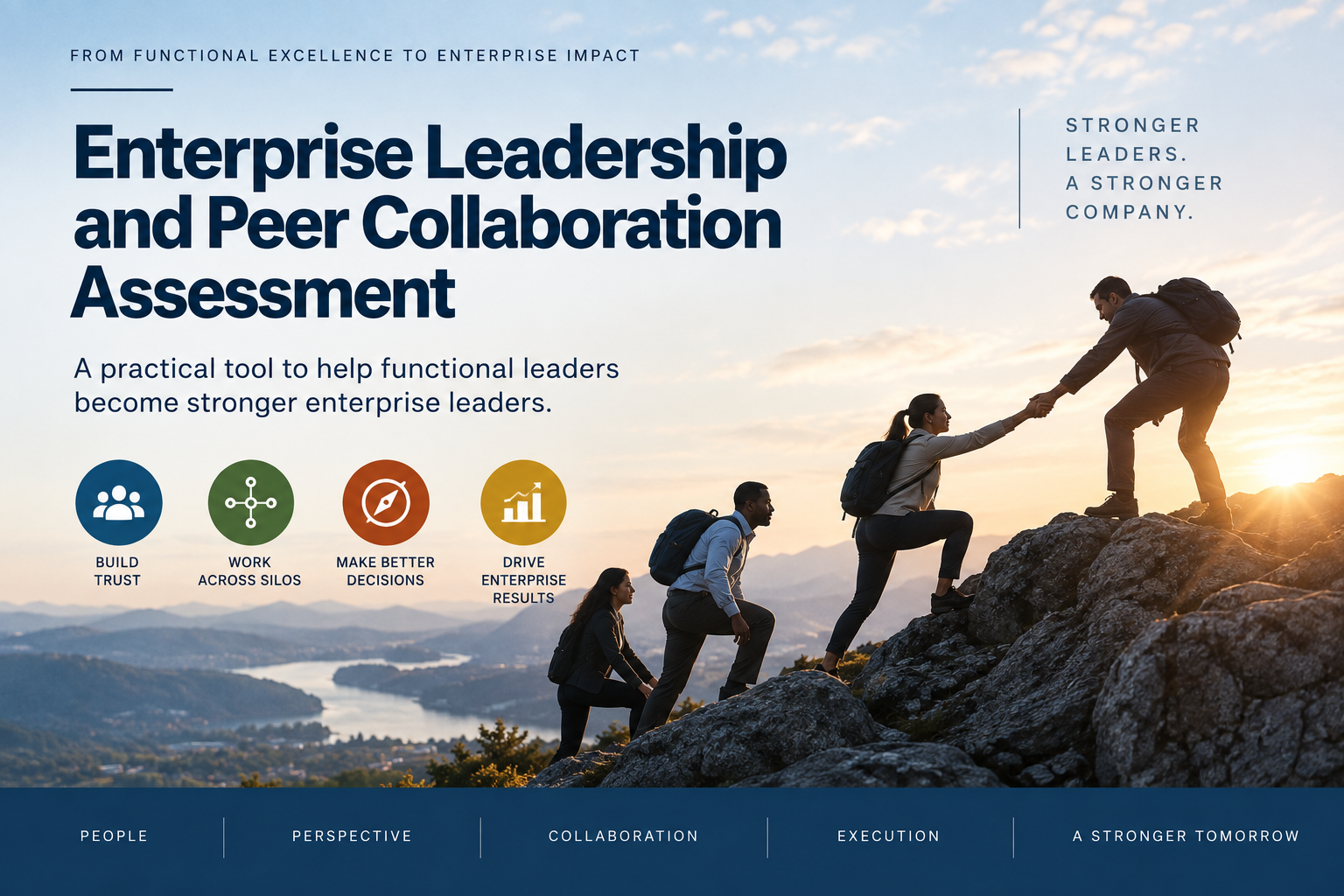
Enterprise Leadership and Peer Collaboration Assessment
Getting strong results in your own function is important. But as leaders move into more senior roles, that is no longer enough.
A senior leader has two jobs: lead the function well and help lead the entire company.
That transition can be harder than it sounds.
Functional leaders are often promoted because they know how to advocate for their people, protect their priorities, solve problems, and deliver results. Those strengths still matter. But at the senior level, leaders also need to understand what is happening across the business, work effectively with leadership peers, respect decision rights, share information and resources, manage disagreements directly, and sometimes put the company’s overall result ahead of what would be best for their own function.
That is why I developed the Enterprise Leadership and Peer Collaboration Assessment.
This practical leadership assessment is designed to help a leader and the leader’s direct manager evaluate whether strong functional leadership is also translating into effective enterprise leadership and peer collaboration.
Is the Leader Leading a Function—or Helping Lead the Company?
One of the biggest transitions in senior leadership is learning to see the business beyond your own department.
A sales leader still needs to deliver sales results. An operations leader still needs to run operations well. A finance leader still needs to protect the financial health of the company.
But senior leadership adds another responsibility.
The leader must be able to sit at the leadership table and think about the company as a whole.
The assessment looks at the behaviors that make that possible, including whether the leader puts the company’s overall result ahead of a functional win when the two conflict, understands the pressures facing other functions, raises cross-functional concerns directly with peers before escalating them, and respects the accountable leader’s authority within that leader’s function.
It also examines whether the leader shares important customer, pipeline, demand, capacity, and other information early enough for peers to plan effectively; considers downstream consequences before making commitments; shares resources and credit when the company needs it; and helps peers solve problems instead of simply pressuring them for answers.
These are not abstract leadership concepts. They are behaviors that affect trust, execution, customers, decision-making, and business performance.
Assess the Quality of Peer Collaboration
Leadership teams can have talented individual executives and still operate poorly as a team.
One common reason is that functional advocacy begins to overpower enterprise responsibility.
Leaders create end-runs around one another. Problems are escalated before peers have spoken directly. Someone starts giving instructions inside another executive’s function. Information arrives too late. Resources become territorial. Leaders continue fighting decisions after the leadership team has made them.
Over time, those behaviors can weaken trust and make execution harder.
The assessment asks leaders to evaluate whether they can advocate strongly without creating a second chain of command, challenge decisions constructively and then support them once made, and lead cross-functional work through influence rather than title.
It ends with a particularly important standard:
Would my leadership peers describe me as candid, dependable, and enterprise-minded?
Compare the Leader’s View With the Manager’s View
I recommend that the leader and direct manager complete the assessment separately.
That matters because the value isn’t only in the score.
A difference between how a leader sees a behavior and how the leader’s manager experiences that behavior can reveal an important development issue.
The assessment therefore looks at the overall score, the number of behaviors rated low, the largest difference between the leader and manager, and the individual behavior creating the greatest enterprise risk.
The scoring system ranges from a trusted enterprise leader at the upper end to a serious enterprise-leadership concern at the lower end.
But I would not use the total score by itself.
As the assessment points out, a high overall score does not cancel out a serious problem involving respect for another leader’s authority, handling disagreement directly, or considering the downstream impact of decisions.
Look at the Evidence Behind the Score
Numbers can start the conversation. Evidence makes the conversation useful.
The Evidence Review on page 2 moves beyond ratings and asks the leader and manager to identify examples of strong enterprise leadership as well as examples of end-runs, role confusion, or boundary violations.
It then examines the impact on peer trust, operations, and customers.
Importantly, the assessment also asks what the leader believes justifies the behavior.
That question can uncover an important issue.
A leader may believe an end-run is necessary because another function isn’t responding quickly enough. A leader may cross a boundary because a customer issue feels urgent. A peer may escalate because decision rights are unclear.
That does not necessarily make the behavior acceptable, but it helps distinguish a leadership behavior problem from an organizational system or decision-process problem.
Sometimes both need to change.
Choose the Enterprise Leadership Behaviors That Matter Most
I would not automatically start with the lowest score.
Start with the behavior creating the greatest business or relationship cost.
The assessment recommends selecting no more than two priorities and defining what leadership peers should see the leader doing differently within 30 days.
That keeps development practical.
Instead of telling someone to “be more collaborative,” define what collaboration should look like in actual leadership behavior.
Maybe the leader needs to raise concerns directly with a peer before escalating.
Maybe important information needs to be shared sooner.
Maybe the leader needs to stop creating a second chain of command inside another function.
Maybe the leader needs to challenge a decision vigorously in the room—and then support the final decision once it has been made.
The behavior should be clear enough that other people can tell whether it is changing.
Turn the Assessment Into a 30-, 60-, and 90-Day Leadership Plan
The final page turns the assessment into action.
The leader identifies two behaviors to stop, two to start, and two to continue, along with a leadership peer who will provide feedback.
The leader and manager then define the evidence they expect to see at 30, 60, and 90 days.
This is an important part of the tool because insight alone is not development.
The completion standard is:
Do not stop with insight. Leave with a clear behavior, an accountable owner, a date, and evidence that will show whether progress occurred.
When to Use This Enterprise Leadership Assessment
I would use this tool when a capable functional leader is moving into a more senior role, joining the executive team, taking on more cross-functional responsibility, or struggling with peer relationships, decision rights, boundaries, or enterprise-wide execution.
It can also be useful when someone is producing strong functional results but creating unnecessary friction elsewhere in the company.
Strong functional performance matters.
But strong functional results do not excuse behavior that weakens trust, execution, or enterprise performance.
The higher a leader moves in an organization, the more important this distinction becomes.
The question is no longer simply:
“Am I leading my function well?”
It becomes:
“Am I also helping my peers lead the whole company well?”
That is the standard this assessment is designed to help you evaluate.