
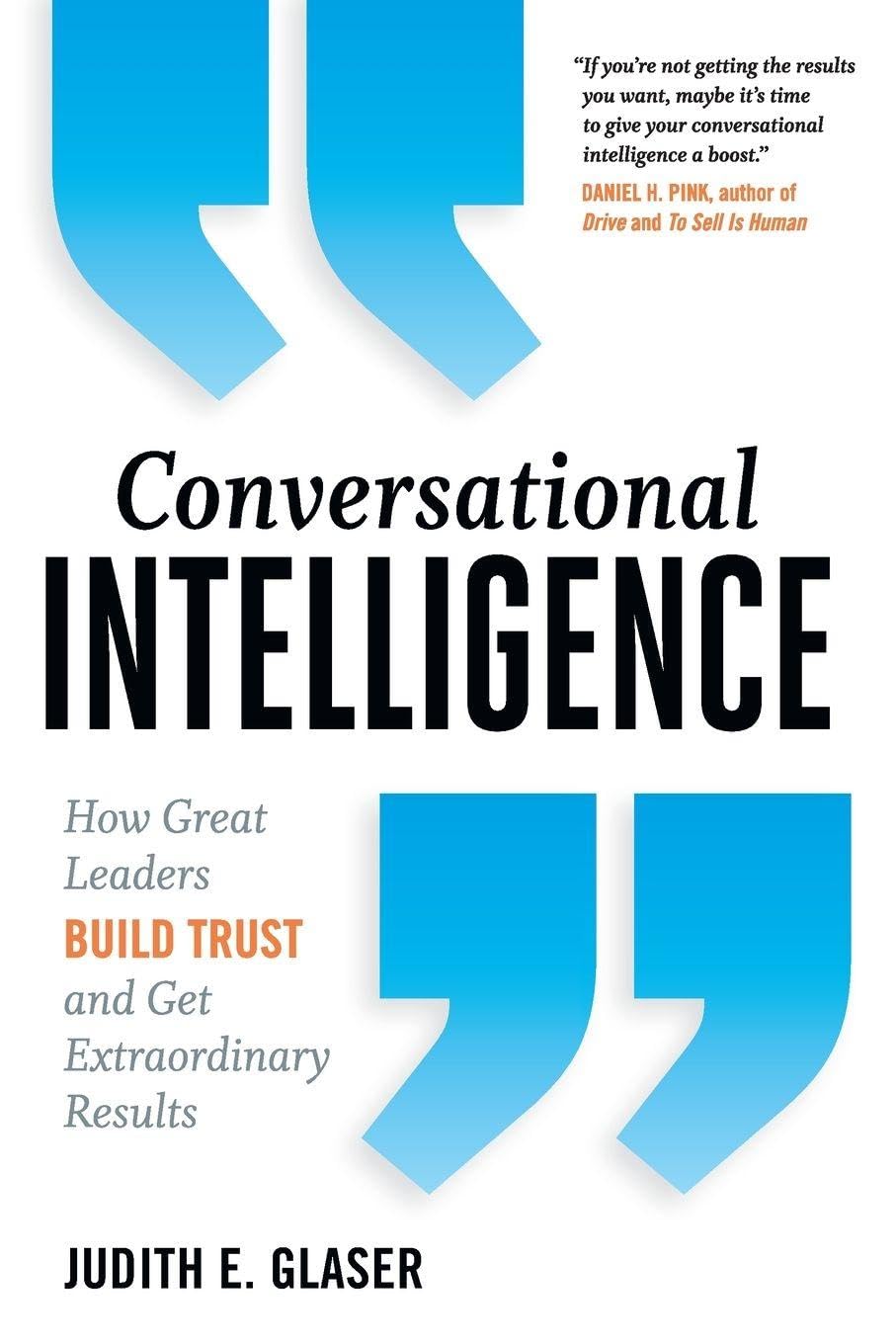
Conversational Intelligence: How Great Leaders Build Trust and Get Extraordinary Results — Judith E. Glaser
Introduction
Most leaders spend a significant portion of their day in conversation. We have meetings, one-on-ones, performance discussions, sales calls, strategy sessions, and countless informal interactions. Yet, how often do we stop and think about the quality of those conversations? We tend to focus on what we want to say rather than what the other person is hearing and experiencing. Conversational Intelligence by Judith E. Glaser challenges us to look at communication differently. Her basic premise is that conversations aren’t simply an exchange of information. They affect trust, relationships, behavior, organizational culture, and ultimately business results. Glaser describes Conversational Intelligence as something we can learn and improve rather than a communication skill we either possess or don’t.
This idea resonates with me because I have long believed that communication is an interpersonal activity. You can be technically correct, have a good strategy, and even have the authority to make a decision, but none of that guarantees people will understand you, trust you, or follow your lead. In my own work with business owners and senior executives, I have seen relatively small communication problems turn into much bigger organizational issues because they weren’t addressed early enough or honestly enough. I have also watched good leaders transform difficult situations simply by slowing down, listening, asking better questions, and creating an environment where people felt comfortable telling the truth. Glaser gives us a useful framework for understanding why this happens and what we can do about it. This emphasis on listening, asking better questions, honesty, trust, and interpersonal communication also closely parallels themes I explore in On Leadership and Business.
Why Conversational Intelligence Is Essential for Business Owners and Leaders
Leadership happens through other people. And much of what happens between people happens through conversation.
You can have the best strategic plan in the world, but somebody still needs to communicate it. You can hire talented people, but expectations need to be discussed and understood. You can talk about accountability, but difficult performance conversations still need to take place. You can say you want innovation, but people won’t offer their best ideas if they don’t feel safe disagreeing with you.
This is where Conversational Intelligence becomes especially relevant to business owners.
One of Glaser’s most important arguments is that trust and distrust affect how people process conversations. When people perceive a threat, they become more defensive and less receptive. When trust is present, people become more capable of openness, collaboration, judgment, and productive dialogue. Glaser’s work connects these different conversational experiences with neuroscience and our responses to trust and threat.
For a leader, the practical implication is significant: your words don’t exist independently of the environment you create around them.
I have seen leaders become frustrated because employees won’t speak candidly during meetings. My first question is usually some version of: What happens when they do?
If people learn that challenging the boss leads to defensiveness, embarrassment, or repercussions, they will eventually stop challenging the boss. The leader may then conclude everyone agrees with them when the opposite may be true.
That isn’t a communication problem. It is a leadership problem.
And eventually, it becomes a business problem.
The Big Ideas in Conversational Intelligence
1. Trust Changes the Conversation
Trust isn’t simply a nice cultural value to put on the wall. It changes what becomes possible between people.
Glaser’s work emphasizes that words can strengthen connection and trust or damage rapport and cause people to perceive one another more as adversaries.
Business leaders need to understand this.
People do their best thinking when they can be honest without constantly worrying about protecting themselves. This doesn’t mean creating an environment where everyone agrees or where accountability disappears. In fact, I would argue the opposite. High-trust organizations should be capable of having more difficult conversations, not fewer.
2. There Are Different Levels of Conversation
One of the useful frameworks in Conversational Intelligence is Glaser’s three levels of conversation.
At the most basic level, people exchange information. At another level, they advocate positions, attempt to persuade, and defend their perspectives. At the highest level—what Glaser calls Level III conversations—people move toward mutual discovery and co-creation.
This distinction matters.
Many leadership teams believe they are collaborating when what they are really doing is taking turns defending their positions.
There is a big difference between asking:
“How do I convince them I’m right?”
and:
“How do we arrive at the best answer together?”
The second question requires confidence, curiosity, and humility.
3. Listen to Understand, Not Simply to Respond
Listening is one of those leadership skills almost everyone believes they possess and comparatively few people consistently practice well.
I’ve written before that active listening can be as important—if not more important—than talking.
Glaser takes this idea further. Effective conversation requires us to become genuinely curious about how another person sees the situation rather than simply waiting for an opportunity to insert our own opinion.
This is harder than it sounds, especially for successful people.
Business owners are accustomed to solving problems. They are rewarded for making decisions. Consequently, they can develop the habit of entering every conversation believing their job is to provide the answer.
Sometimes your job is to provide the answer.
Sometimes your job is to ask the question that helps someone else discover it.
Knowing the difference is leadership.
4. Leaders Create the Conversational Environment
Leaders sometimes underestimate how much their behavior affects everyone else in the room.
I have always believed that leaders set the tone in their organizations. Glaser’s work reinforces this idea from the standpoint of conversation.
If you interrupt people, others will become more cautious about speaking.
If you punish disagreement, disagreement will go underground.
If you pretend to listen while checking your phone, people notice.
If you ask questions when you’ve already decided what answer you want, people figure that out too.
Conversely, if you demonstrate genuine curiosity, acknowledge when you’re wrong, listen carefully, and allow people to challenge your assumptions, you create a very different environment.
Culture isn’t what you say it is.
It is what people repeatedly experience.
5. Move from “I” Thinking to “WE” Thinking
A recurring theme in Glaser’s work is moving from self-protective or “I-centric” thinking toward collaborative, “WE-centric” relationships. Her broader Creating WE work argues that organizational performance is tied to culture, culture to relationships, and relationships to the quality of conversations.
This doesn’t mean leaders abdicate responsibility or turn every decision into a committee meeting.
Someone still needs to make the final call.
However, there is an enormous difference between making the decision and believing you must possess every answer.
The best leaders I know surround themselves with smart people and actually listen to them.
Key Quotes
A few quotes capture the central message particularly well:
- “Everything happens through conversation!” — Judith E. Glaser
- “Listen to connect, not reject.” — Judith E. Glaser
- “Navigating the future is a wiser strategy than working on fixing the past.” — Judith E. Glaser
What I like about these ideas is their simplicity. None requires an elaborate leadership program to begin implementing. You can start with your very next conversation.
Top 7 Takeaways from Conversational Intelligence
- Trust comes first. If people don’t trust you, the quality of almost every important conversation will suffer.
- Your intention isn’t the only thing that matters. What matters is also how your words are received. Leaders need enough self-awareness to understand their impact on other people.
- Listening is an active leadership responsibility. Don’t listen simply to formulate your response. Listen to understand what the other person is actually trying to tell you.
- Ask better questions. Good questions open conversations. Poor questions shut them down or steer people toward the answer the leader already wants.
- Disagreement isn’t necessarily dysfunction. Healthy disagreement can improve decision-making. The challenge is creating enough trust that people can disagree without making the conflict personal.
- Move conversations from advocacy toward discovery. Stop spending all your energy trying to prove you are right. Create opportunities for people to think together and develop better answers.
- The quality of your conversations eventually becomes the quality of your culture. If communication throughout the business is guarded, political, defensive, or dishonest, don’t be surprised when the culture reflects those behaviors.
Applying Conversational Intelligence to Your Leadership
I wouldn’t recommend reading this book and then trying to implement everything at once. Knowledge without action is just the passage of time. Pick a few things that are relevant to your current leadership situation and work on them deliberately.
Start by paying attention to yourself.
For the next week, observe your conversations. How much are you actually listening? How often do you interrupt? Do you ask genuine questions, or are your questions really statements disguised by a question mark? What happens when somebody disagrees with you? Do you become curious or defensive?
Then look at your leadership team.
At your next meeting, pay attention to who talks and who doesn’t. Are two or three people dominating the discussion? Are people challenging one another’s assumptions? Is the boss doing most of the talking? Does everyone suddenly agree once the most senior person states an opinion?
These patterns tell you something.
You might also ask your people a deceptively simple question:
“What conversations aren’t we having that we need to be having?”
Then be quiet and listen.
You may not like everything you hear. That’s okay.
Leadership isn’t about being comfortable all the time. It is about creating the conditions necessary for the organization and its people to succeed.
Possible Next Steps
Choose one important relationship in your business where communication could be better. It could be with a business partner, senior executive, employee, customer, or even a family member involved in the company.
Don’t begin by deciding what the other person needs to change.
Ask yourself what you can do differently.
Schedule a conversation. Remove the distractions. Put the phone away. Ask questions. Listen carefully. Don’t immediately defend yourself when you hear something uncomfortable. Look for areas where your assumptions may be wrong.
Most importantly, leave the conversation with clarity about what happens next.
Then repeat the process.
Improving your Conversational Intelligence isn’t something you accomplish at a seminar or by reading one book. It becomes a leadership habit, and habits are developed through practice.
Conclusion
Conversational Intelligence reinforces something that is easy to understand but surprisingly difficult to master: leadership is fundamentally relational. Strategy matters. Financial discipline matters. Execution matters. Talent matters. But all of these things depend on human beings working effectively together, and human beings work together largely through conversation. Judith E. Glaser gives leaders a useful way of thinking about the connection between conversation, trust, collaboration, and organizational performance. The question isn’t whether you’re communicating—you are doing it all day long. The better question is: What are your conversations creating? For any business owner or leader willing to examine that question seriously, Conversational Intelligence is well worth reading