
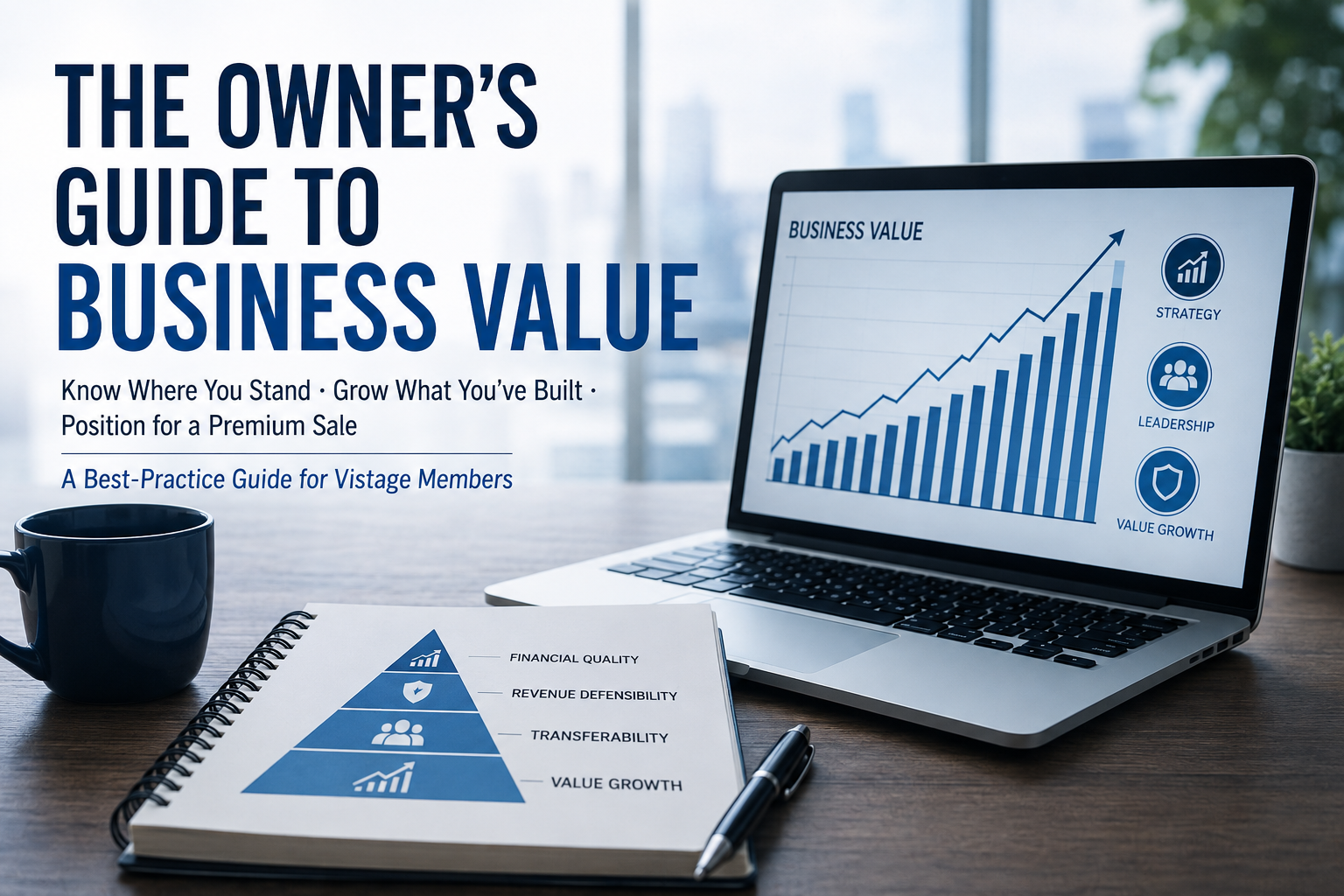
The Owner’s Guide to Business Value
What Owners Know—and What They Don’t
Most business owners I work with know their revenue, margins, and profitability. They know what happened last month, what the pipeline looks like, and where they need the business to go next.
Far fewer can answer another important question with the same confidence: What is my business actually worth—and why?
For many owners, the business is the single largest asset they have built. Yet we often spend years focused on growing revenue and improving profitability without giving the same attention to the factors that determine what someone else would ultimately be willing to pay for the company.
That is why I put together The Owner’s Guide to Business Value.
How Business Value Really Works
My goal with this guide is not to turn you into a valuation expert. It is to give you a practical understanding of how business value works, what drives it, what can quietly suppress it, and what you and your leadership team can begin doing now to build a stronger and more valuable company.
Value Is Created Twice
One of the most important ideas in the guide is that value is created twice: first through the earnings your business produces, and then through the multiple the market is willing to apply to those earnings. Most owners naturally spend a great deal of time working on the first. The second—reducing risk, strengthening revenue quality, developing management depth, reducing dependence on the owner, and making the business more transferable—is where I often see significant untapped opportunity.
The guide walks you through both sides of that equation.
You’ll get a plain-language explanation of the primary business valuation methods and the different definitions of value, along with a closer look at the factors buyers and investors consider when deciding what a company is worth. We’ll look at financial quality, recurring and defensible revenue, customer concentration, cash flow, management depth, owner dependence, transferability, deal structure, and the difference between a headline sale price and what an owner may actually take home.
Practical Tools You Can Use
Just as importantly, I wanted this to be something you could use, not simply read.
The guide includes a Value-Readiness Assessment to help you identify where your company stands today, a Sequential Value-Acceleration Checklist for turning those insights into action, and a Value Dashboard with practical measures you can use to track progress with your leadership team over time.
Valuable Whether or Not You Sell
And you do not need to be preparing to sell your company to benefit from this work.
In my experience, many of the same things that make a company more valuable to a future buyer also make it a better business to own today: stronger margins, more dependable revenue, less concentration, better financial information, a capable management team, documented processes, and an organization that does not require the owner to be involved in every important decision.
If a sale is somewhere in your future, starting this work early gives you options. If a sale is nowhere on the horizon, building a more valuable, transferable, and resilient company is still a worthwhile objective.
Download The Owner’s Guide to Business Value and use it to start a different conversation with your leadership team: Where does our value stand today, what is holding it back, and what can we deliberately do over the next two to three years to improve it?