
A Fictional Interview with Queen Elizabeth I -The Fixed Star
A Conversation at Richmond Palace, March 1603
Who She Was
Elizabeth I ruled England for forty-four years, from 1558 to 1603, and turned a poor, divided, and threatened kingdom into a confident and creative power — the age of Shakespeare and Drake, of the defeated Spanish Armada and the first stirrings of empire. She did it as a woman in a world that believed women could not rule, and she did it against odds that would have destroyed almost anyone. She was born to a father, Henry VIII, who executed her mother when she was two, declared her illegitimate, and restored and disinherited her by turns; she was imprisoned in the Tower by her own sister under suspicion of treason, never certain whether she would leave by the gate or the scaffold. She came to the throne of a country torn by religious civil war, nearly bankrupt, and surrounded by Catholic powers who regarded her as a bastard heretic to be removed.
And she endured. That is her genius, and the reason she opens this section: not conquest, not brilliance of a single stroke, but the sustained, patient art of holding steady through four decades of existential threat. She refused the extremes that were tearing Europe apart, steering a religious middle way; she made her very vulnerability — her unmarried, heirless, female sovereignty — into an instrument of independence, keeping every suitor and rival in play without surrendering her power to any. She survived assassination plots, a great invasion, rebellion, and the constant pressure to marry or name a successor, by a discipline of patience, calculated ambiguity, and iron steadiness. She called herself, in effect, a fixed star in a volatile sky, and that is exactly what she was.
Historical Context
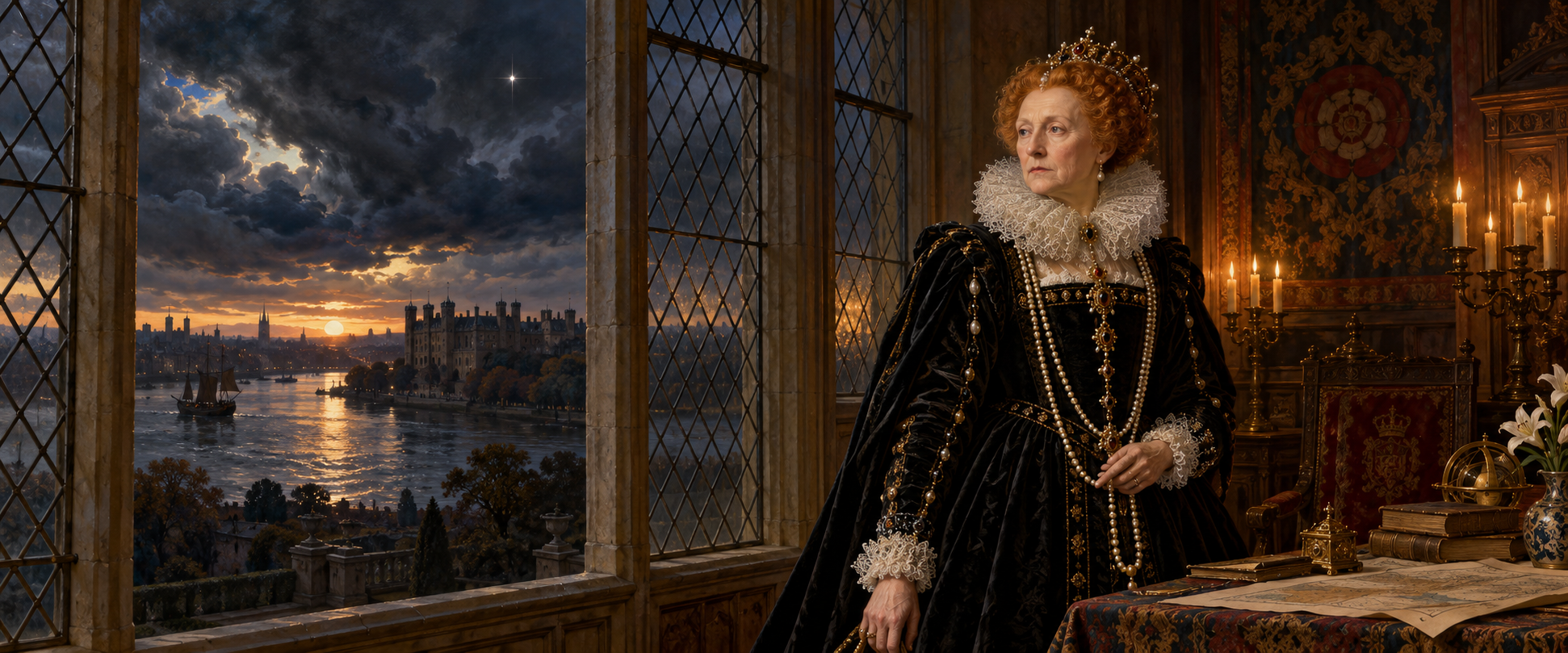
I meet her at the very end, at Richmond Palace in March of 1603, in the final days of her long reign. She is sixty-nine, and she is dying, though she has named no illness and summoned no physician; in recent weeks she has refused food and slept on cushions on the floor rather than take to her bed, and the death of a beloved companion has sunk her into a melancholy she seems unwilling to leave. Her famous red hair is subdued beneath a plain veil, her ornate gowns set aside for a sombre velvet robe. She sits composed in a high-backed chair by the hearth, hands clasped, her gaze steady but touched with weariness. Outside, England rests — Protestant, prosperous, and beginning to reach across the oceans — the country she made. Her body is failing. Her mind is as sharp as it ever was.
She does not rise as I enter — she is far past that — but her eyes, dignified and piercing despite their sadness, invite me to begin. I kneel, as any subject must before the Queen of England, and remain there until a small motion of her hand bids me rise. Then I address her as her courtiers did.
The Conversation
ED: Your Majesty, I am honored beyond words, and mindful of the hour. You were not expected to wear the crown. How did you prepare for a power you never thought would be yours?
ELIZABETH: (Her voice is quiet but exact.) By watching. By listening. By enduring.
ED: Tell me more about that.
ELIZABETH: Very well. Though ’tis no pleasant tale.
Favor is fleeting, young man, and power is deadly. Most of all to a girl born under a shadow, as I was.
I was two years old when my mother went to the scaffold. Too young to remember her face. Old enough to inherit her disgrace. They declared me a bastard and stripped me of my title, and I grew up never knowing whether I was a princess or nothing at all.
ED: And later your own sister sent you to the Tower.
ELIZABETH: She did, God forgive her. The same fortress where my mother spent her last days. (A pause.) I did not know, from one dawn to the next, whether I would leave by the gate or by the block.
So I measured every gesture. I weighed every word, because a careless one could kill me. It was a hard schooling. And it made me.
When the crown came at last, its dangers did not surprise me. I had already survived my own family. After that, a kingdom full of enemies held few terrors I had not already met.
ED: Who did you learn from, Majesty? Was there anyone you looked up to?
ELIZABETH: (She considers.) More than you would think, for a girl so often out of favor.
My father first. Whatever else he was, he could fill a room simply by walking into it. Men felt his presence before they heard his voice. I marked it well, and I took it for my own. What I did not take was his temper, or his way with wives. I saw where both of those led.
Then Queen Katherine Parr, my father’s last wife. She took me into her household and saw to my schooling. She was the first woman I knew who was learned and devout and still held her own among men. She taught me that a learned woman need make no apology for it.
And Master Ascham, my tutor. Greek in the morning, Latin in the afternoon, day after day. He taught me that a mind well furnished is the one possession no man can take from you. I have used it upon every ambassador who thought to talk down to me, and I have answered most of them in their own tongue.
ED: And your mother?
ELIZABETH: (A long pause.) I have always said little about my mother. I will say little now. But I have not forgotten her.
ED: You ruled a world that doubted you before you spoke, because you were a woman. How did you command it?
ELIZABETH: (There is steel in it.) By being more than they expected. But never less than myself.
They said a woman could not command an army, or a council, or a kingdom. That she was fit only to be married off and ruled through. I did not answer them with a strength I did not have. I answered with intellect, presence, and resolve, which I had in full measure.
And then I did the thing they least expected. I would not marry.
ED: Every prince in Europe sought your hand.
ELIZABETH: Every one. Philip of Spain, who had been my sister’s husband. The Archduke. The Duke of Anjou. I entertained them all, for years, as policy required. And I gave myself to not one of them.
(She leans forward slightly.) Mark you the purpose of it? A married queen must share her throne with a husband who will seek to rule through her. Or else her court divides into his faction and hers. So I made my unmarried state both a weapon and a fortress.
The crown sat on my head, and on no man’s beside it. They thought my womanhood was my weakness. I turned it into an independence no one could share.
ED: What does leadership mean to you, Majesty? Not the crown. The task itself.
ELIZABETH: (She says it as a settled truth.) Leadership is not the crown. It is the weight that comes with wearing it.
It is knowing when to speak. And, far harder, when to hold your tongue. It is standing your ground while others panic around you, and yielding, swallowing your pride, when standing would only break you.
The people do not need a sovereign who rules by vanity or by rage. God knows my father showed me enough of the second. They need one who stands steady when the sky is falling. One who does not flinch, for a flinch runs like fire through a frightened realm.
A ruler must be a fixed star in a turning sky. The point others take their bearing from, precisely because it does not move. (A faint smile.) For forty-four years, in every storm, I did not move.
ED: You chose extraordinary counselors. Cecil. Walsingham. How did you pick them?
ELIZABETH: (A flicker of warmth.) I chose men who were loyal but not blind. There is all the difference in the world between the two.
William Cecil, my Spirit, served me for forty years with a calm and a thoroughness I never found in another man. He was my anchor from my first day until his death. Francis Walsingham, my Moor, built a web of agents across Europe. I think he never slept. He found the plots against my life before the daggers were drawn.
ED: Did they always agree with you?
ELIZABETH: No, God be thanked. And I would have it so. Cecil and I fought bitterly over my cousin of Scotland.
Hear my rule, for I hold it as firmly as any I have. A ruler must not surround herself with mirrors, which only show her own face flattered back. She hath need of windows. Men who show her the truth outside herself, the threat and the chance she cannot see alone.
I welcomed their disagreement in private. I demanded perfect unity in public. The private argument kept me from error. The public unity kept my enemies from finding the seams.
(She studies me for a moment.) But I have talked long about my counsellors. You have the look of a man who has spent his life around people who rule things. So tell me, sir. How do you keep them honest?
ED: Mostly by making sure they aren’t alone, Majesty. For many years now I’ve sat with small groups of chief executives, a dozen or so at a time, once a month. They all run different companies, so nobody in that room needs anything from anybody else. That turns out to matter a great deal. A leader’s own people will tell him what he wants to hear. Even the good ones do it. The people at that table won’t. So when someone brings in a hard problem, the others ask the questions his staff never would. I’ve watched that save a lot of companies. I’ve also watched a few leaders stop coming when the questions got too close. Those were usually the ones who needed it most.
ELIZABETH: (A slow nod of approval.) Then you keep windows too. Guard them well. And when one of your rulers ceases to come to that table, that is the day to fear for him.
ED: The Armada. All of Europe watched to see if England would fall. What do you remember?
ELIZABETH: The fear in my councillors’ faces. And a strange calm that came over me.
(She straightens, and for a moment the queen of Tilbury is in the room.) Philip sent a hundred and thirty ships to crush Protestant England and make me a prisoner or a corpse. His Enterprise of England, he called it. My court trembled. Some counselled flight.
Instead I rode to Tilbury, to the army gathered against the invasion. In armor, on a grey horse. And I told my soldiers the truth as I felt it. That I had come among them not to keep myself safe, but to live or die with them.
I told them I knew I had the body of a weak and feeble woman. But that I had the heart and stomach of a king. And of a king of England too.
ED: Did they believe you?
ELIZABETH: (Quietly.) They did. Because it was true, and men can always tell.
I will not claim the victory was mine alone. The winds and the storms and the courage of Drake’s seamen scattered the Spaniard around Scotland and Ireland, and half his fleet never saw Spain again. The weather and the sailors won it.
But to stand there in armor, when they looked for a frightened woman to flee? That was mine to give. And I gave it.
ED: When you came to the throne, England was tearing itself apart over religion. Your sister had burned Protestants. How did you navigate that?
ELIZABETH: (This is plainly a point of pride.) By refusing the extremes that were burning the rest of Europe to the ground.
My father broke with Rome. My brother pushed hard for reform. My sister burned nearly three hundred Protestants at Smithfield and elsewhere. I watched a kingdom tear its own flesh over how God is best worshipped.
So I made my Settlement a middle way. Protestant in its doctrine, with ceremony enough to comfort those who still loved the old forms. And I said, and meant, that I had no desire to make windows into men’s souls. Let them believe as their conscience directs, so long as they keep the peace and obey the law.
ED: That can’t have pleased everyone.
ELIZABETH: (A dry laugh.) It pleased no one. The Pope excommunicated me. The Puritans thought me too soft. The Catholics plotted my murder. I satisfied no zealot on either side, which is how I know I had it right.
And England did not burn as it had under my sister. I count that quiet thing among the greatest victories of my reign. The fires that did not happen. The neighbors who did not kill one another. No poet will ever sing of a massacre averted.
The extremists always promise that their purity is worth the blood. It never is. The hardest task in a divided house is to hold the sane and weary middle while both edges cry out against you.
ED: You’ve told me a good deal about where you succeeded. Where do you think you fell short?
ELIZABETH: (Her mouth tightens.) You are bolder than most who come to this chair. That is well. I have had my fill of the other kind.
Ireland. I never governed Ireland. I only held it, and poorly, and at a ruinous cost. For nine years the Earl of Tyrone has made war on me there, and it has drained my treasury as nothing else ever did, not even the Armada. I am told it is nearly finished. Whether I shall live to see it, God knows.
And these last years have not been my best. Prices rose, and my people felt the pinch of it. I sold crown lands to pay for the wars. I let too many monopolies go to my courtiers, and my last Parliament rose up about it, and rightly. I yielded to them, and gladly. But I ought never to have let it come to that.
(Quietly.) An old queen grows weary, young man. She listens a little less. Warn your rulers of it. It cometh on by stealth, and none dare tell her so.
ED: I’d like to ask about the Earl of Essex, if you’ll allow it.
ELIZABETH: (Something passes over her face.) God’s death. You would. Everyone does, in the end.
He was young and brilliant and handsome, and he made an old woman feel admired. I will not dissemble about it. I gave him honors and offices and command. I forgave him more than I have ever forgiven any man. And each time I forgave him, he took it for proof that he could not be denied.
I sent him to Ireland with the greatest army I ever raised. He made a truce with Tyrone I had not allowed. Then he left his post, rode home, and burst into my chamber before I was even dressed. Mud upon his boots, and I with my hair about my face. And two winters ago he tried to raise the streets of London against me. So I signed his warrant too.
ED: Looking back, where was the mistake?
ELIZABETH: Not at the end of it. At the beginning. I let charm do the work that proof should have done. I mistook his applause for loyalty.
Mark this. The men who flattered me most were rarely the ones who served me best. Cecil never once flattered me in forty years. Essex hardly ever stopped. And I knew the difference, and for a time I chose the flattery all the same.
(More softly.) I had loved once before, when I was young. The Earl of Leicester. I keep his last letter still, written a few days before he died. Perhaps I wanted that feeling back. A queen is still a woman. That is where the danger lay, and I should have seen it sooner.
ED: You signed the death warrant of Mary, Queen of Scots. Your own cousin, and an anointed queen. How do you reflect on that now, at the end?
ELIZABETH: (A long silence. The grief is real even now.) With grief. Perhaps most of all, now.
Mary was my kin. An anointed sovereign, as I am. For that reason I delayed through nineteen years of her captivity, ever hoping for some other road. Exile. Silence. Peace.
But she would not be still. Her name was a banner for every rebellion. And when Walsingham finally decoded her letters, they gave her blessing to my assassination.
So at last I signed. And I tell you, I felt I had killed some part of myself. If an anointed queen may be put to death by law, then the sacred thing that protected me was diminished too.
ED: Is there anything more you’d want to say about her?
ELIZABETH: (A pause.) Only this.
She lies at Peterborough now. We were never sisters in life. I pray we may be something gentler than enemies in death.
That is the loneliest cost of this crown. Its duties sometimes require the very thing your soul most abhors. And then you live with it. Alone. Because no one else can carry it for you.
ED: You never married, and you leave no direct heir. Was it worth the solitude?
ELIZABETH: (Without self-pity, as a bargain long since made.) England was my spouse. Her glory was my child.
I did not choose solitude because I lacked a heart to give. I loved, more than the histories will ever rightly say. But I could not divide my heart without dividing my power. And a divided power, in a realm like mine, meant civil war.
’Tis not an easy life. The higher you climb, the fewer souls you can truly trust, until at the summit you can trust almost no one. That is the true tax of the crown. Not the labor. The loneliness.
(Her gaze steadies.) But hear the reckoning of it. History is full of kings who bore sons and watched those sons grow into rivals who tore their fathers’ kingdoms apart. Let it also remember one queen who bore no son, and left instead a long age of stability and peace.
I told my Parliament once that a marble stone would be enough for me, if it declared that this queen lived and died a virgin. Let that be my monument. I gave myself to England. She was enough.
ED: Forgive me for pressing, Madam. But you’ve never named a successor. Even now the whole court is guessing. Why hold it back?
ELIZABETH: (Sharply.) We are not accustomed to be pressed upon that matter, sir. (Then, more softly, and as herself again.) But I will answer you. A named heir is a second court. Every ambitious man in England would have turned his face toward him and away from me. I know, because I was that heir. In my sister’s reign, men came to me to plot against her in my name. More people worship the rising sun than the setting one.
When I was young, they pressed me to name one. I asked them whether they thought I could love my own winding-sheet.
ED: But hasn’t the silence left your people anxious?
ELIZABETH: It hath. I grant you that. For forty years they have wondered what comes after me, and that fear has cost them something.
(A thin smile.) But I am no fool. I suspect my little Cecil has been writing to Scotland for some time now. Let him. The thing will go quietly because I kept it close. Whether I was right, you may judge when I am gone.
ED: A final question, Majesty. How do you hope to be remembered?
ELIZABETH: (She rises slowly, spine straight despite the years, and moves toward the window and the pale light over Richmond.) As a ruler who loved her country more than herself.
Let them say I found England torn by faction and religious hatred, and left her stronger, safer, and more respected in the world. Let them say I knew when to speak and when to hold my tongue. When to strike and when to wait.
The waiting was the harder art. And it was the one that saved us.
ED: And to those who will lead after you?
ELIZABETH: (She turns back to me.) Lead with clarity, not ambition. Ambition is loud. It burns fast, and it consumes the one who carries it. You have met such men, I doubt not. Duty is quiet, and it endures.
Glory fades. I have had more of it than almost anyone, and I feel it leaving me now, like warmth from this fire. But the steadiness you gave your people, the fires you did not let them light, that endures.
Guard your honor. It is the only true possession a ruler can finally claim.
ED: Before I go, Madam, is there anything I haven’t asked that you’d want me to carry away?
ELIZABETH: (She considers the fire for a long moment.) Only what I told my last Parliament, when they came to me angry about the monopolies and went away gentler than they came.
I said that though God had raised me high, I counted this the glory of my crown, that I had reigned with their loves. Not their fear. Their loves.
Remember it. Any prince may make his people obey. Very few can make them willing. And only the willing stand fast when the storms come.
(Softly.) All my possessions, now, for a single moment more of time.
(A small gesture of dismissal, still every inch a queen.) But time has run its course. Now go. And govern your own house well.
Leadership Reflections
Elizabeth opens the section on crisis and endurance because she embodies its central and least glamorous virtue: the capacity to hold steady through decades of threat without breaking and without lashing out. Her owned idea is the “fixed star” — the leader whose great gift is not a single brilliant stroke but sustained, patient steadiness, the refusal to be moved by every gust that panics everyone around her, so that others take their bearing from her precisely because she does not waver. In an age of leaders who are prized for decisive action and bold moves, Elizabeth is the permanent case for the underrated power of not flinching, of patience, of the strategic value of simply enduring.
Three further disciplines define her. The first is her rejection of extremes — the religious “middle way” that satisfied no zealot on either side and precisely for that reason held a realm together that was tearing every other European country apart. Her insight that the leader’s hardest task in a divided house is to hold the sane, weary middle while both edges scream, and her refusal to “make windows into men’s souls,” is one of the most relevant lessons in this book for any polarized institution or society. The second is her transformation of vulnerability into strength — making her unmarried, heirless, female sovereignty into an instrument of unshareable independence rather than the weakness her enemies assumed. The third is her practice with counsel, honed across four decades with Cecil and Walsingham: seek windows, not mirrors — advisers who show you the truth outside yourself rather than your own flattered face — and welcome disagreement in private while demanding unity in public.
She is just as candid about where she fell short, and this is where the chapter’s warnings live. Ireland was a war she held rather than governed, and it drained her treasury. Her late reign grew tired, and she admits that an aging leader “listens a little less.” The Earl of Essex is her clearest failure and the book’s cleanest case of the Applause Trap: she let charm do the work that proof should have done, and she chose flattery even when she knew the difference. Her refusal to name a successor is the Succession Trap seen from the inside. She had a sound reason, since a named heir becomes a rival court, but the silence left her people anxious for forty years. She defends it, and she also concedes its cost.
And she is honest, as this book’s great leaders always are, about the cost. Her grief over Mary, Queen of Scots — the sense that in executing an anointed queen she had “killed some part of herself” — and her clear-eyed account of solitude as “the tax of the crown,” the loneliness that deepens with every step toward the summit until one can trust almost no one, give the chapter its human weight. She made the loneliest kind of decisions, the ones no one could share or carry for her, and lived with them alone. Her steadiness was not the absence of feeling; it was feeling fully governed, the storm held behind a face that would not break because a whole frightened realm was reading that face for permission to despair.
Lessons for the Modern Leader
Elizabeth’s first lesson is the strategic power of steadiness itself. In a crisis, a leader’s most important product is often not a decision but a demeanor: the visible calm that tells a frightened organization it is not, in fact, the end of the world. People read their leader’s face for permission to panic or to hold, and the leader who can be a “fixed star” — composed, unflinching, patient — steadies everyone in range, while the leader who transmits their own fear multiplies it. This is not passivity; it is, as Elizabeth shows at Tilbury, an active and demanding discipline of governing your own visible fear so that others can borrow your calm.
Her second lesson is the underrated value of the moderate path in a polarized environment. Elizabeth held England together by refusing the extremes that were burning the rest of Europe, and by accepting that the right position often satisfies neither zealous faction — that being attacked from both sides can be a sign you have found the sane center rather than a sign of failure. For any leader navigating a divided team, company, or society, her middle way and her refusal to “make windows into men’s souls” — to police belief rather than behavior — is a model of how to lower the temperature and keep a fractured house standing. The third lesson is her reframing of apparent weakness: the discipline of finding, in the very trait others count against you, a source of strength they did not anticipate. And beneath all of it runs her counsel of patience — that “the waiting was the harder art,” that knowing when to strike and when to wait, when to stand and when to yield, is the core skill of enduring leadership, and that the loud virtue of decisive action is often less valuable than the quiet virtue of not acting rashly under pressure.
Her failures carry two more lessons. The first is to watch the people who make you feel admired. Elizabeth kept Cecil, who never flattered her, and still gave her heart and her army to Essex, who never stopped. Every leader has an Essex somewhere, and the test is whether proof or charm is doing the promoting. The second is that silence about succession is not neutral. Her reasons for keeping it quiet were real, and she still left a kingdom guessing for a generation. A leader who will not name what comes next should at least know who is quietly preparing for it. Her closing counsel ties it together: any ruler can make people obey, but the ones who last are the ones who reign “with their loves.”
Questions for Reflection
Consider these as Elizabeth might — with patience, and an eye on the long horizon.
— In your last real crisis, did your visible demeanor steady the people around you — or did it transmit your own fear and multiply it?
— Where are you being pulled toward an extreme that satisfies a faction, when the harder and wiser path is the sane middle both sides will attack?
— What trait that others count as your weakness could become, handled differently, a genuine source of strength and independence?
— Do you surround yourself with mirrors that flatter you or windows that show you the truth — and do you welcome real disagreement in private?
— Is there someone in your organization whose charm is doing the work that proof should be doing?
— If you stepped away tomorrow, would your people know what comes next — or have you, like Elizabeth, left them guessing?
Afterward: What Became of Her
Elizabeth died at Richmond Palace on the 24th of March, 1603, at sixty-nine, after a reign of forty-four years — slipping away, as her chaplain’s account was recorded, “mildly like a lamb, easily like a ripe apple from the tree.” With her ended the Tudor dynasty. The crown passed, by the succession she had pointedly refused to name aloud until the end, to James VI of Scotland — the son, in one of history’s sharpest ironies, of the cousin she had sent to the block, Mary, Queen of Scots — who rode south to unite the crowns of England and Scotland and become James I of England.
The age she presided over became, almost at once, a legend. The “Elizabethan age” is remembered as one of the great flowerings of English civilization — the theatre of Shakespeare and Marlowe, the poetry of Spenser who cast her as Gloriana, the seamanship of Drake and Raleigh, the defeat of the Armada that announced England as a power, the first reaching toward the empire that would follow. Her religious settlement held, sparing England the wars of religion that ravaged France and Germany, and shaped the character of the English church for centuries. She had taken a poor, divided, and endangered realm and, by patience and steadiness more than by any single brilliant stroke, left it prosperous, confident, and secure. “Good Queen Bess” and “Gloriana” entered the national memory as the sovereign under whom England became itself. She had promised her people, at the start, only that she would love them and stand steady; across forty-four years of plots and armadas and the constant pressure to yield, she did exactly that, and it proved to be enough — which is the whole argument of this section, made by a queen who never once, in all her storms, moved from her place.
To Learn More
Elizabeth the Great, Elizabeth Jenkins, or the more recent Elizabeth I, by Anne Somerset — both excellent, readable full-life biographies of the Queen.
The Life of Elizabeth I, Alison Weir — a vivid, accessible narrative especially strong on the personal drama of the reign.
Elizabeth I: Collected Works, edited by Leah Marcus et al. — her own letters, speeches, and poems; the place to hear the Queen in her own remarkable voice.
The Armada, Garrett Mattingly — the classic narrative history of the great crisis of her reign, gripping and authoritative.
Sources
Primary sources:
- Elizabeth’s speeches (notably the Tilbury speech, 1588) and letters, collected in Marcus, Mueller, and Rose, eds.,
- Elizabeth I: Collected Works (Chicago, 2000); state papers of the reign;
- Contemporary accounts of the Armada and the trials of Mary, Queen of Scots and the Earl of Essex;
- Roger Ascham, The Scholemaster (1570).
Biographical background:
- Anne Somerset, Elizabeth I (1991);
- Alison Weir, The Life of Elizabeth I (1998);
- Garrett Mattingly, The Armada (1959);
- John Guy, Elizabeth: The Forgotten Years (2016);
- Paul E. J. Hammer, The Polarisation of Elizabethan Politics: The Political Career of Robert Devereux, 2nd Earl of Essex (1999);
- the Oxford Dictionary of National Biography, entry on “Elizabeth I.”