
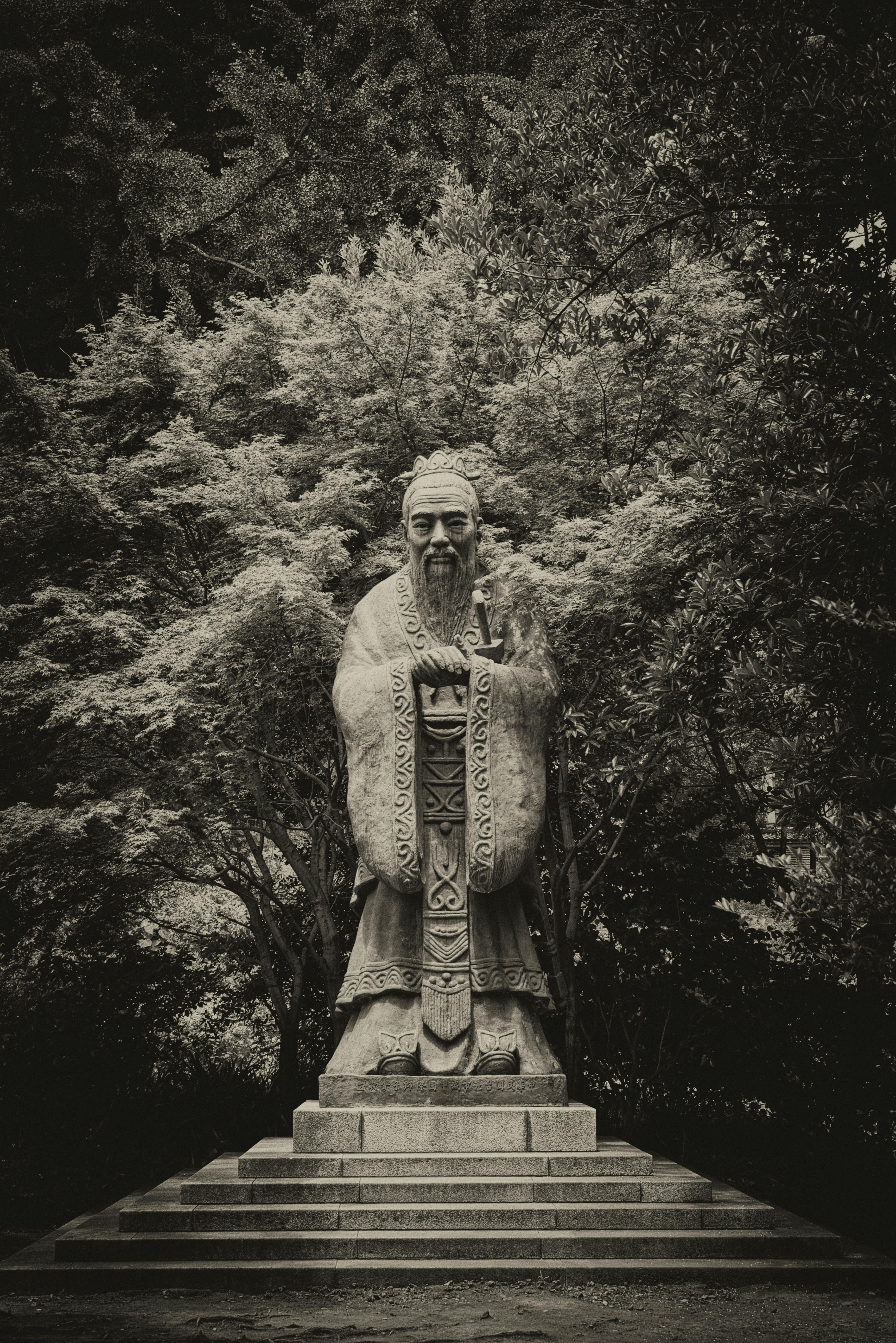
Here is the next installment of my fictional interviews with important historical figures. This time it is Confucius.
“When we see men of worth, we should think of equaling them; when we see men of a contrary character, we should turn inward and examine ourselves.”
Introduction: Who Was Confucius?
Confucius (551–479 BCE), known in Chinese as Kongzi or Master Kong, was a philosopher, teacher, and political thinker whose ideas have profoundly shaped Chinese civilization and influenced cultures across East Asia for over two millennia. Born during the tumultuous Spring and Autumn period in the state of Lu (modern-day Shandong province), Confucius experienced firsthand the social disorder and moral decline of his era. This inspired a lifelong quest for wisdom, moral rectitude, and social harmony rooted in the restoration of ethical traditions, rigorous self-cultivation, and the pursuit of virtuous leadership.
As a revered teacher, Confucius attracted a devoted circle of disciples who compiled his teachings into the Analects, a foundational text of Confucianism. His philosophy champions the cultivation of character, the proper fulfillment of social roles, and the pursuit of benevolence (ren), righteousness (yi), and ritual propriety (li). Confucius’s emphasis on lifelong learning, meritocracy, and leading by example continued to inform government, education, and social norms in China and beyond. Although he held only brief political office and often wandered in search of receptive rulers, his enduring legacy is his vision of order, harmony, and moral leadership.
The Setting
Qufu, in the former Lu state, 500 BCE.
The courtyard is tranquil, enclosed by a quiet grove of cypress and stone tablets etched with teachings. Confucius, known as Master Kong, sits beneath a wooden pavilion. His robe is neat, his posture is still, and his expression is composed.
There is no ceremony, no pretense—only a man committed to truth and virtue. He gestures calmly for you to sit. And so begins a conversation not with a ruler or warrior—but with a teacher, philosopher, and steward of wisdom.
Self-Cultivation, Learning, and Leadership
On Where Wisdom Begins
Me: Master Kong, you’ve taught generations of students. Where does true wisdom begin?
Confucius:
With humility and discipline.
The path to wisdom begins when a person examines himself, not others. Before one leads, one must learn. Before one speaks, one must listen. Before one governs, one must first govern the self.
Wisdom is not a matter of cleverness—but of consistency and virtue. The person who believes they have arrived stops growing. The person who knows they have further to go continues ascending. True knowing begins with acknowledging what one does not yet know.
I have spent my life among books and students, yet each day I discover anew how much remains beyond my grasp. This awareness does not discourage me—it guides me. Let it guide you as well.
On Learning and Leadership
Me: What role does learning play in becoming a good leader?
Confucius:
A central role. No one is born knowing.
The noble person (junzi) studies not to impress, but to improve. Leadership must be earned through lifelong learning and moral clarity. Books sharpen the mind—but practice tempers the soul.
The gentleman is ashamed if his words exceed his deeds. Learning without action is hollow. Action without reflection is reckless. The two must walk together, hand in hand, throughout one’s entire life.
Study the ancients. Learn from history. Observe the present. And always ask: What can this teach me about virtue, about service, about leading well?
On Self-Cultivation
Me: How does one truly cultivate the self?
Confucius:
By mastering the small before attempting the great.
Begin with your thoughts, speech, and conduct. Ask yourself each evening: Have I been faithful? Have I spoken truthfully? Have I honored my responsibilities? Only through reflection do we shape the character required to lead with virtue.
Self-cultivation is not a singular act but a daily discipline. It is the careful tending of one’s inner garden—pulling weeds of selfishness, planting seeds of compassion, watering the roots of integrity. No one sees this work but you. Yet it is this invisible labor that determines the visible fruit of your leadership.
Do not wait for great crises to test your character. Build it now, in quiet moments, through small choices. The leader who cannot govern his own temper will not govern a province wisely. The leader who cannot keep her own word will not inspire loyalty in others.
Begin with the self. All else follows.
On the Core Virtues: Ren, Li, and Yi
Me: Master Kong, what do the virtues of ren, li, and yi mean for one striving to lead?
Confucius:
They are the pillars upon which all righteous leadership rests.
Ren is compassion—the highest form of human kindness. It is feeling with others, not merely for them. It is the capacity to see yourself in another’s suffering and to act accordingly. Without ren, leadership becomes cold calculation.
Li is ritual and respect—the structures that guide our conduct and relationships. It is knowing how to honor others through proper behavior, speech, and ceremony. Li is not rigidity; it is the form that holds meaning, the vessel that carries virtue into the world.
Yi is righteousness—doing what is right even when it challenges your interests or comfort. It is the inner compass that refuses to bend toward convenience. A leader with yi will stand alone if necessary, not out of stubbornness, but out of moral clarity.
Together, these three form the foundation. A leader with compassion but no structure becomes chaotic. A leader with ritual but no heart becomes empty. A leader with righteousness but no empathy becomes harsh. Balance them, and you will lead well.
Power, Governance, and Social Harmony
On Power and Responsibility
Me: How should a ruler understand power?
Confucius:
As a burden, not a prize.
Power exists to serve others—not to elevate oneself. The ruler is like the wind; the people, like the grass. If the wind blows gently with justice and virtue, the people will follow. But if it howls with selfishness, all harmony is lost.
Lead not by fear, but by moral example.
Many seek power for what it can give them: status, wealth, control. But true power is measured by what it allows you to give others: security, justice, dignity. The moment you begin to enjoy power for its own sake, you have lost the way.
On Governing Justly
Me: What is the essence of just government?
Confucius:
Government begins with the rectification of names.
Let each role—father, minister, subject—reflect truth through conduct. When language and behavior are aligned, order prevails. When they are not, confusion spreads.
If a ruler is called a ruler but acts as a tyrant, the title is false, and the people suffer. If a father is called a father but abandons his children, the name is empty, and the family fractures. Words must match reality. Titles must reflect responsibility.
Justice thrives where clarity lives. Begin by calling things what they truly are.
On Ruling by Example
Me: How does a ruler guide without control?
Confucius:
By living what he teaches.
If a ruler is upright, his people will follow—even in silence. If he is corrupt, no number of laws can restore virtue. Words alone do not teach. Actions do.
To lead is not to command—it is to inspire through daily integrity.
I have seen rulers issue a thousand decrees and accomplish nothing. I have also seen leaders speak little yet transform entire communities. The difference? One ruled by edict, the other by example. People watch their leaders more closely than they listen to them. Show them virtue, and they will walk toward it. Show them hypocrisy, and they will turn away—or worse, imitate it.
On the Mandate of Heaven
Me: Some speak of Heaven’s mandate. How does it relate to leadership?
Confucius:
The right to lead is not inherited—it is earned by virtue.
Heaven blesses the just and upright. If a ruler governs with compassion and righteousness, Heaven’s favor endures. But if a ruler becomes unjust, cruel, or neglectful, the people will suffer and Heaven’s favor will fade. Authority is not a permanent possession—it is a trust that must be honored daily.
Lead with compassion and righteousness, for authority must serve not self but all. The ruler who forgets this will find that even the most ancient throne can be swept away.
Family, Social Ritual, and Public Harmony
On the Role of the Family
Me: Why do you place so much emphasis on the family?
Confucius:
Because it is the foundation of all society.
If a child honors their parents, they will honor their elders. If a father leads his family with fairness, he will govern others with wisdom. The habits of the home become the virtues of the nation.
Put the family in order, and the kingdom will follow.
Consider this: a nation is made of provinces, provinces of towns, towns of families. If the smallest unit is broken, how can the largest stand? The family is where we first learn respect, responsibility, love, and sacrifice. It is the training ground for citizenship and leadership.
I have watched rulers try to reform their kingdoms while their own homes were in chaos. It cannot be done. The disorder within will always spill outward. Begin at home. Tend to your relationships with care. Only then will you be prepared to tend to the relationships of a community or a nation.
On the Five Relationships
Me: You speak often of harmony. What are the five cardinal relationships that create it?
Confucius:
Society is structured by bonds: ruler to subject, father to son, husband to wife, elder to younger sibling, and friend to friend. Each asks for respect, responsibility, and reciprocity.
These relationships are not arbitrary—they reflect the natural order of human life. In each, there is a role of care and a role of response. The ruler cares for the people; the people, in turn, will support the ruler. The father guides the son; the son honors the father. The elder teaches; the younger listens.
But hear me clearly: these are not relationships of domination. They are relationships of mutual obligation. The ruler who ignores his people’s welfare forfeits moral authority. The father who abuses his children breaks the sacred bond. Each role carries a duty.
By honoring these roles, we maintain balance, order, and peace in the community. When they are neglected, society begins to unravel.
On Ritual and Harmony
Me: What role do rituals play in leadership and life?
Confucius:
Ritual (li) is not mere ceremony—it is structure, respect, and continuity.
Ritual teaches us restraint, balance, and the dignity of every interaction. When society honors ritual, it honors relationship. It slows us down, reminds us of our place, and strengthens the moral fabric.
Without ritual, even wisdom becomes chaotic. Imagine a gathering with no greeting, no courtesy, no acknowledgment of rank or age. What results? Confusion, offense, disorder. Ritual provides the framework within which respect can be expressed and relationships can flourish.
Some dismiss ritual as outdated or superficial. They are mistaken. Ritual is the outer expression of inner virtue. It is how we show honor, not just feel it. It is how we mark transitions, celebrate achievements, and mourn losses together. Strip away ritual, and you strip away much of what binds us together.
On Dealing With Dissent
Me: How should a leader approach disagreement?
Confucius:
With grace and attentiveness.
Harmony does not mean silence or sameness. It means a respectful balance. A wise leader listens to those who disagree—not to be flattered, but to be refined. Praise is pleasant—but criticism, when sincere, is more valuable.
A chorus is not made of one note.
I have always valued the student who questions, the advisor who challenges, the friend who speaks truth even when it stings. These are the people who sharpen you. If you surround yourself only with agreement, you will grow dull and blind to your own faults.
But dissent must be offered respectfully, and received humbly. Disagreement for its own sake—or delivered with contempt—tears the fabric. Disagreement offered in the service of truth and the common good strengthens it.
Disappointment, Discipline, and Enduring Principles
On Personal Disappointments
Me: What disappointed you most in your lifetime?
Confucius:
That those in power often ignored the call to virtue.
I advised rulers. I offered reforms. I walked from state to state, carrying my teachings like a torch in the darkness. But few listened. They sought quick victories over lasting order, immediate gain over enduring peace. What pained me was not my rejection, but the suffering of the people under unjust leadership.
Still, I continued. To teach is to plant seeds, even in barren ground. I may not see the harvest, but I trust that the seeds will find soil somewhere, sometime. Disappointment is the companion of those who pursue what is right rather than what is easy.
On Dealing with Adversity
Me: How does one endure hardship in the pursuit of virtue?
Confucius:
Hardship is the teacher of patience and resilience.
The path of goodness will face resistance. Society often rewards the cunning, the ruthless, the expedient. The virtuous may find themselves overlooked, criticized, even exiled. But this is not a reason to abandon the path—it is a reason to walk it more carefully.
Let disappointment refine your spirit, not embitter it. Let hardship clarify your purpose, not cloud it. Continue in virtue, knowing that the seeds you plant may blossom beyond your sight, in hands you will never meet, in times you will never see.
This is not a path for those who seek immediate reward. It is a path for those who seek lasting meaning.
On the Values That Guided His Life
Me: What values guided you most consistently?
Confucius:
Three, above all: Ren, Li, and Yi.
Ren is compassion—humaneness in thought and deed.
Li is ritual—proper conduct in all relationships.
Yi is righteousness—doing what is right, not merely what is profitable.
These are the pillars of the moral life. Without them, no title, wealth, or talent has meaning. A leader without ren is a tyrant. A society without li is chaos. A person without yi is adrift.
I have tried, however imperfectly, to live by these principles. They have guided my teaching, counsel, relationships, and choices. They are not easy to uphold. But they are worth the effort.
The Modern World and Timeless Wisdom
On Meritocracy and Education
Me: Should power and office belong only to the well-born?
Confucius:
No. Merit comes from virtue and ability, not birth.
A wise ruler values talent and character above lineage. I have taught farmers and nobles alike. What mattered was not their family name but their commitment to learning and their capacity for virtue.
Teach all who are willing, for learning is the path to improvement—and government thrives when officials are chosen for their knowledge, integrity, and service, not for the accident of their ancestry.
Hereditary privilege can protect the incompetent and exclude the capable. A society that elevates only the well-born will stagnate. A society that seeks out and nurtures merit—wherever it is found—will flourish.
On the West and Modern Society
Me: If you could see the modern world, what would you admire—and what would concern you?
Confucius:
There is much to honor: innovation, inquiry, and the belief in human dignity.
The West has built remarkable institutions, pursued knowledge with vigor, and championed the rights of the individual. These are noble achievements. I admire the spirit of questioning, the refusal to accept tradition uncritically, and the commitment to progress.
But I also see disorder. Families strained. Communities fractured. Institutions are losing trust. Freedom celebrated—but without the corresponding discipline.
The West cherishes individuality, which is noble. But individuality without self-regulation leads to chaos. Freedom is not the absence of boundaries—but the presence of wise ones. Rights must be balanced with responsibilities. Liberty must be grounded in virtue.
Let progress walk beside tradition. Let inquiry be tempered by virtue. The ancient and the modern need not be enemies—they can be partners in the pursuit of a flourishing life.
On Hope and Endurance
Me: Did you ever lose hope?
Confucius:
No.
The path of virtue is long, and the world may ignore it for a time. But it always returns. My role was not to transform the world in my lifetime—but to set the compass for those who would come after.
Hope is not optimism about immediate outcomes. Hope is trust in the enduring power of truth and goodness. I have seen empires rise and fall. I have watched leaders come and go. But the principles of virtue remain. They outlast kingdoms. They outlast kings.
The way is not in changing others, but in refining oneself. Change yourself, and you change your family. Change your family, and you change your community. This is how the world is transformed—quietly, steadily, one person at a time.
On How He Hopes to Be Remembered
Me: What legacy would you hope to leave behind?
Confucius:
Let them remember me not as a master, but as a student.
I wrote no scripture. I claimed no divinity. I walked with my students, listened to the ancients, and left behind what I could. If I am remembered for loving truth, honoring tradition, and teaching with sincerity, then I am satisfied.
I do not need monuments. I do not need worship. I need only for the path to continue—for others to walk it, to refine it, to pass it on. That is legacy enough.
On Advice to Future Leaders
Me: What would you say to those who lead today?
Confucius:
Start with your character. Then your home. Then your people.
Lead with discipline. Rule with ritual. Act with compassion. Never ask of others what you have not demanded of yourself.
When you rise, do so gently. When you fall, examine your heart. And remember: to lead without virtue is to build without foundation. The structure may stand for a time, but it will not endure.
Leadership is not a title—it is a calling. It is a daily commitment to serve, to listen, to learn, and to live in alignment with what is right. If you do this, your influence will outlast your tenure. If you do not, your name will be forgotten—or worse, remembered with regret.
The Farewell
The evening sun dips lower behind the stone courtyard walls. He stands with calm grace, offering a light bow—not as a man above you, but as one who has traveled the same path of reflection. He turns slowly, his footsteps firm and quiet, carrying centuries of discipline into silence.
Confucius:
Correct yourself before you correct others. Let the moral path be your lantern.
And walk it—quietly, steadily, completely.