Continuing in my series of fictional interviews with historical figures and leaders I admire, I’ve created this imagined twilight dialogue with Napoleon Bonaparte. I hope you find the conversation both engaging and thought-provoking—and perhaps it allows you to see him in a slightly different light.
Too often, portrayals of Napoleon in film and popular literature feel oversimplified, heavily biased, or stripped of meaningful context. I believe it’s important to revisit such towering figures with a mindset rooted in nuance, not caricature.
Napoleon didn’t just seize power—he filled a vacuum left by the chaos of the French Revolution. He brought order to disorder, and in doing so, reshaped the legal, political, and geographical structure of Europe in a matter of years. His leadership acumen, military genius, and reformist legacy are undeniable. Yes, his ambition often outpaced wisdom, and he suffered from misjudgments that ultimately led to his downfall. But history books will always record his name—not merely for the empire he built, but for the indelible mark he left on the world.
The Setting
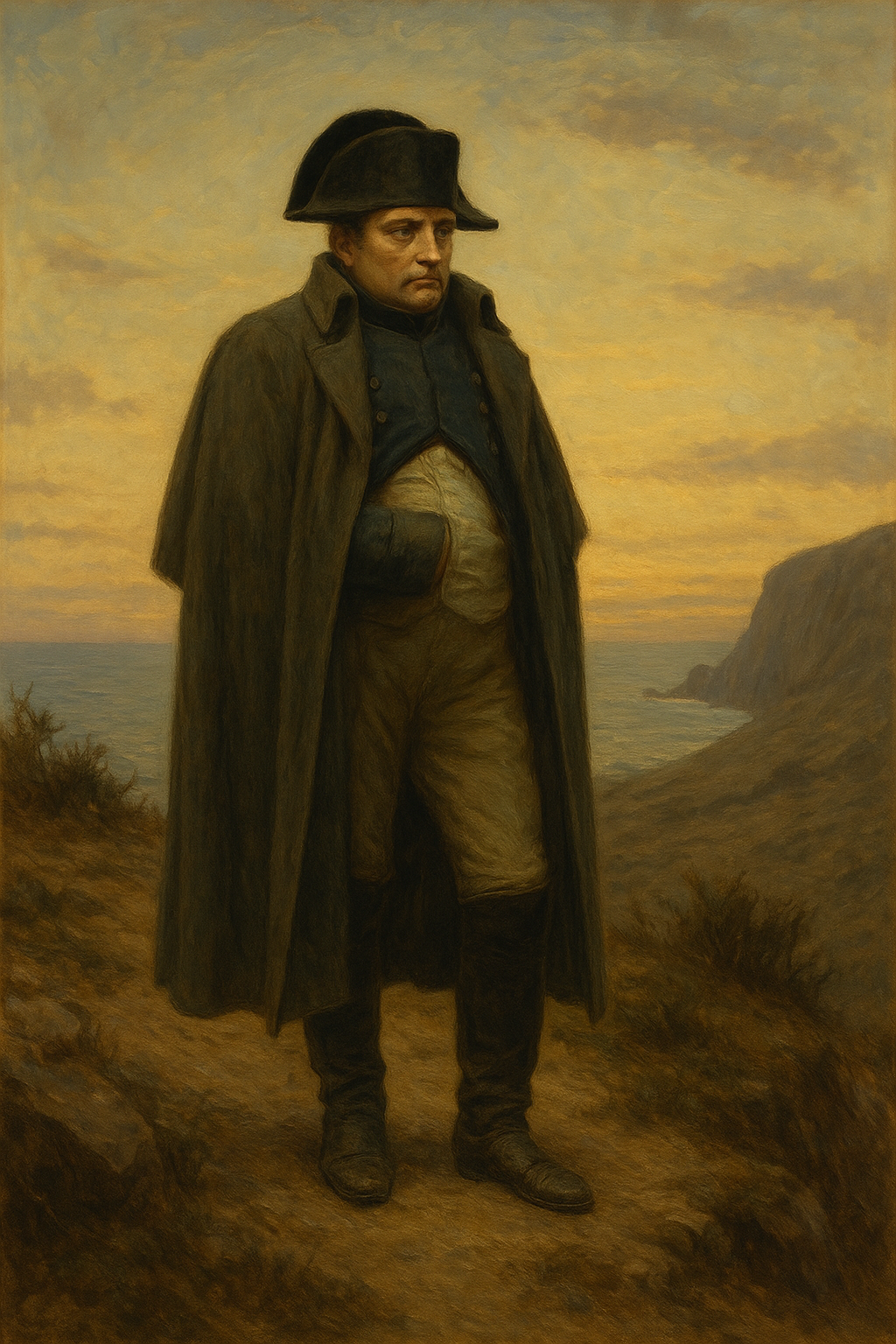
St. Helena. A desolate, wind-scoured island in the South Atlantic. The sea is vast, the horizon unreachable. In the waning light of day, you climb the path to Longwood House, where the former emperor of France now resides—not as sovereign, but as prisoner of history.
In a modest drawing room, Napoleon Bonaparte sits by a fireplace, wrapped in a military cloak. There are no aides. No maps. Only the smell of damp parchment, scorched tea, and salt air. He looks up—his face more lined than legend often allows—and motions to the empty chair beside him.
“Glory is fleeting, but obscurity is forever.” — Napoleon Bonaparte
I. The Origins of Power
On Rising from Nothing
Me: You were born on a small island—Corsica. How did you rise to lead a continent?
Napoleon: Because I saw the cracks in the old world—and I dared to walk through them.
France was imploding. Revolution had torn away the aristocracy, but left chaos in its place. I did not wait to be asked. I stepped into the breach. I won battles others feared to fight. I brought order where there was only ideology.
I rose because I believed merit should outweigh bloodlines. And I rose fast—because I moved faster than doubt.
On the Meaning of Power
Me: What did power mean to you—at the height of your reign?
Napoleon: Power is the capacity to shape reality.
I used it to end civil wars, to standardize laws, to unify fractured states. But power is also a seducer. It flatters the mind and blinds the heart. In my rise, I thought power would answer every question. In my fall, I learned it only asks harder ones.
On Becoming Emperor
Me: You crowned yourself Emperor. Why not let the Pope do it?
Napoleon: (Smiling faintly.) Because I owed my ascent to no one but the people—and myself.
I took the crown from the Pope’s hands and placed it on my own head in Notre-Dame. It was not arrogance. It was clarity. I wanted France to see that their destiny would not be decided by priests or kings—but by one who rose through merit.
I was born a citizen. I died an emperor.
On His Son, Napoleon II
Me: And your son—the King of Rome. What became of that dream?
Napoleon: (Quietly.) He was born into thunder, but raised in a whisper.
Taken to Austria. A pawn of courts, not a student of conquest. I do not blame him. But he carried my name without my will. My greatest hope… became a symbol I could not guide. My heart never reached him, and my hand never shaped him. That is a sorrow history seldom sees, but I feel it every day.
II. War and Rule
On Choosing His Generals
Me: You led brilliant men—Davout, Ney, Lannes. How did you choose your generals?
Napoleon: I did not choose by rank. I chose by instinct.
Davout never lost a battle—because he planned obsessively and fought fiercely. Ney had courage but lacked precision. Murat was a cavalry god, but a poor strategist. I studied my commanders the way I studied terrain: carefully, and without sentiment.
And I demanded results. Loyalty mattered—but brilliance mattered more.
On War as Chess
Me: Did you see war as art—or science?
Napoleon: Neither. I saw it as chess—with living pieces.
I calculated terrain like geometry. I baited enemies like a strategist. I understood morale—how to inspire, and when to press. War, to me, was rhythm and timing. But the board always changed—and the pieces bled.
On the Spanish Campaign
Me: Spain resisted you bitterly. Why did that war turn so grim?
Napoleon: (Frowning.) Because I misread a people’s soul.
I thought I was bringing order—but to them, I brought insult. I replaced their king, dismissed their culture, and underestimated their pride. Every street became a battlefield. Every priest a general. It was not Spain I lost—it was the illusion of universal acceptance. Empire built by sword alone is empire on sand.
On Conquest and Control
Me: You conquered more of Europe than anyone since Charlemagne. Did you ever want to stop?
Napoleon: (Pauses.) Yes. After Austerlitz. After Jena. After Wagram.
But peace is fragile when surrounded by monarchs who resent your very existence. I did not pursue conquest for conquest’s sake. I pursued a new European order—one based on talent, not lineage.
But I stayed too long in battle. I mistook momentum for destiny.
On the Invasion of Russia
Me: What about Russia? Your most famous failure.
Napoleon: A campaign begun with vision—and ended with ice.
I reached Moscow. But the Russians burned their own capital. I waited too long for peace. Then the snows came. Disease. Starvation. It was not the Czar who defeated me—but distance, cold, and my own hesitation.
I lost more to winter than to war.
III. The Reformer
On the Napoleonic Code
Me: Beyond war, what do you consider your greatest accomplishment?
Napoleon: The Code.
It swept away feudal privilege. It protected property rights. It brought uniformity and secular law to a country divided by custom and corruption.
I built schools, a central bank, a system of civil administration. These were not glorious—but they were lasting.
In time, battles fade. But structure endures. That is legacy.
On His Style of Rule
Me: Some say you ruled as a dictator. How do you respond?
Napoleon: (Firmly.) I ruled decisively.
France had known anarchy. I brought clarity. Yes, I held power tightly—but I used it to build. I listened to counsel. I debated ministers. But I did not tolerate delay.
The people wanted bread, order, pride. I gave them all three
IV. Failure, Regret, and Loss
On Waterloo
Me: Let’s speak of Waterloo. What happened there?
Napoleon: (Sighs deeply.) A convergence of bad timing and exhausted fortune.
Wellington was cautious and firm. Blücher arrived faster than expected. My marshals were uncertain. The ground was wet. My instincts were dulled.
But above all—I was leading a France that no longer believed. Waterloo was not just a loss—it was a reckoning. The end of movement. The beginning of memory.
On Personal Mistakes
Me: If you could undo one decision, what would it be?
Napoleon: I would have stopped at Tilsit. Or perhaps after Wagram.
I would have turned my energy inward—strengthening France, preserving alliances, preparing succession. But ambition grows quietly. You don’t notice it devouring you until it is done.
On Josephine
Me: What about Josephine? You loved her, then divorced her. Any regrets?
Napoleon: (Softly.) Josephine was my heart’s first empire.
She brought elegance to my ambition. Grace to my fury. I divorced her for an heir—but never stopped loving her. When she died, a part of me fell silent forever.
Power can buy loyalty. But it cannot buy peace with the past.
On Loneliness in Exile
Me: Do you ever feel truly alone now?
Napoleon: (Staring into the fire.) I once stood surrounded by thousands—yet knew silence. Here, in exile, I have no army, no court, no children. And yet… the silence is honest. I hear myself here. That is both gift and punishment. It strips away flattery. It leaves only memory—and the questions you once outran
V. Final Reflections
On Comparing Himself to History
Me: Do you believe you surpassed Caesar?
Napoleon: (Smiles faintly.) In law, yes. In conquest, perhaps. In restraint—no.
Caesar fell to daggers. I fell to coalitions. We both believed we could outpace history. We were wrong.
On Redemption
Me: Do you believe in redemption?
Napoleon: (Quietly.) Not in the way priests mean it. But yes. If my story cautions a leader against arrogance… if it warns them to love before they conquer… then maybe my downfall has purpose. And that, perhaps, is redemption enough.
On What He Wishes People Would Remember
Me: What do you hope endures about your legacy?
Napoleon: That I brought light into chaos. That I did not inherit—but built. That I made France stand tall—not on the shoulders of kings, but on the backs of engineers, soldiers, and citizens.
Let them remember my failures. But let them also remember I tried to craft something greater than myself.
The Farewell
Night descends. The fire grows low. Napoleon rises and gazes out the window, toward a sea that holds no more battles for him.
Napoleon: I ruled an empire once. Now I govern only memory.
If my story helps another lead with discipline and heart—then even exile has purpose.
He offers a hand—steady, unbowed.
Napoleon: Lead with vision. Temper it with restraint. And when the world applauds you—remember how quickly it forgets.
He walks slowly back into the shadows of Longwood House.
And you are left with the weight of a man who once carried the world—and now carries only truth.
The door creaks closed behind him.
Outside, the wind carries a distant sound—hooves? drums? Or perhaps, just memory.
Watch the video