
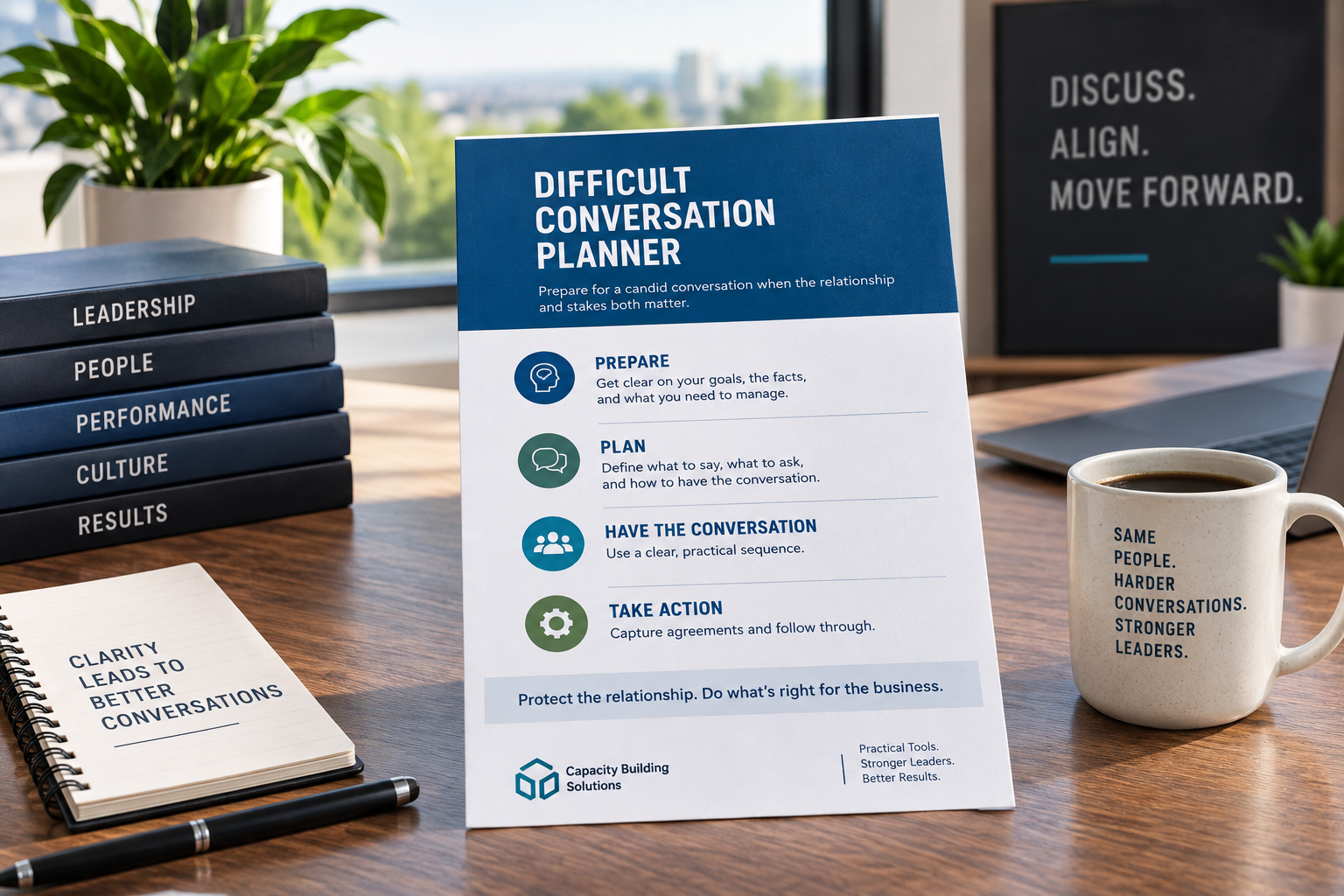
Difficult Conversation Planner for CEOs and Managers
Difficult conversations are part of leadership. Avoiding them usually doesn’t make the issue go away. It gives the issue more time to affect the individual, the team, the relationship, and sometimes the business.
The challenge is that the conversations that matter most are often the hardest to have.
There may be years of personal history. The individual may have made important contributions to the company. Loyalty may be involved. You may be concerned about damaging the relationship, creating conflict, losing a valued employee, or saying something you cannot take back.
At the same time, the role may have changed. Expectations may have increased. A behavior may no longer be acceptable. Performance may not be where it needs to be. Or you may have reached the point where you need to have an honest conversation about whether the individual and the role still fit.
That is why I developed this Difficult Conversation Planner.
It is a practical tool for CEOs, business owners, executives, and managers who need to prepare for a candid conversation when both the relationship and the stakes matter.
The goal is not to make a difficult conversation comfortable. It is to help you enter it prepared, clear, fair, and ready to listen—while protecting both the relationship and the needs of the business.
Prepare Yourself Before the Conversation
A productive difficult conversation starts before you sit down with the other person.
The first section of the planner asks you to get clear about what you actually want—for the business, the relationship, and the individual.
It also asks some harder questions:
What are you afraid may happen? What have you been avoiding saying? How might your own behavior have reinforced the pattern? What emotions or triggers do you need to manage? What facts need to be discussed? And, importantly, what conclusion have you not yet earned?
That last question matters.
There is a difference between entering a conversation with facts, concerns, and standards and entering it having already decided what another person thinks, why they behaved a certain way, or what the final outcome must be.
Good leadership requires clarity, but it also requires judgment.
Plan What You Need to Say—and What You Need to Hear
Once you have prepared yourself, the planner helps you think through the actual conversation.
You will identify what is working and should be acknowledged, how you will state the concern in plain language, which specific examples you will use, and what impact the issue is having on the company.
You will also prepare a question that helps you understand the other person’s perspective rather than simply delivering your own.
If role fit is part of the issue, the planner helps you think about how you will raise it directly. It also asks you to identify any immediate boundaries that need to be established and the next action or decision you need to request.
The objective is not to script every word.
It is to make sure that when the conversation becomes difficult, you don’t lose sight of why you are having it.
A Practical Sequence for Difficult Leadership Conversations
The planner provides an eight-step conversation sequence:
Begin with shared purpose and respect. Recognize the person’s contributions and current results. Describe the behavior and impact clearly. Ask for the person’s perspective and listen. Name the standard the role now requires. Clarify immediate boundaries. Agree on the next assessment or action. Send a concise written recap.
This structure helps keep the conversation from becoming either too soft or unnecessarily confrontational.
Respect does not require avoiding the issue. Clarity does not require treating someone without respect.
Effective leaders need to be able to do both.
Turn the Difficult Conversation Into Action
A difficult conversation should not end with everyone simply feeling that they “had a good talk.”
Something should become clearer.
The final section of the planner helps capture what was acknowledged, where disagreement remains, what immediate commitments were made, when the next meeting will occur, and what you as the leader need to follow through on.
The completion standard in the tool captures the point well:
Do not stop with insight. Leave with a clear behavior, an accountable owner, a date, and evidence that will show whether progress occurred.
If you have been putting off an important conversation because the relationship matters, the history is complicated, or you are uncertain how to approach it, use this planner before you meet.
Take a few minutes. Get clear on the facts. Think about your own role in the situation. Decide what needs to be said. Prepare to listen. Know the standard. And determine what needs to happen next.
A difficult conversation handled well may not be easy.
But avoiding an important conversation rarely makes leadership easier.