
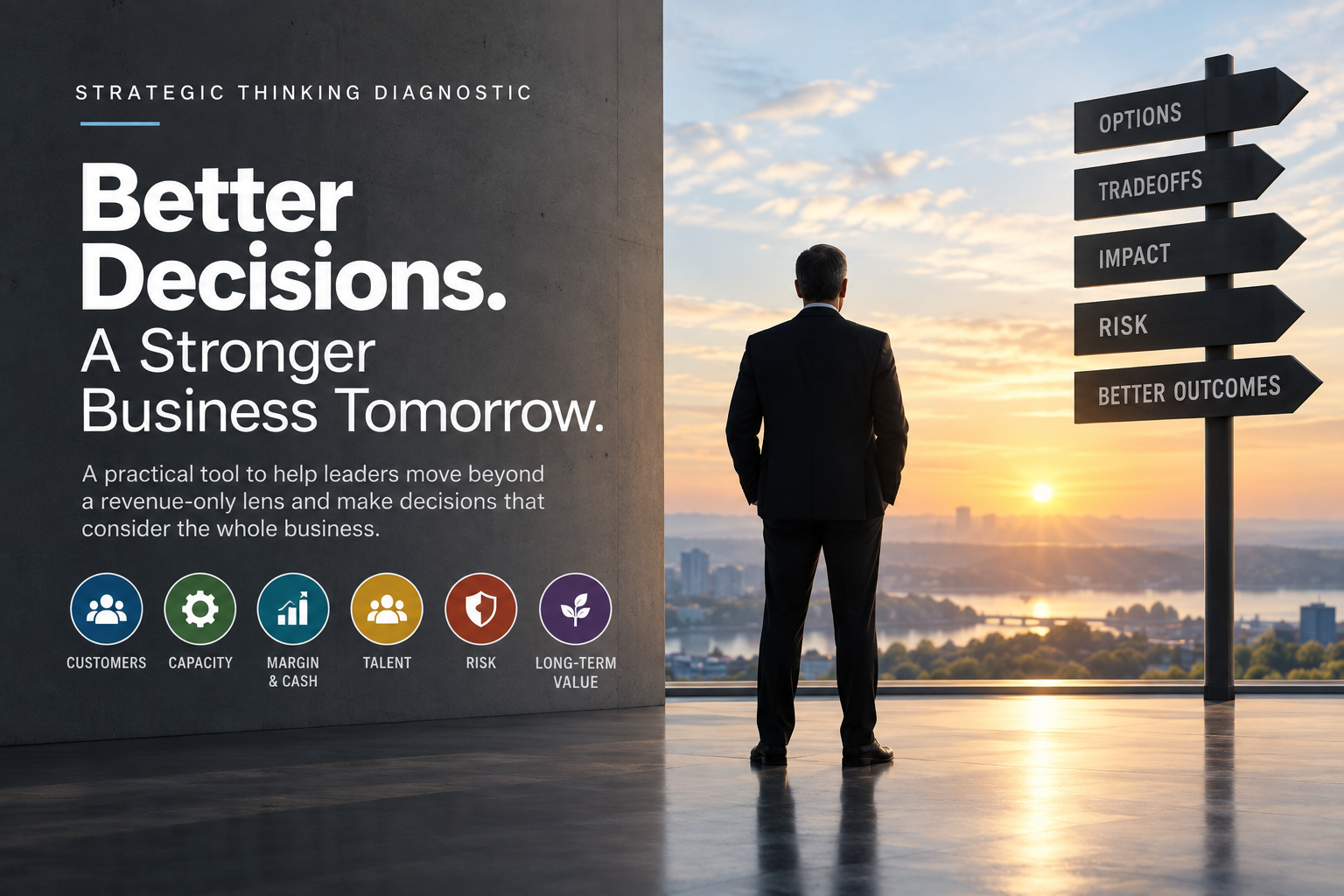
Strategic Thinking Diagnostic: Help Leaders Make Better Business Decisions
Being strategic is not simply about thinking further into the future. It is about making better decisions today while understanding how those decisions affect the rest of the business.
A customer asks for something important. A new opportunity appears. Sales wants to make a commitment. Operations is concerned about capacity. A leader needs to decide whether to invest, delay, change scope, adjust pricing, or move ahead.
These are the moments when strategic thinking becomes real.
The question is not simply, “Can we do it?”
A strategic leader also asks: Should we do it? What problem are we actually solving? What assumptions are we making? What will this require? What will we have to give up? What could happen next? And does this decision make sense for the business as a whole?
That is why I developed the Strategic Thinking Diagnostic.
This practical leadership assessment helps CEOs, business owners, executives, and managers evaluate whether a leader is looking beyond an immediate opportunity or revenue target and making decisions that balance customers, capacity, margin, cash, talent, risk, and long-term value.
Strategic Thinking Starts With Defining the Real Decision
One of the easiest mistakes leaders make is jumping too quickly from a problem to a solution.
A customer makes a request, and the organization immediately starts figuring out how to deliver it.
But the customer’s request and the customer’s underlying need are not always the same thing.
A strategic leader slows the process down enough to understand the real issue before committing resources or making promises.
The diagnostic asks whether the leader can distinguish the customer request from the underlying customer need and define the real decision before debating solutions.
That creates room for better alternatives.
Instead of viewing a decision as simply yes or no, the leader can consider changing the timing, scope, price, sequence, resources, or other elements of the opportunity.
Better strategic thinking often begins with better options.
Look Beyond Revenue to the Whole Business
Revenue matters, but a good revenue opportunity is not automatically a good business decision.
The Strategic Thinking Diagnostic deliberately moves leaders beyond a revenue-only lens.
It asks whether the leader understands the margin and cash implications of an opportunity and whether operational capacity and delivery risk have been considered before commitments are made.
It also asks a question that is easy to overlook:
What other work, customers, or priorities may be displaced?
Every significant decision consumes something—money, time, capacity, management attention, talent, or organizational energy.
A strategic leader learns to recognize those tradeoffs rather than evaluating an opportunity in isolation.
Test the Assumptions Behind the Decision
Every important business decision contains assumptions.
The problem is that leaders do not always make those assumptions visible.
We assume the customer will buy. We assume the volume will be there. We assume operations can absorb the work. We assume the margin will hold. We assume the right people will be available. We assume another priority can wait.
The diagnostic asks leaders to identify what must be true for the decision to work.
Once those assumptions are visible, they can be challenged.
That does not slow decision-making unnecessarily. It can improve decision quality by helping leaders identify where confidence is justified and where more evidence may be needed.
Consider Second-Order Effects
Some decisions look good when you only examine the immediate result.
Strategic thinking requires going another step.
What happens because this happens?
The diagnostic asks leaders to anticipate second-order effects on people, systems, and customer trust. It also examines whether the leader understands when a decision is reversible and when a decision requires greater care.
A reversible decision may justify moving quickly, testing, learning, and adjusting.
A difficult-to-reverse decision with significant financial, operational, customer, or people consequences deserves more deliberate thinking.
Strong strategic leaders learn to recognize the difference.
Assess Strategic Thinking With More Than a Score
I recommend that the leader and direct manager complete the Strategic Thinking Diagnostic separately.
The ten strategic-thinking behaviors are rated on a five-point scale. The results then identify the overall score, average score, number of low-rated items, lowest-rated strategic habit, and the actual decision where that weakness is most visible.
The scoring ranges from consistently strong strategic judgment to an immediate decision-quality risk.
But I would not use the average score as the answer.
As the diagnostic points out, one weak strategic habit can materially affect a high-stakes decision.
The purpose is not simply to determine whether someone is “strategic.”
The purpose is to identify which strategic-thinking habit needs to get better.
Apply the Diagnostic to a Real Business Opportunity
This is where I think the tool becomes especially useful.
Rather than stopping with an assessment, page 2 asks the leader to apply the diagnostic to a real opportunity or decision.
The leader works through:
the decision that needs to be made, the underlying customer need, available options, decision criteria, capacity requirements, margin and financial impact, work or priorities that may be displaced, key assumptions, and major risks.
This turns strategic thinking from an abstract leadership competency into something a leader can actually practice.
Turn Strategic Thinking Into a Leadership Habit
The goal is not to complete an assessment and put it in a file.
The diagnostic recommends choosing one strategic habit and applying it to a real decision within the next two weeks.
It also recommends asking a knowledgeable peer to challenge the leader’s assumptions, alternatives, operational implications, and second-order effects before the decision is finalized.
That is an important part of developing strategic judgment.
Good strategic thinkers do not need to have every answer themselves. They need to know which questions to ask, where their own thinking may be incomplete, and who can help them challenge it.
The final section of the tool identifies the strategic habit to strengthen, where it will be practiced, who should challenge the leader’s thinking, and what evidence will demonstrate improvement. It also captures the recommendation and rationale, decision owner, and review trigger or date.
The completion standard is straightforward:
Do not stop with insight. Leave with a clear behavior, an accountable owner, a date, and evidence that will show whether progress occurred.
When to Use the Strategic Thinking Diagnostic
I would use this tool when you have a capable leader who needs to become more strategic in how they make decisions.
It can be particularly useful when a leader moves quickly to solutions, focuses too heavily on revenue or the needs of one function, makes commitments before understanding capacity, overlooks financial implications, fails to consider what will be displaced, or does not consistently think through downstream consequences.
It is also useful when preparing someone for a more senior leadership role where the quality of their decisions will increasingly affect the entire business.
Strategic thinking does not have to remain a vague leadership expectation.
You can identify the behaviors. You can practice them on real decisions. You can challenge the thinking. And you can look for evidence that the quality of the leader’s decisions is improving.
That is how strategic thinking becomes a leadership capability rather than simply a leadership concept.