
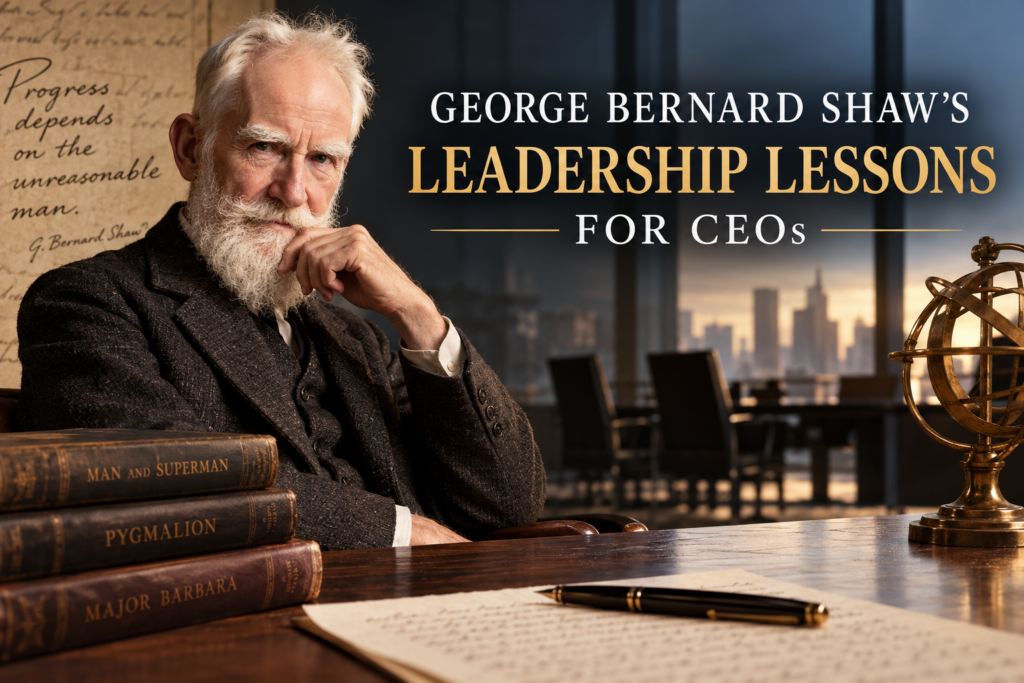
George Bernard Shaw’s Leadership Lessons for CEOs: Challenging Conventional Wisdom and Becoming a Better Leader
Introduction
One of the things I’ve learned over the years is that leadership has a lot less to do with having all the answers and a lot more to do with asking the right questions. The longer you’re in a leadership position, the easier it becomes to get comfortable with your own thinking. You develop habits, form opinions, establish routines, and begin to rely on approaches that have worked for you in the past. There’s nothing inherently wrong with that. Experience matters. However, experience can also become a liability when it keeps you from recognizing that circumstances have changed or that there may be a better way of doing things.
That’s one of the reasons I find George Bernard Shaw’s observations about life, people, and human behavior so interesting. Shaw was a playwright, critic, and independent thinker who had a remarkable ability to challenge conventional wisdom and expose the inconsistencies in how people think and act. He wasn’t particularly interested in making people comfortable with their existing beliefs. He wanted them to think, question, and reconsider what they accepted as true.
I believe there’s a great deal that CEOs, business owners, executives, and emerging leaders can learn from that approach.
George Bernard Shaw’s leadership lessons are especially relevant to anyone responsible for making difficult decisions, leading people, building an organization, and producing results through others. His observations remind us that effective leadership requires intellectual honesty, personal accountability, adaptability, and the courage to challenge our own assumptions.
These qualities are easy to talk about. They’re considerably harder to practice consistently.
Great Leadership Starts With Challenging Your Own Thinking
One of the biggest obstacles to becoming a better leader is the belief that you’ve already figured things out. Success has a way of reinforcing our opinions. When our decisions produce positive results, we naturally become more confident in our judgment. Over time, that confidence can turn into certainty, and certainty can become a dangerous thing when it discourages us from considering other perspectives.
I’ve seen business leaders become so attached to a particular strategy, management style, or way of operating that they struggle to recognize when it’s no longer working. Sometimes the evidence is right in front of them. Employee turnover increases, customer relationships deteriorate, financial performance begins to slip, or talented people stop offering their opinions. Yet instead of questioning their assumptions, leaders double down on what they’ve always done.
The problem isn’t necessarily a lack of intelligence or commitment. More often, it’s an unwillingness to acknowledge that the situation may require a different approach.
Shaw’s willingness to challenge accepted thinking offers an important reminder: just because something is familiar doesn’t mean it’s right, and just because an approach worked in the past doesn’t mean it will continue to produce the same results.
As a CEO or business owner, you need to be willing to ask yourself some uncomfortable questions. What am I assuming to be true that may no longer be accurate? Where have I become too comfortable? Am I surrounding myself with people who challenge my thinking, or people who tell me what I want to hear? Am I making decisions based on facts and sound judgment, or am I protecting my ego?
These aren’t always easy questions to answer, but they’re essential to effective executive leadership.
Personal Accountability Is Where Effective Leadership Begins
It’s easy to point to external circumstances when things aren’t going well. The economy is challenging. Good employees are difficult to find. Customers are becoming more demanding. Competitors are putting pressure on margins. Technology is changing too quickly. While these challenges may be legitimate, they don’t eliminate a leader’s responsibility to respond effectively.
One of the most important leadership principles I’ve come to appreciate is that we have far more influence over our circumstances than we sometimes want to acknowledge.
We may not control everything that happens to us or our businesses, but we do control how we respond, what we prioritize, the standards we establish, and the decisions we make.
Shaw’s observations about personal responsibility and human behavior provide a useful framework for examining how we approach these choices.
I’ve always believed that leaders need to spend less time explaining why something can’t be done and more time figuring out what can be done. That doesn’t mean ignoring reality or pretending that difficult circumstances don’t exist. It means refusing to surrender your ability to influence the outcome.
If your organization isn’t performing at the level it should, you need to be willing to examine your own contribution to the problem. Are expectations clear? Do people have the tools and support they need? Are you holding the right people accountable? Are you addressing performance issues directly, or allowing them to continue because the conversations are uncomfortable?
Leadership accountability starts with the person at the top. You can’t reasonably expect your employees to take ownership of their responsibilities if you aren’t demonstrating the same behavior yourself.
The Courage to Think Differently and Challenge the Status Quo
Every successful business eventually faces a difficult choice. Do we continue doing what has worked in the past, or do we take the risk of doing something different?
This is where leadership gets interesting.
It’s one thing to talk about innovation, continuous improvement, and organizational change. It’s another thing to challenge established practices, question long-held assumptions, and make decisions that may initially be unpopular.
Most organizations don’t become stagnant overnight. It happens gradually. People become comfortable with existing processes. Meetings become routine. Problems are discussed without being resolved. Employees learn which subjects are safe to raise and which ones are better left alone. Eventually, maintaining the status quo becomes more important than improving performance.
Shaw’s independent thinking challenges this tendency.
For CEOs and business owners, the lesson is straightforward: if you want your organization to improve, you have to create an environment where people are encouraged to think critically, question assumptions, and offer better alternatives.
That starts with your own behavior.
How do you react when someone disagrees with you? Do you listen with genuine curiosity, or do you immediately begin defending your position? Are you willing to admit when someone else has a better idea? Do your employees believe they can challenge an existing process without being labeled difficult or negative?
You can’t build an innovative organization while discouraging independent thinking.
At the same time, challenging conventional wisdom doesn’t mean rejecting every established practice or constantly changing direction. Good leadership requires the judgment to distinguish between what needs to be preserved and what needs to change.
The objective isn’t change for the sake of change. It’s continuous improvement based on thoughtful evaluation, honest conversations, and a willingness to act when the evidence supports a better approach.
Understanding People Is Essential to Business Leadership
One of the reasons Shaw’s writing remains relevant is his understanding of human nature. People are complicated. We aren’t always rational, consistent, or particularly good at recognizing our own contradictions. We say one thing and do another. We resist changes that might benefit us. We defend beliefs that may no longer serve us.
If you’ve spent any meaningful amount of time leading people, you’ve probably experienced all of these behaviors.
Of course, leaders aren’t immune to them either.
A CEO can have a compelling vision, a sound business strategy, and ambitious growth objectives, but none of those things will matter very much if the people responsible for execution aren’t engaged, capable, and aligned with the organization’s priorities.
That’s why effective leadership requires more than technical knowledge or business expertise. It requires an understanding of what motivates people, how they respond to uncertainty, and why they sometimes struggle to do what appears obvious to everyone else.
I’ve found that many leadership problems are really people problems, and many people problems can be traced back to unclear expectations, inconsistent communication, poor accountability, or a failure to address difficult issues before they become bigger ones.
Strong leaders recognize that people need clarity, direction, honest feedback, and a sense that their contributions matter. They also understand that treating people with respect doesn’t mean avoiding difficult conversations or lowering performance expectations.
In fact, one of the most respectful things you can do as a leader is tell someone the truth about their performance and give them a fair opportunity to improve.
Understanding human behavior also means recognizing your own tendencies. Are you patient when someone needs additional guidance? Do you make assumptions about people’s intentions? Are you consistent in how you treat employees? Do you hold yourself to the same standards you expect from others?
These questions are important because your leadership behavior helps establish the culture of your organization, whether you intend it to or not.
Leadership Requires the Willingness to Grow and Change
One of the more challenging aspects of leadership is recognizing that the person who built a business to its current level of success may need to become a different kind of leader to take it to the next level.
The skills required to start a company aren’t necessarily the same skills needed to manage a growing organization. As a business becomes larger and more complex, the CEO’s responsibilities change. You have to learn to delegate, develop other leaders, establish systems, communicate more effectively, and spend more time thinking strategically rather than managing every detail.
This transition can be difficult, particularly for business owners who are accustomed to being involved in everything.
I’ve seen leaders unintentionally become bottlenecks in their own organizations because they struggle to let go of decisions, responsibilities, or activities that once defined their value to the business.
The irony is that the very behaviors that contributed to their early success can eventually limit their organization’s potential.
Shaw’s willingness to question established ideas offers a useful reminder that personal growth requires us to reconsider not only how the world works, but also how we see ourselves.
If you want your organization to grow, you have to be willing to grow along with it.
That means developing new capabilities, seeking honest feedback, acknowledging your limitations, and occasionally letting go of approaches that have served you well in the past.
It also means recognizing that leadership development isn’t something you complete. It’s an ongoing responsibility.
The best leaders I’ve encountered remain curious. They read, ask questions, listen to people with different experiences, and continue looking for ways to improve. They understand that there’s always something new to learn, regardless of how long they’ve been in business or how successful they’ve become.
Turning Leadership Philosophy Into Practical Action
I enjoy reading the observations of great thinkers, but I’ve always believed that wisdom has limited value unless you’re willing to do something with it.
It’s easy to read an insightful quote, nod your head in agreement, and move on with your day. The more difficult task is examining how that idea applies to your own behavior and deciding what you’re going to do differently as a result.
That’s the approach I encourage you to take with this guide.
As you explore George Bernard Shaw’s leadership lessons for CEOs, don’t simply focus on whether you agree with a particular observation. Think about what it reveals regarding your assumptions, decisions, relationships, and responsibilities as a leader.
Consider where you may be accepting an unnecessary limitation, avoiding a difficult conversation, holding on to an outdated practice, or allowing your own preferences to interfere with better decision-making.
You may also discover opportunities to improve how you communicate with your team, approach strategic challenges, develop emerging leaders, or create greater accountability throughout your organization.
The goal isn’t to become a perfect leader. There’s no such thing.
The goal is to become more intentional about how you lead, more honest about where you need to improve, and more willing to make the changes necessary to produce better results.
Sometimes meaningful leadership improvement begins with a major strategic decision. Other times, it starts with something as simple as listening more carefully, asking a better question, admitting you were wrong, or addressing an issue you’ve been avoiding.
Small changes in leadership behavior can have a significant impact when they’re practiced consistently over time.
What CEOs and Business Owners Can Take Away From This Guide
At its core, effective business leadership is about making thoughtful choices, taking responsibility for the outcomes, and helping other people perform at their best.
Shaw’s observations provide an opportunity to examine these responsibilities from a different perspective.
They encourage us to challenge conventional wisdom without becoming argumentative, maintain confidence without becoming arrogant, pursue improvement without losing sight of what matters, and recognize that our own thinking can sometimes be the biggest obstacle to progress.
For CEOs, business owners, and executives, these are more than interesting philosophical concepts. They relate directly to strategic decision-making, organizational culture, leadership development, employee performance, and long-term business success.
I encourage you to approach this resource with an open mind. Some of the ideas may reinforce what you already believe. Others may challenge your assumptions or make you uncomfortable. That’s not necessarily a bad thing.
In my experience, some of the most valuable leadership lessons are the ones that force us to reconsider something we thought we already understood.
You don’t have to agree with everything George Bernard Shaw believed to benefit from his perspective. What matters is your willingness to think critically about the ideas, evaluate their relevance to your own circumstances, and apply what makes sense.
Ultimately, leadership isn’t measured by how much you know, how impressive your title sounds, or how confidently you express your opinions. It’s reflected in the quality of your decisions, the standards you establish, the people you develop, and the results your organization achieves.
Download George Bernard Shaw’s Leadership Lessons for CEOs and take some time to reflect on the ideas presented. Challenge your assumptions, consider where you may need to adjust your approach, and identify one or two practical changes you can make in how you lead.
Because becoming a better leader isn’t about knowing more than everyone else. It’s about remaining willing to learn, grow, and do the hard work of leading more effectively.