
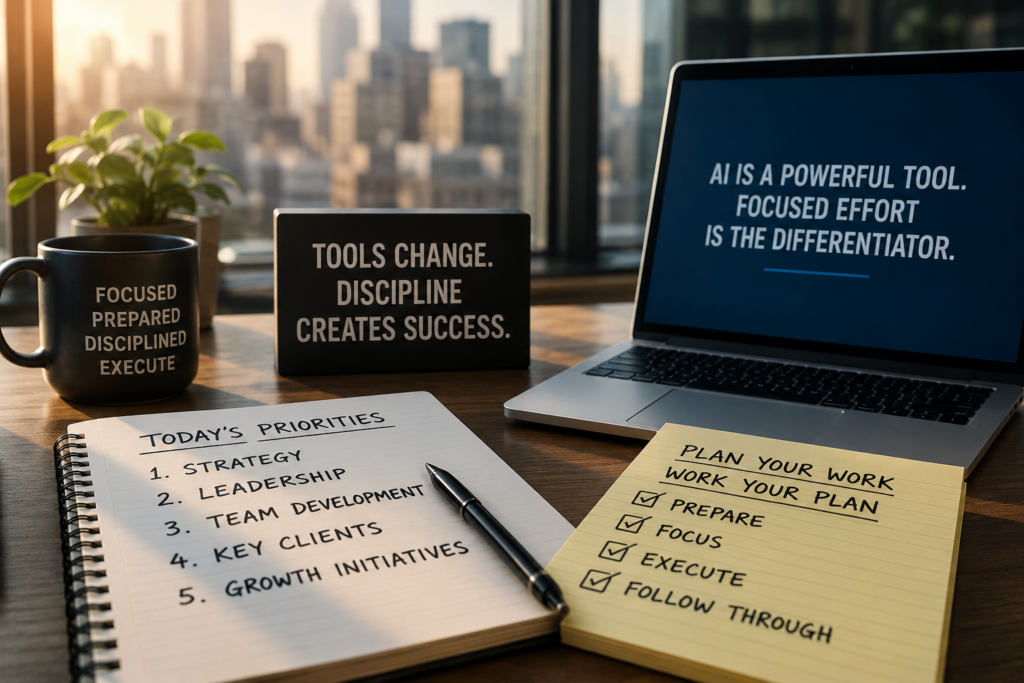
Success Still Requires Focused Effort
“Success usually isn’t determined by who has access to the best tools. It’s determined by who uses those tools with the greatest discipline.”
We are living through one of the most remarkable periods of productivity in history. Artificial intelligence can research in seconds, summarize complex information, generate ideas, analyze data, improve writing, and complete tasks that once required hours of work. Every week seems to bring another breakthrough that promises to make us faster, smarter, and more productive. Yet despite all of these advances, one thing hasn’t changed: success still requires focused effort.
I’ve embraced AI enthusiastically because I believe it represents one of the most significant technological advances of my lifetime. It has fundamentally changed the way I work. Today I can research topics faster, organize information more effectively, challenge my own thinking, improve my writing, and solve problems in a fraction of the time it once required. I probably accomplish ten times as much today as I could before AI became part of my daily routine.
What AI hasn’t done is make me more disciplined.
It hasn’t taught me how to prioritize my day, prepare for an important meeting, build stronger relationships, ask better questions, or follow through on commitments. Those responsibilities still belong to me, just as they belong to every other leader. AI has simply amplified habits that were already there. That’s why I believe many people are misunderstanding what this technological revolution actually means.
As AI becomes available to everyone, access to technology is no longer a competitive advantage. Nearly everyone has access to remarkably capable tools. The leaders who distinguish themselves won’t necessarily be the ones with the newest software or the most sophisticated prompts. They’ll be the ones who prepare more thoroughly, think more critically, ask better questions, make better decisions, and execute more consistently. In other words, they’ll combine powerful technology with focused effort.
That, in my opinion, is where the real opportunity lies.
Technology Has Changed. Human Nature Hasn’t.
Throughout history, every major technological advancement has promised to make work easier. In many respects, it has. Farmers produce more food with less labor than ever before. Manufacturers produce higher-quality products with fewer people. Business leaders can access information in seconds that once required days or weeks of research. Technology has consistently expanded our capabilities and improved our efficiency.
What it has never done is eliminate the need for discipline.
Every generation seems convinced it has discovered a shortcut that previous generations somehow missed. Yet when you study the lives of highly successful entrepreneurs, executives, athletes, military leaders, scientists, and artists, you find remarkably consistent patterns. They prepared more thoroughly. They practiced longer. They continued learning after others stopped. They paid attention to details others overlooked, and they developed habits that allowed them to perform consistently when motivation alone wasn’t enough.
The tools changed.
Human nature didn’t.
Success has always required people to make good decisions repeatedly over long periods of time. It has required them to delay gratification, persist through setbacks, remain curious, and stay focused on what matters most. AI hasn’t changed those requirements. If anything, it has made them even more important, as distractions have become more abundant and attention increasingly scarce.
Sometimes, I think our greatest challenge today isn’t a lack of information but an overabundance of it. Every day we are bombarded with emails, podcasts, videos, social media updates, newsletters, text messages, and notifications, all competing for our attention. AI has dramatically increased our ability to consume information, but consuming it has never been the same as creating value.
Knowledge without execution has always had limited value. That was true before AI, and it remains true today.
AI Rewards Disciplined People
One of the biggest misconceptions surrounding artificial intelligence is that it somehow replaces thinking. I don’t believe that’s true. I believe AI rewards people who already know how to think.
People who understand strategy receive better strategic insights because they know which questions to ask. People with strong financial backgrounds can quickly recognize when an analysis makes sense and when it doesn’t. Experienced leaders know how to challenge recommendations rather than accept them blindly. They use AI as a thought partner rather than a substitute for judgment.
The quality of the output still depends heavily on the quality of the person using the tool.
That’s certainly been my experience. AI accelerates almost everything I already do. It helps me research more quickly, organize my thinking, improve my writing, challenge assumptions, and explore ideas from multiple perspectives. It allows me to spend less time gathering information and considerably more time interpreting it, connecting ideas, and deciding what they actually mean. That’s where the real value lies—not simply producing more work, but producing better work.
The same principle applies to leadership. AI cannot build trust with your employees. It cannot coach someone through a difficult conversation. It cannot establish credibility with a customer, create a healthy culture, or make a courageous decision when the facts are incomplete. Leadership remains deeply human because leadership is fundamentally about judgment, relationships, character, and accountability. Technology can support those responsibilities, but it cannot assume them.
One of the reasons I remain optimistic about AI is that I believe it will reward the same qualities that have always separated exceptional leaders from average ones. Curious people will learn faster because they have better tools for exploration. Disciplined people will execute more effectively because routine work consumes less of their time. Lifelong learners will continue to grow because knowledge has become more accessible than ever before.
The opposite is also true. People who lack discipline won’t suddenly become disciplined because AI exists. Leaders who avoid difficult conversations won’t suddenly become courageous because technology offers another recommendation. Organizations with poor execution won’t solve their execution problems simply by purchasing another software platform.
Technology amplifies habits. It makes good habits more valuable and poor habits more obvious. I suspect that will become one of the defining leadership lessons of the AI era.
Most Leaders Don’t Have a Time Problem
One observation has become increasingly clear after working with business owners and executives for more than three decades.
Most leaders don’t actually have a time problem.
They have an attention problem.
People often tell me they simply don’t have enough hours in the day. Occasionally that’s true, but more often I find they’re investing their time in the wrong places. They begin the morning reacting instead of leading. Email determines their priorities before they’ve identified their own. They rush into meetings they haven’t adequately prepared for, spend hours solving problems someone else should own, and wonder why they never seem to have time for strategy, leadership development, or long-term planning.
I tend to get more done by 9:30 in the morning than many people accomplish in an entire day. That isn’t because I’m smarter or more talented. It’s because I wake up early, identify my priorities, and get to work. I don’t dilly. I don’t dally. Before the day has a chance to fill itself with meetings, interruptions, and distractions, I’ve already made meaningful progress on the work that matters most.
That habit has served me well throughout my career, and AI has only increased its value. Instead of spending hours researching a topic, organizing information, or refining a piece of writing, I can move much faster. The time I save isn’t an opportunity to do less. It’s an opportunity to think more deeply, solve more meaningful problems, spend more time coaching leaders, and create greater value for the people I serve.
The discipline came first.
AI simply multiplied its impact.
Focus on the Work That Moves the Needle
One of the biggest lessons I’ve learned over the years is that not all work creates equal value. We all have the same twenty-four hours in a day, but how we invest those hours largely determines the results we achieve. Too many leaders confuse activity with accomplishment. They spend their days answering emails, attending meetings, putting out fires, and solving problems that someone else should have handled. By the time they leave the office, they’re exhausted, yet they’ve made very little progress on the issues that will truly determine the future of their business.
I often encourage CEOs to ask themselves a simple question: What are the things that only I can do? The answer is usually surprisingly short. It may involve setting strategic direction, making critical decisions, coaching key leaders, strengthening important customer relationships, recruiting exceptional talent, or thinking through the next opportunity before it becomes obvious to everyone else. Those are the activities that deserve the greatest percentage of a leader’s time because they create disproportionate value. Everything else should be delegated, streamlined, automated, or eliminated whenever possible.
This approach is another reason I’m so enthusiastic about AI. Used properly, it can eliminate or dramatically reduce much of the work that adds little strategic value. It can summarize reports, organize research, analyze information, prepare first drafts, and provide another perspective on difficult problems. What it cannot do is determine which problems deserve your attention in the first place. That responsibility still belongs to you. The better we become at distinguishing between important work and merely urgent work, the greater the return we’ll receive from both our time and our technology.
Over the years, I’ve found that highly successful leaders don’t necessarily accomplish more because they work dramatically longer hours. They accomplish more because they spend a greater percentage of their time on high-value activities. They’ve learned to protect their attention, say no more often, and resist the temptation to become consumed by work that feels productive but ultimately produces very little value. Focused effort isn’t about doing more things. It’s about doing the right things exceptionally well.
Preparation Is an Underrated Competitive Advantage
Preparation rarely receives much recognition because it happens quietly. No one applauds the executive who spends an hour preparing for a thirty-minute meeting or the business owner who researches an industry before meeting a prospective client. People usually don’t see the preparation. They only see the confidence, clarity, and quality of the decisions that preparation makes possible.
I’ve always believed preparation is one of the most underrated competitive advantages in business. Whether I’m facilitating a Vistage meeting, coaching a CEO, speaking to an audience, or attending a conference, I invest considerable time before the event ever begins. I want to understand the people I’ll be meeting, the issues they’re facing, the questions worth asking, and the outcomes I’m hoping to achieve. That investment consistently produces better conversations because I’ve already done much of the thinking before I walk into the room.
The same philosophy applies to conferences and networking events. I’ve often said I can probably get more networking opportunities and long-term business value out of two days at a conference than many people get out of years of attending conferences. That isn’t because I’m naturally better at networking. It’s because I approach those events intentionally. Before I arrive, I usually know who I want to meet, what I want to learn, and which conversations deserve my time. Afterward, I follow up. Relationships are rarely built during the conference itself. They’re built in the weeks and months that follow.
Once again, AI has made preparation easier than ever before. I can quickly research companies, industries, competitors, market trends, and individuals before an important meeting. I can explore different perspectives, identify blind spots, and prepare better questions. But AI isn’t creating the discipline. It’s rewarding the discipline that already exists. Leaders who prepare well simply have better tools than they had a few years ago. The underlying habit hasn’t changed.
Focused Effort Doesn’t Mean Living Out of Balance
Whenever I write about hard work or discipline, I worry that someone will misinterpret the message. I’m not suggesting that success requires working around the clock or sacrificing your family, your health, or the relationships that matter most. I’ve coached enough business owners over the years to know that professional success achieved at the expense of everything else is ultimately a hollow victory.
Balance still matters.
Rest matters.
Time away from work matters.
Your spouse, your children, your friends, and your health all deserve your attention. In fact, I’ve found that leaders often make better decisions when they create enough margin in their lives to think clearly rather than constantly operating under pressure.
The point of this article isn’t to encourage people to work longer. It’s to encourage them to work more intentionally. When you’ve decided it’s time to work, then work with purpose. Eliminate distractions. Prepare thoroughly. Focus on the handful of activities that create the highest value. When it’s time to be home, be home. When it’s time to take a vacation, take one. Focused effort isn’t about working every minute of the day. It’s about making the minutes you choose to work count.
Success Is Built on Ordinary Discipline
A few weeks ago I watched an interview with Will Smith that captured something I’ve believed for years. He acknowledged there were many actors more talented than he was, but he made it clear that no one was going to outwork him. Whether someone agrees with everything about his career isn’t really the point. The point is that he understood something fundamental about achievement: talent may open the door, but disciplined effort is usually what determines how far someone ultimately goes.
I’ve seen the same pattern repeated throughout my career. After coaching CEOs and business owners for more than thirty years, I’ve become convinced that the leaders who consistently outperform their peers aren’t necessarily the smartest people in the room. They aren’t always the most charismatic, the best educated, or the ones who started with the greatest resources. More often than not, they’re the ones who prepare better, follow through more consistently, continue learning after others have become complacent, and execute long after the excitement of a new idea has worn off.
That’s one of the reasons I become skeptical whenever someone attributes another person’s success primarily to luck, privilege, or timing. Those factors certainly exist, and they occasionally create opportunities others don’t receive. But they represent the exception rather than the rule. Most successful organizations are built through years of disciplined execution that very few people ever see.
The leaders I’ve admired most make difficult decisions when easier ones would be more comfortable. They prepare for meetings that others assume they can simply “wing.” They keep commitments even when doing so becomes inconvenient. They continue investing in their own development long after they’ve become successful. None of those habits seem particularly remarkable in isolation. Over time, however, they compound into something extraordinarily valuable. They build credibility, trust, influence, and a reputation that opens doors to opportunities that less disciplined people rarely experience.
When I look back on the most successful leaders I’ve known, I don’t remember them for constantly talking about success. I remember them because they consistently demonstrated the habits that eventually produced it. Their discipline wasn’t something they turned on when circumstances demanded it. It had become part of who they were.
Plan Your Work and Work Your Plan
One of my former bosses had a saying that has stayed with me throughout my career: “Plan your work and work your plan.” At the time, it sounded almost too simple. The older I’ve become, however, the more I’ve come to appreciate the wisdom behind those few words.
Every day presents more opportunities than any of us can possibly pursue. There are more meetings than we should attend, more emails than we can answer, more articles than we can read, and more ideas than we could ever implement. The challenge isn’t finding work. The challenge is deciding what work actually deserves our attention.
That decision has become even more important in the age of AI. Technology has dramatically increased our ability to produce, research, analyze, and create. As remarkable as those capabilities are, they also create a subtle temptation. We begin to believe that because we can do more, we should do more. We fill every available minute with activity instead of asking whether the activity itself is worthwhile.
The most effective leaders I’ve worked with think differently. Before they ask how something should be done, they first ask whether it should be done at all. They don’t measure themselves by the length of their to-do list or the number of meetings on their calendar. They measure themselves by whether they’re making meaningful progress on the handful of priorities that will have the greatest long-term impact on their organization.
That requires discipline because no one else can make those decisions for you.
It also requires the confidence to let go of work others can do so you can focus on what only you can do. If AI can reduce the time you spend gathering information, organizing documents, preparing presentations, or analyzing data, embrace it. But don’t use the time you save to simply become busier. Use it to think more deeply, coach more intentionally, build stronger relationships, and spend more time on the strategic issues that determine your organization’s future.
That’s where leaders create value.
One Final Thought
If there’s one idea I’d leave you with, it’s this: the real competitive advantage today isn’t artificial intelligence. It’s disciplined people using artificial intelligence.
Technology will continue to evolve. Five years from now it will almost certainly be capable of things we can’t even imagine today. I welcome those advances because I believe they’ll help all of us become more productive. But I don’t believe they’ll ever replace discipline, judgment, curiosity, preparation, courage, or consistent execution. Those qualities have always separated exceptional leaders from average ones, and I suspect they always will.
Tomorrow morning, before you open your email, check your phone, or attend your first meeting, ask yourself a simple question: What work will genuinely move the needle today? Then protect your attention long enough to finish it.
AI can help you do that work faster.
It can’t decide what your work is.
Only you can do that.
As my former boss used to remind me, plan your work and work your plan. That advice was true long before artificial intelligence arrived, and I believe it will remain true long after today’s technology has been replaced by something even more powerful.
Carpe diem.
Reflection Questions
- If someone observed how I spent my workday for the next month, what would they conclude are my real priorities?
- Which responsibilities truly require my knowledge, judgment, and leadership, and which ones should I delegate?
- Am I investing more time reacting to problems than preventing them?
- How am I using AI to improve my judgment, preparation, and execution rather than simply increasing my activity?
- What habits consistently help me focus, and which habits repeatedly distract me from the work that matters most?
- If I became just 10 percent more intentional with my time over the next year, what meaningful results might that produce?