
Leadership Lessons from Napoleon Bonaparte
An Imagined Conversation About Power, Ambition, Success, Failure, and the Legacy We Leave Behind
Introduction
History has always fascinated me, especially the lives of individuals who managed to accomplish extraordinary things under extraordinarily difficult circumstances. I am particularly interested in what made these individuals successful, how they approached difficult decisions, how they inspired others, and what ultimately contributed to their success or failure. I believe we can learn just as much from their mistakes as we can from their achievements.
Napoleon Bonaparte is one of those historical figures who has always captured my attention. Few individuals have risen so far, accomplished so much, influenced so many people, or experienced such a dramatic reversal of fortune. He was a brilliant military commander, a gifted administrator, a tireless worker, and a man of enormous ambition. He was also capable of serious misjudgments, excessive confidence, authoritarian behavior, and decisions that imposed tremendous suffering on others.
What makes Napoleon particularly interesting to me is that these qualities existed within the same individual. The characteristics that helped him achieve greatness also contributed to his downfall. His decisiveness could become impatience. His confidence could become arrogance. His ambition could push him toward extraordinary accomplishments while making it difficult to recognize when enough was enough.
As I reflect on his life, I cannot help but see parallels with the challenges facing today’s CEOs, business owners, and senior executives. Obviously, running a business is not the same as commanding an army or governing an empire. However, the underlying leadership questions are often remarkably similar. How do we make good decisions with incomplete information? How do we know when to trust our instincts and when to question our assumptions? How do we build strong teams, develop capable successors, and create organizations that can function without our constant involvement?
Perhaps most importantly, how do we pursue our ambitions without losing sight of the people, principles, and relationships that give those ambitions meaning?
These are the questions that inspired my latest fictional historical interview, The Weight of Glory: A Twilight Conversation with Napoleon Bonaparte.
An Imagined Evening with Napoleon
For this conversation, I travel back to approximately 1817, to Longwood House on the remote island of Saint Helena in the South Atlantic. Napoleon has been defeated at Waterloo, removed from power, and placed under British supervision. The man who once commanded armies across Europe now finds himself confined to a relatively small island, with little ability to influence events beyond its shores.
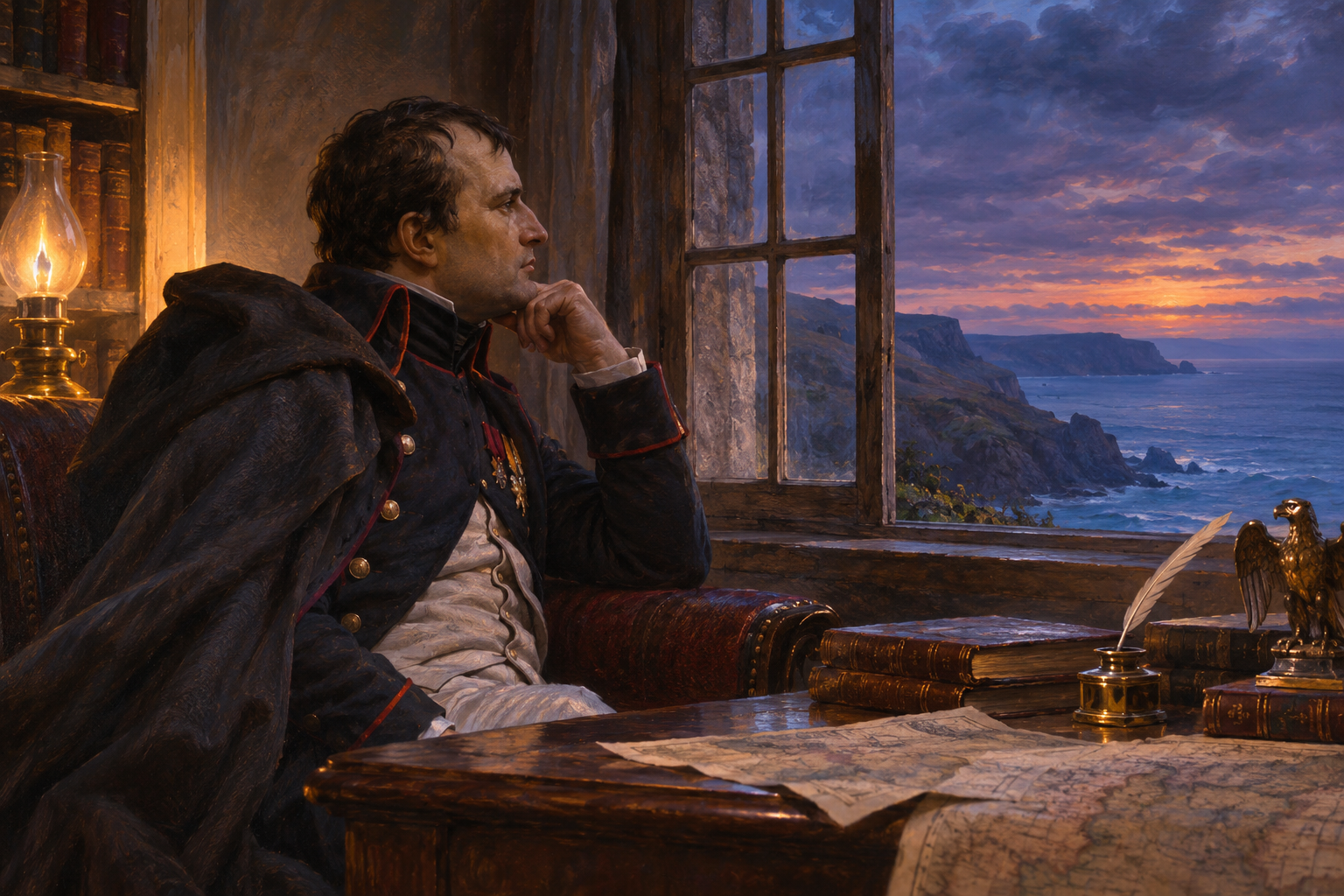
I imagine arriving as the sun begins to set, the wind moving across the island, and Napoleon sitting near a fireplace in a modest drawing room. He is no longer surrounded by the enormous military and political machinery that once responded to his commands. Instead, he has time to remember, defend, reconsider, and perhaps question some of the decisions that defined his life.
I wanted to meet Napoleon at this particular moment because I believe adversity often reveals things about leadership that success can conceal. When everything is going well, it is easy to believe our judgment is sound, our strategy is working, and our decisions are justified. When circumstances change, we are forced to confront questions that we may have avoided during our ascent.
Throughout the imagined conversation, Napoleon is not always cooperative or particularly interested in accepting my conclusions. He challenges my assumptions, defends his decisions, and occasionally acknowledges that he might have approached something differently. At other times, we simply disagree.
That tension is intentional. I did not want to create a fictional Napoleon who conveniently agrees with every modern leadership principle. Nor did I want to portray him as either an unquestionable hero or an irredeemable villain. My goal was to explore a complicated individual within the context of his time while still examining the consequences of his choices.
This is a fictional interview, not a historical transcript. The dialogue is imagined, although the conversation draws upon documented historical events, campaigns, decisions, and relationships. I have included historical background and sources in the complete work to help distinguish the factual record from my creative interpretation.
The Importance of Preparation and Recognizing Opportunity
One of the first subjects we explore is Napoleon’s extraordinary rise to power.
Born in Corsica in 1769, Napoleon did not begin life with the advantages enjoyed by the most powerful families in France. Although his family belonged to the lesser nobility, he was an outsider in many respects. His accent, background, and limited connections distinguished him from many of his contemporaries.
The French Revolution fundamentally changed the environment in which he operated. Established institutions were disrupted, traditional privileges were challenged, and opportunities emerged for individuals who possessed the ability and determination to take advantage of them.
Napoleon was ready.
He had studied military history, artillery, geography, logistics, and the practical requirements of commanding soldiers. His ability to make decisions quickly was not simply a product of natural genius. It was supported by considerable preparation and an extraordinary capacity for work.
This is an important distinction for business leaders. We often admire someone who makes a bold decision at precisely the right moment, but we do not always appreciate the years of preparation that made that decision possible.
I have encountered many talented executives who recognize opportunities but are not adequately prepared to pursue them. They may lack the necessary financial resources, organizational capacity, leadership depth, or understanding of the marketplace. Others spend so much time preparing that they never act.
Effective leadership requires both preparation and the willingness to move when an opportunity presents itself.
Napoleon’s early success illustrates the value of developing competence before circumstances demand it. It also reminds us that opportunities rarely arrive under perfect conditions. The leader’s responsibility is to understand the situation, assess the available resources, and make a thoughtful decision despite the inevitable uncertainty.
The lesson is not simply to be bold. It is to do the work that allows boldness to be supported by sound judgment.
Decisiveness, Judgment, and the Danger of Overconfidence
Napoleon’s ability to make decisions under pressure was one of his defining characteristics. He could absorb large amounts of information, recognize patterns, identify opportunities, and act with a speed that frequently surprised his opponents.
His victories at Rivoli, Austerlitz, Jena, Friedland, and Wagram demonstrate different aspects of this capability. He understood the importance of timing, concentrating resources, recognizing weaknesses, and ensuring that individual actions supported a larger strategic objective.
However, the same confidence that enabled these achievements sometimes made it difficult for him to reconsider his assumptions.
This is where the conversation becomes particularly relevant to modern leadership.
Most successful CEOs develop confidence in their judgment through experience. They have made difficult decisions, overcome obstacles, and produced results. Over time, they naturally begin to trust their instincts.
That confidence is often deserved. However, past success does not guarantee that the next decision will be correct.
The danger emerges when leaders begin confusing confidence with certainty. They may dismiss information that contradicts their preferred strategy, underestimate competitors, or assume that circumstances will eventually conform to their expectations.
Napoleon’s invasion of Russia in 1812 provides a powerful example. He assembled an enormous army and expected military pressure to produce a political settlement. Instead, the Russian forces continued retreating, supply difficulties intensified, and the distances involved became increasingly destructive.
Even after reaching Moscow, Napoleon did not obtain the political result he expected. His decision to remain there while hoping for a settlement contributed to the catastrophe that followed.
What interests me most is not simply that the campaign failed. Even capable leaders make mistakes. The more important question is why an experienced commander continued pursuing an objective after the assumptions supporting his strategy had become increasingly questionable.
Business leaders face similar challenges, although the consequences are obviously different. A company may continue investing in an unsuccessful product, expanding into an unattractive market, maintaining an underperforming acquisition, or defending a strategy that no longer fits the competitive environment.
The original decision may have been reasonable. The problem arises when the leader becomes unwilling to reconsider it.
Good judgment requires more than the courage to make a decision. It also requires the humility to revisit that decision when circumstances change.
Building a Strong Team and Knowing Whom to Trust
Another important part of the conversation examines Napoleon’s relationships with the commanders who helped make his achievements possible.
His marshals were not interchangeable. Davout, Ney, Lannes, Murat, and others possessed different strengths, personalities, and capabilities. Napoleon understood that leadership involved recognizing these differences and placing people in positions where they could contribute most effectively.
Davout, for example, demonstrated extraordinary discipline and independent command ability. His victory at Auerstedt in 1806 illustrates the importance of having capable subordinates who can act effectively even when the senior leader’s understanding of the situation is incomplete.
Napoleon also understood the importance of communicating the broader purpose behind an assignment. A commander needed to understand what an operation was intended to accomplish, not simply follow instructions without considering changing circumstances.
That distinction is essential in business.
I regularly encounter leaders who believe they are delegating when they are actually assigning tasks while retaining nearly all meaningful decision-making authority. Their employees may understand what they have been told to do, but they do not necessarily understand the desired outcome, the boundaries of their authority, or how to respond when conditions change.
Effective delegation requires more than transferring work. It involves selecting capable people, clarifying expectations, providing the necessary resources, and allowing individuals to exercise judgment.
Napoleon was not always successful in this regard. He sometimes allowed loyalty, family relationships, or personal preferences to influence appointments. His decision to place his brother Joseph on the Spanish throne illustrates the risks of assigning responsibility based partly on considerations other than demonstrated suitability.
This raises an important question for every executive: Are we placing people in positions because they have demonstrated the necessary capabilities, or because they are familiar, loyal, available, or personally important to us?
There is nothing wrong with valuing loyalty. Trust matters enormously in leadership. However, loyalty cannot substitute for competence, particularly when the responsibilities involved exceed someone’s demonstrated abilities.
Strong organizations require both.
Creating an Environment Where People Tell You the Truth
One of the most interesting exchanges in the interview concerns Napoleon’s expectations of his subordinates and the difficulty of communicating bad news to a powerful leader.
Napoleon demanded accurate information. He studied reports, questioned officers, and expected people to understand the conditions affecting their assignments.
At the same time, he could be demanding, impatient, and severe. Those characteristics sometimes made it difficult for people to challenge his assumptions or communicate unwelcome information.
This creates a familiar leadership dilemma.
A CEO may genuinely believe that employees are encouraged to speak openly. However, the real measure is not what the CEO says about openness. It is what happens when someone delivers disappointing news, questions an important decision, or disagrees with the leader in front of others.
If the response is anger, embarrassment, dismissal, or defensiveness, people learn to protect themselves. Over time, information becomes filtered as it moves upward through the organization.
Eventually, the leader may receive a version of reality that is more comfortable than accurate.
I believe one of the greatest risks associated with senior leadership is becoming increasingly insulated from the truth. As authority increases, fewer people may feel comfortable challenging the individual who possesses it.
That is one reason I place so much value on trusted advisors, strong leadership teams, and peer groups where individuals can speak candidly without worrying about organizational politics.
Leaders need people who will tell them what they need to hear, not simply what they want to hear.
Napoleon’s experience reminds us that gathering information is only part of the responsibility. We must also examine whether our behavior encourages people to share that information honestly.
The Difference Between Winning and Achieving Your Objective
Napoleon was an extraordinary battlefield commander, but one of the most important distinctions explored in the interview is the difference between winning individual battles and achieving the larger strategic objective.
His Egyptian campaign illustrates this problem. French forces won significant engagements, but the destruction of the French fleet by the British at the Battle of the Nile undermined the expedition’s ability to sustain itself. The failure to capture Acre created additional difficulties.
Military victories could not compensate for the loss of essential logistical support or guarantee the political and strategic results Napoleon wanted.
The Russian campaign raised a related issue. Reaching Moscow was a significant military accomplishment, but occupying the city did not compel Tsar Alexander to negotiate.
In both cases, there was a meaningful difference between accomplishing an immediate objective and producing the desired long-term outcome.
Business leaders should pay close attention to this distinction.
Organizations can become very good at measuring activity without adequately evaluating whether that activity is producing the results that matter.
A sales organization may celebrate revenue growth while margins deteriorate. A company may open new locations without improving overall profitability. A leadership team may complete numerous strategic initiatives without making meaningful progress toward its most important goals.
Activity is not the same as progress. Winning an individual contest does not necessarily mean the larger strategy is working.
One of the most useful questions a leader can ask is: What are we ultimately trying to accomplish, and how will we know whether our actions are moving us closer to that outcome?
Napoleon’s campaigns offer repeated reminders that tactical excellence cannot overcome a fundamentally flawed strategic objective.
Knowing When Enough Is Enough
Perhaps the most important theme running throughout the interview is Napoleon’s difficulty recognizing when to stop.
His ambition was extraordinary. He continually pursued new opportunities, expanded his influence, and sought to strengthen his position through additional victories.
To be fair, Napoleon operated in a European political environment where other powers repeatedly challenged his authority. Not every conflict was simply the result of his personal ambition, and it would be historically misleading to suggest otherwise.
Nevertheless, his decisions sometimes expanded the very problems he was trying to solve.
Spain became a prolonged and costly struggle. Russia produced catastrophic losses. Even his remarkable return from Elba in 1815 ultimately led to another military campaign, defeat at Waterloo, and permanent exile.
The question is not whether Napoleon should have abandoned ambition. His willingness to pursue difficult objectives was central to his accomplishments.
The more useful question is whether he could distinguish between necessary persistence and an unwillingness to accept limits.
I see versions of this challenge frequently in the business world.
Entrepreneurs are often successful precisely because they refuse to accept conventional limitations. They persist when others quit. They take risks that more cautious individuals avoid. They believe they can accomplish things that initially appear unlikely.
Those are valuable characteristics, especially during the early stages of building a business.
However, there comes a point when the same behavior can create problems. The founder who once succeeded by controlling every important decision may eventually become the organization’s primary bottleneck. The CEO who built a company through aggressive expansion may struggle to shift toward operational discipline and sustainable profitability.
The leader who has always found a way to win may find it difficult to acknowledge that a particular opportunity is no longer worth pursuing.
One of the most difficult leadership transitions is recognizing that the behavior responsible for our past success may not be the behavior required for our future success.
Knowing when to stop is not necessarily a sign of weakness. Sometimes it is evidence of maturity, discipline, and sound judgment.
The Difference Between Authority and Acceptance
Napoleon’s experience in Spain provides another important lesson.
He believed that replacing an ineffective monarchy with a more capable administration could improve the country’s political situation while serving French interests. However, he underestimated the importance of national identity, religious beliefs, local loyalties, and the population’s unwillingness to accept a ruler imposed through foreign intervention.
French military power could occupy territory, but it could not automatically produce legitimacy or genuine acceptance.
This distinction is highly relevant to organizational leadership.
A CEO can announce a new strategy, reorganize departments, replace managers, implement technology, or establish new performance expectations. The authority to make those decisions may be unquestionable.
However, having the authority to impose change does not mean employees understand it, support it, or are prepared to make it successful.
People bring their own experiences, loyalties, concerns, and expectations into the workplace. Ignoring those realities can create resistance even when the proposed changes have legitimate business advantages.
I have seen organizations invest substantial resources in initiatives that struggled because leadership focused almost exclusively on the technical aspects of implementation while underestimating the human dimension.
Effective change management requires more than explaining what will happen. Leaders must help people understand why the change is necessary, how it affects them, and what role they will play in making it successful.
They also need to listen.
Napoleon’s experience reminds us that compliance and commitment are not the same thing. You may possess the authority to require a particular action, but lasting success generally depends on something more than authority alone.
Leadership, Accountability, and the Consequences of Our Decisions
An honest examination of Napoleon’s life must go beyond his military setbacks and organizational shortcomings.
His record also includes decisions with profound moral consequences.
The interview addresses the execution of prisoners at Jaffa, the restoration or continuation of slavery in French colonies under his government, restrictions on the press, and the use of state power against political opponents.
These subjects matter because leadership cannot be evaluated solely by whether a decision produced the desired outcome.
Napoleon often defended his actions by referring to military necessity, political stability, national interests, or the difficult circumstances in which he operated. Understanding those circumstances is important. However, understanding why someone made a decision does not automatically justify its consequences.
This is an essential distinction for anyone exercising authority.
Business leaders frequently face pressure to deliver results. Investors expect returns, customers expect performance, employees depend on financial stability, and competitors are constantly looking for advantages.
Those pressures are real, but they do not eliminate our responsibility to consider the ethical implications of our choices.
A company can achieve impressive financial results while treating employees poorly, misleading customers, compromising its values, or imposing unreasonable burdens on the people who make its success possible.
Results matter, but so does how those results are achieved.
I believe leadership carries an obligation to consider the interests of people who may have little ability to influence the decisions affecting them.
The greater our authority, the greater our responsibility to exercise it thoughtfully.
Building Institutions That Outlast the Leader
One of the most revealing parts of the imagined conversation comes when I ask Napoleon to identify his greatest accomplishment.
Rather than selecting one of his famous military victories, he points to the Civil Code and the administrative institutions developed during his rule.
This is significant.
Napoleon’s empire eventually collapsed, but many of the legal and administrative reforms associated with his government had a lasting influence. His achievements were not limited to the battlefield. He also helped establish systems that continued functioning after he was no longer in power.
Those institutions were not without serious limitations, including unequal treatment under the law. Nevertheless, their durability offers an important contrast with the political structure that depended so heavily on Napoleon’s personal authority and continued military success.
I believe this may be one of the most important lessons for entrepreneurs and business owners.
Too many organizations remain excessively dependent on the individual who founded or currently leads them.
The owner maintains the most important customer relationships, approves nearly every significant expenditure, makes the difficult personnel decisions, and possesses knowledge that has never been adequately documented or transferred.
From the outside, the business may appear successful. Revenue may be growing, customers may be satisfied, and employees may be busy.
However, beneath that success may be an organization that cannot function effectively without one individual.
That is not a sustainable leadership model.
A truly successful leader builds systems, develops people, establishes clear expectations, and creates an organizational culture that can endure beyond their personal involvement.
This includes succession planning, delegation, documented processes, financial discipline, leadership development, and a shared understanding of the organization’s purpose and values.
I often encourage business owners to consider a simple question: If you disappeared from the business for ninety days, what would happen?
Would the organization continue operating effectively, or would important decisions remain unresolved because everyone was waiting for you?
The answer reveals a great deal about the difference between building a successful personal career and building a successful organization.
Napoleon’s experience illustrates that distinction on a much larger scale.
The Personal Price of Ambition
As the conversation progresses, we move away from military campaigns and political decisions to explore Napoleon’s personal relationships.
This is one of the more reflective sections of the interview.
We discuss his marriage to Josephine, their eventual divorce, his marriage to Marie-Louise, and his separation from his son following the collapse of the empire.
These relationships introduce a different perspective on ambition.
Napoleon could command armies, negotiate with monarchs, and influence the political direction of Europe. Yet his power could not protect him from personal loss or guarantee that the people he loved would remain close to him.
His separation from his son is especially poignant. The child who represented the future of his dynasty grew up in Austria, beyond Napoleon’s reach. Father and son never saw one another again after their separation in 1814.
In the imagined conversation, this becomes an opportunity to explore the difference between professional achievement and personal fulfillment.
I believe this is a subject that deserves more attention in leadership discussions.
Many successful executives spend years convincing themselves that their sacrifices are temporary. They tell their families that things will slow down after the next acquisition, the next major project, the next financial milestone, or the next stage of growth.
Sometimes that happens. Often, however, the next challenge simply replaces the previous one.
Ambitious people are particularly good at finding new goals.
There is nothing inherently wrong with working hard, pursuing excellence, or making sacrifices for something important. The problem arises when we assume that the people closest to us will always be willing to wait.
Time is one resource we cannot replenish.
A successful career is meaningful, but it is only one dimension of a successful life. Our relationships, health, friendships, interests, and contributions outside work also deserve our attention.
The conversation with Napoleon is a reminder that leadership should not become an excuse for neglecting everything else that matters.
The Importance of Reflection Before Circumstances Force It Upon Us
Napoleon’s exile on Saint Helena provides the setting for another important discussion: the value of reflection.
During his years in power, he was constantly occupied with military campaigns, political challenges, administrative responsibilities, and the demands of governing.
At Saint Helena, his circumstances were dramatically different. He had time to revisit decisions, defend his record, reconsider mistakes, and reflect on the events that had shaped his life.
Of course, reflection does not guarantee objectivity. Napoleon remained deeply interested in how history would remember him, and his recollections were influenced by that concern.
That, too, is an important leadership lesson.
We are all capable of interpreting past events in ways that protect our self-image. We remember the obstacles we overcame, the risks we accepted, and the decisions that worked. We may be less inclined to acknowledge the warnings we ignored, the people we failed to listen to, or the opportunities we missed because we were too committed to our original approach.
Meaningful reflection requires a willingness to challenge our own version of events.
One of the reasons I value executive coaching and peer advisory groups is that they create opportunities for leaders to examine their assumptions before circumstances force them to do so.
We need time away from the daily demands of running a business to consider the bigger picture.
Are we pursuing the right objectives? Are we measuring the right things? Are we developing the next generation of leaders? Are we listening carefully enough? Have our priorities changed? Are we still leading in ways that reflect our values?
These questions are difficult to answer when every day is consumed by immediate responsibilities.
Napoleon’s experience reminds us that reflection is most valuable when we still have the opportunity to act on what we learn.
What Does It Really Mean to Leave a Legacy?
As the imagined evening draws to a close, I ask Napoleon what he most wants people to remember about him.
His answer focuses not simply on his victories, but on the institutions he helped create, the opportunities he provided to talented individuals, and the administrative reforms that survived his fall.
He also remains determined that his achievements be judged within the historical circumstances in which they occurred.
I find that tension interesting.
Most leaders want to be remembered for what they accomplished. We want our efforts to matter. We want to believe that the sacrifices we made produced something worthwhile.
However, we do not get to determine our legacy entirely on our own.
Other people experience our leadership differently. Employees remember how they were treated. Colleagues remember whether we listened. Customers remember whether we honored our commitments. Family members remember whether we were present.
The results we produce are part of our legacy, but so are the methods we use and the relationships we build along the way.
For business owners, this raises questions that extend beyond financial success or the eventual sale of the company.
Did we create opportunities for others? Did we develop people who became better leaders because of their association with us? Did we establish an organization with values worth preserving? Did we treat people fairly when doing so was inconvenient? Did we make a positive contribution to our communities?
And perhaps most importantly, did we build a life that we would consider successful even if the professional accomplishments eventually faded from memory?
These are not easy questions. However, I believe they are worth asking while we still have time to influence the answers.
Questions for Today’s CEOs and Business Owners
As you read the complete interview, I encourage you to consider the following questions in the context of your own leadership journey.
1. Preparation and opportunity: Are you developing the capabilities, relationships, and organizational resources needed to take advantage of future opportunities, or are you relying too heavily on what has worked in the past?
2. Decision-making: When was the last time you changed your mind about an important business decision because new information challenged your original assumptions?
3. Delegation: Have you surrounded yourself with people who can make meaningful decisions independently, or does too much responsibility continue to flow through you?
4. Candor and accountability: Do your employees feel comfortable telling you the truth, particularly when that truth contradicts your expectations?
5. Strategic discipline: Are you measuring genuine progress toward your most important objectives, or are you sometimes confusing activity, growth, and short-term victories with long-term success?
6. Knowing when to stop: Is there a project, investment, business relationship, or strategic initiative that you continue supporting primarily because you have already committed so much to it?
7. Change leadership: When you introduce change, do you invest enough time understanding how the people affected will experience it?
8. Ethics and responsibility: Are you considering the broader consequences of your decisions, particularly for people who may have limited influence over them?
9. Organizational sustainability: Could your company continue performing effectively without your daily involvement? If not, what needs to change?
10. Personal priorities: Are the people who matter most to you receiving the time and attention they deserve, or are you assuming there will always be another opportunity later?
11. Reflection: Have you created regular opportunities to examine your own leadership effectiveness with people who are willing to challenge your thinking?
12. Legacy: If you stepped away from your business tomorrow, what would people remember most about your leadership?
I would encourage you not to rush through these questions. Choose two or three that resonate most strongly and spend some time thinking about them. Better yet, discuss them with your leadership team, a trusted advisor, or a group of peers who will give you candid feedback.
The purpose of reflection is not simply to feel better informed. It is to identify something we can do differently.
Turning Historical Lessons into Practical Action
History becomes especially valuable when we use it to improve our present decisions.
For those interested in translating the themes of this conversation into practical leadership improvements, I would suggest several starting points.
First, examine one important strategic assumption underlying your current business plan. Ask what evidence supports it, what circumstances might invalidate it, and how you would recognize the need to change direction.
Second, evaluate your leadership team’s ability to operate independently. Identify the decisions that still require your involvement and determine whether those responsibilities could be delegated with clearer expectations, better training, or improved systems.
Third, create an opportunity for candid feedback. Ask a few trusted people what they believe you may be overlooking. Resist the temptation to explain or defend your behavior immediately. Listen carefully and look for patterns.
Fourth, consider whether you are investing your time in the areas that matter most. Review your calendar, your personal priorities, and the commitments you have made to people outside work. Determine whether your actual behavior reflects what you say is important.
Finally, consider the legacy you are building. Think beyond the next quarter, the next financial milestone, or the eventual exit from your business. What are you creating that will continue providing value after you are no longer directly involved?
None of these exercises requires extraordinary resources. They do require honesty, discipline, and a willingness to challenge comfortable assumptions.
Why I Continue to Study Historical Leaders
One of the reasons I enjoy creating these fictional interviews is that they allow me to explore leadership from a different perspective.
Most business leadership books and articles focus on contemporary organizations, successful executives, management frameworks, and current research. Those resources are valuable, and I regularly draw upon them in my work.
However, history offers something different.
It allows us to examine individuals who operated under circumstances far removed from our own, yet confronted familiar human challenges involving ambition, judgment, fear, loyalty, pride, responsibility, and uncertainty.
Historical leaders also provide the advantage of perspective. We can examine the long-term consequences of their decisions in ways that are not always possible when studying contemporary executives whose stories are still unfolding.
Of course, we must be careful not to oversimplify the past or impose modern business concepts on historical circumstances without recognizing the differences.
Napoleon was not a CEO, and the consequences of his decisions often involved war, political repression, and enormous human suffering. Those realities should never be minimized simply to create a convenient management lesson.
Nevertheless, studying his leadership can help us think more carefully about the responsibilities associated with power and influence.
I believe the most useful historical lessons emerge when we resist the temptation to classify individuals as entirely admirable or entirely flawed.
Human beings are more complicated than that.
Napoleon’s accomplishments deserve serious examination. So do his failures and the suffering caused by some of his decisions. We learn more by considering both than by allowing either to dominate the entire story.
Final Thoughts: The Weight of Leadership
When I imagine leaving Napoleon at Longwood House, I picture a man who once possessed extraordinary power but now has very little control over his circumstances.
His military victories are behind him. His empire is gone. His family is beyond his reach. He is left with his memories, his arguments, his accomplishments, and the consequences of his decisions.
There is something deeply instructive about that image.
Leadership provides opportunities to accomplish meaningful things, influence other people’s lives, and create institutions that can endure. It also carries responsibilities that become greater as our authority expands.
The challenge is not simply to become more ambitious, more confident, or more decisive. It is to develop the judgment necessary to understand when those qualities are serving us well and when they may be leading us in the wrong direction.
We need the courage to act, but also the humility to reconsider. We need the ambition to pursue meaningful goals, but also the discipline to recognize limits. We need the ability to inspire others, but also the willingness to listen when they challenge us.
And we need to remember that professional achievement, however impressive, is only part of the story.
Napoleon’s life reminds us that the true measure of leadership is not simply how much power we accumulate or how many victories we achieve. It is also what we build, whom we serve, how we exercise our authority, and what remains when our time in charge comes to an end.
That is the weight of leadership. And that is why I believe Napoleon’s story remains worth studying more than two centuries later.
I invite you to read my complete fictional interview, The Weight of Glory: A Twilight Conversation with Napoleon Bonaparte. The extended conversation explores his remarkable rise, major military campaigns, leadership philosophy, personal relationships, moral contradictions, and reflections during exile. It also includes historical background and source references for readers interested in exploring the subject further.
I hope it encourages you to examine your own leadership journey, question some of your assumptions, and consider what kind of legacy you ultimately want to leave.