
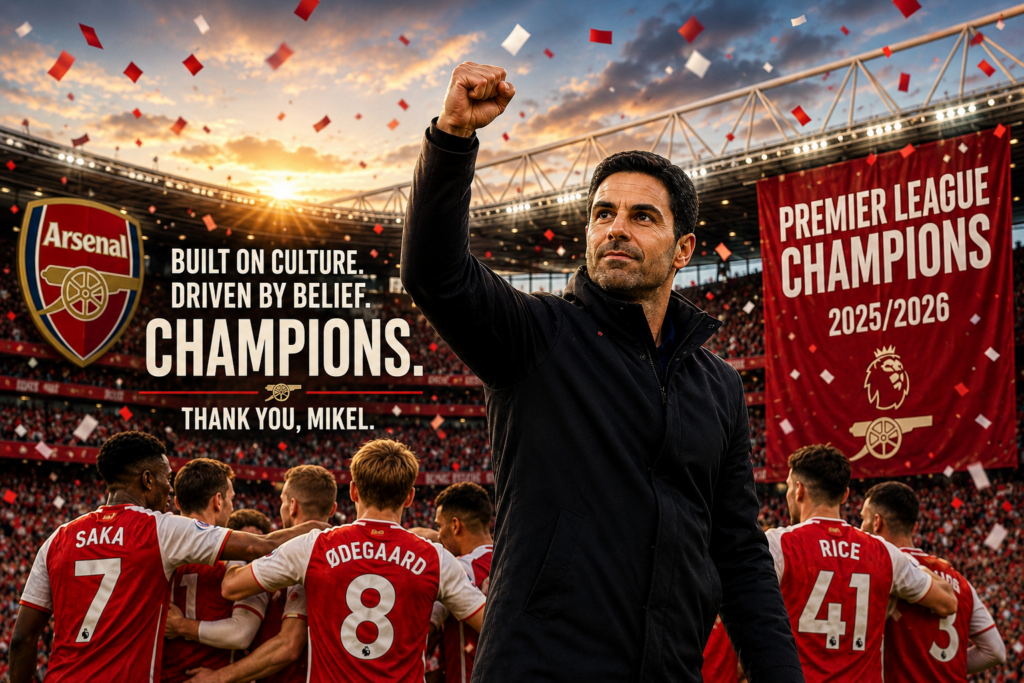
Thank You, Mikel: A Leadership Lesson Acknowledged by a Lifelong Arsenal Fan
I have been an Arsenal fan since 1971.
I was a boy living in England at the time, and I will never forget my first game. Arsenal beat Leeds United 2-1. Like most kids, my loyalty was probably formed by something pretty simple: they won, and I liked their jersey better.
That was enough.
More than fifty years later, it still is.
Being an Arsenal fan has been one of the great joys of my life. There have been wonderful highs, painful lows, frustrating stretches, near misses, and seasons where hope was tested more than rewarded. The recent Premier League title chase has not always been easy to weather. Coming close and falling short is hard, especially when you care deeply.
But everything changed this past week.
Arsenal are Premier League champions again.
And while this is certainly a moment to celebrate the players, the staff, the ownership, and the supporters, I believe it is also important to pause and acknowledge great leadership when we see it.
Not just because leadership is what I think about and work on for a living. But because when someone does something truly exemplary, it deserves to be recognized.
Mikel Arteta deserves to be recognized.
A Young Leader Walking Into a Turnaround
When Mikel Arteta took the Arsenal job in the winter of 2019, he was only 37 years old.
Think about that for a moment.
This was his first managerial position, and he was being asked to lead one of the biggest football clubs in England, if not the world. He was also taking over a club still living in the shadow of Arsène Wenger, his former manager and mentor, and one of the most important figures in Arsenal’s history. His predecessor, Unai Emery, a great coach in his own right, didn’t last very long.
This was not an easy job.
Arsenal was a club in transition. There were flashes of brilliance, but not enough consistency. The defensive structure was fragile. The team could look talented in stretches, but it lacked the ability to sustain momentum across a full match, let alone an entire season. The bench strength was not what it needed to be. The standards had slipped. The connection between the team, the fans, and the club’s best identity needed to be rebuilt.
For all intents and purposes, Mikel walked into a turnaround situation.
And he did so with very little managerial experience, enormous expectations, and a fan base that wanted progress immediately.
Many people underestimate how difficult that is.
It is one thing to inherit a winning machine and keep it going. It is another thing entirely to inherit a proud organization that has lost some of its edge, its confidence, and its internal alignment. That requires more than tactics. It requires conviction. It requires patience. It requires courage. It requires the willingness to make unpopular decisions before the results fully justify them.
That is leadership.
The Job He Always Wanted
Mikel was a terrific Arsenal player. He may not have been the most gifted player on every team he played for, but he was one of the most reliable. He got the most out of his abilities. He was smart, composed, and steady. He was a student of the game. He was also a quiet leader on the field.
You could count on him in big moments.
In many ways, his playing career foreshadowed the type of manager he would become. He understood structure. He valued discipline. He respected the small details. He knew that talent alone was never enough.
It feels fitting that he scored in his final match for Arsenal.
There was always a sense that Arsenal mattered deeply to him. The story has long been that, after retiring as a player, this was the job he truly wanted. He tried to get it once and did not. A couple of years later, the club came back to him.
The rest has been history in the making.
Rebuilding More Than a Team
What I admire most about Mikel is that he did not simply try to build a better team.
He worked to rebuild a culture.
Over the years, I have read a lot about his efforts to improve the atmosphere at the stadium and restore the connection between the fans and the players. That connection had been one of the great strengths of Arsenal at its best. When Arsenal felt right, it felt like more than a club. It felt like a family, a standard, and a way of doing things.
Arsène Wenger built a remarkable culture at Arsenal. Yes, it was a culture of professionalism and beautiful football, but it was also a culture where how you treated people mattered. Players who joined Arsenal were not just joining a team. They were joining something bigger.
Under Mikel, that feeling has returned.
Maybe even more so.
He had to make hard decisions along the way. Some veteran star players did not fit the system or the standards he wanted to establish. Managing those situations is never easy. Big names bring attention. They bring opinions. They bring pressure. But if a leader is serious about culture, then no one can be bigger than the team.
Mikel understood that.
He also had to manage through budgetary limitations early on. He did not immediately have every player he wanted. He had to work with what was there, improve what could be improved, and gradually attract the right kind of talent.
That is what good leaders do. They do not simply complain about what they lack. They start building with what they have.
A Five-Year Plan and a Long-Term Standard
Rumor has it that when Mikel took over, he presented a five-year plan to win the Premier League.
It did not happen exactly within five years, but the progress has been undeniable.
Arsenal finished runner-up three years in a row — twice to Manchester City and once to Liverpool. There is no shame in that. In fact, it speaks to just how far the club had come. When Mikel arrived, Arsenal was not in the Champions League. Now they are in the Champions League final.
That is not accidental.
He has attracted talent. He has improved existing talent. He has helped young players mature, veteran players buy in, and the entire club believe again.
Most importantly, he has created a standard.
Championship organizations do not just win because they have talent. They win because the talent is organized around a shared purpose. They win because people understand what is expected. They win because accountability becomes normal. They win because the best players are willing to sacrifice for the team.
That is what Arsenal has become.
Culture Shows Up When Things Get Hard
I judge teams, whether in sports or in business, by how they handle a few important things.
Can they work together as one unit rather than a collection of individuals?
Can they handle adversity, which inevitably comes for every team?
Do they keep working hard when given their opportunity?
Do they make the best use of their own talents while respecting the talents of their colleagues?
Do they cheer for others when they are not on the field?
Do they support the team publicly, or do they complain at the water cooler and in the press?
Mikel has cultivated all of these things and more.
You can tell the players generally like and respect him. That matters. Respect cannot be manufactured through a title. It has to be earned through consistency, competence, fairness, honesty, and belief.
He has taken a collection of players from all over the world and turned them into one cohesive unit. He has helped them push through self-doubt. He has helped them manage the anxiety of getting close to the finish line and not quite making it. He has rarely, if ever, criticized them publicly. Yet it is obvious that his standards behind the scenes are very high.
That combination is powerful.
Public loyalty. Private accountability.
That is one of the marks of mature leadership.
Credit to the Ownership, Too
It is also worth acknowledging the Kroenkes.
I know Arsenal supporters have had mixed feelings about ownership over the years, but I believe the Kroenkes have helped create the foundation that has allowed Mikel to do this work. Based on their broader experience owning professional teams, they seem to understand that winning does not happen through constant chaos. It requires structure, resources, patience, and the right people in the right roles.
As an Arsenal fan, I believe we are fortunate to have them at this stage of the club’s journey.
They backed the manager. They stayed the course. They allowed the culture to take root.
That matters.
Too many organizations say they want long-term success but behave impatiently at the first sign of difficulty. Arsenal did not do that. They gave a young leader the room to grow into the job.
And he has rewarded that belief.
A Fitting Moment for Arsène Wenger
One of the most fitting parts of this championship moment was that the public acknowledgment of Arsenal winning the Premier League was first done by Arsène Wenger.
That felt right.
Wenger is a class act. I will always admire him, not just for what he accomplished on the field, but for who he is as a person. He brought elegance, intelligence, and humanity to the game. He changed Arsenal forever.
To see him connected to this moment was special.
It felt like a bridge between eras. Wenger built so much of what Arsenal became. Mikel has now restored and renewed it in his own way.
That is how great institutions evolve.
They honor the past without being trapped by it.
Why This One Feels So Good
It has probably taken longer than any of us would have liked.
It would have been nice to win the championship sooner. But sometimes the timing of things makes the achievement even sweeter. Sometimes the struggle is what gives the victory its meaning.
This Arsenal team did not arrive here by accident. It was built.
Patiently.
Deliberately.
Culturally.
And as I leave for vacation in France, I do so with a big smile on my face.
Arsenal are once again Premier League champions.
Even more importantly, in my personal opinion, Arsenal now has one of the best cultures in professional sports.
As a lifelong fan, that makes me proud.
As someone who studies leadership, it makes me appreciative.
Thank you, Mikel.
Thank you to the team!
Thank you to your staff.
Thank you to the owners!
And thank you to this team for reminding us that great leadership, strong culture, and patient belief can still produce something beautiful.