
Leadership Fatigue Is Real — But So Is the Opportunity
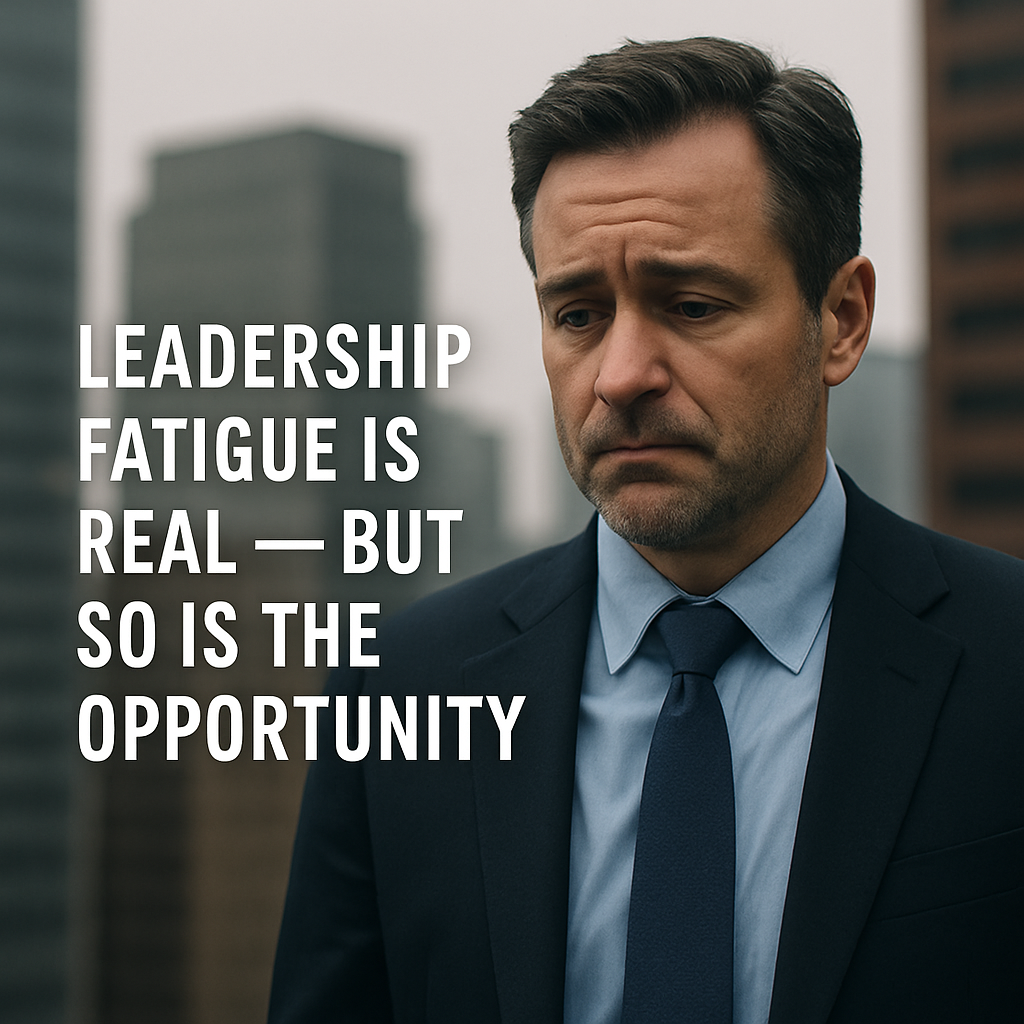
Lately, I’ve been having a lot of conversations with fellow business owners and leaders who are just flat-out tired. Burned out. Numb from the endless waves of uncertainty and pressure.
We don’t always say it out loud, but it’s there—leadership fatigue. And it’s real.
For many, it’s been a grueling 10-year climb. Just when you think you’ve found stable footing, something shifts. First, it was the lingering effects of the Great Recession. Then the war for talent. Then the spike in inflation, COVID, global supply chain disruption, political dysfunction, and now a tidal wave of technological disruption.
You adapt. You pivot. You survive. But it wears on you.
And somewhere deep down, many of us are still holding out hope that eventually—finally—it’ll all get easier.
But I’ve got to say it plainly:
“Easy isn’t coming.”
This Isn’t the First Hard Era for Leaders
Here’s some perspective: what we’re experiencing today—while exhausting—isn’t entirely new. Business leaders across history have had to lead through chaos, disruption, and seismic change.
- In 1918, business owners battled through a global pandemic (the Spanish Flu) while simultaneously navigating the end of World War I and its economic fallout.
- In the 1930s, they fought to keep their companies alive during the Great Depression, when unemployment was near 25% and the banking system collapsed.
- In the 1940s, they navigated the complexities of wartime production, rationing, and workforce shifts as millions were deployed overseas.
- In the 1970s, they dealt with energy crises, runaway inflation, and global economic stagnation.
- In 2008, they survived a financial collapse that took down some of the world’s biggest institutions.
Each of these periods had one thing in common: the leaders who survived weren’t the ones who had the easiest path. They were the ones who learned to adapt, endure, and rethink everything.
“A smooth sea never made a skilled sailor.” — Franklin D. Roosevelt (adapted from an older proverb)
The Rules Have Changed, But the Game Is the Same
Yes, today’s pace of change is rapid. Technology is rewriting the rules. AI is destabilizing traditional value structures. Employees no longer stay 20 years. New competitors pop up overnight. Global events ripple into your local market within hours.
But business has always been hard. Scaling a company has always demanded grit, courage, and relentless reinvention. What’s changed is the frequency and velocity of the challenges—not the existence of them.
“It is not the strongest who survive, nor the most intelligent, but those most responsive to change.” — Charles Darwin
Nobody gets a perfectly smooth journey. The difference today is that your ups and downs are compressed. But the question remains the same:
Is your slope still trending upward?
If yes—you’re growing. Maybe not as fast as you want. Maybe not in the way you imagined. But you’re moving forward.
Stop Waiting for a Better Reality
Some leaders wear themselves down by holding onto a fantasy that if only this one issue were resolved, business would finally get easier.
“If we just had a better hiring market…”
“If we didn’t have to deal with this legislation…”
“If our clients would just commit faster…”
But here’s the hard truth: there is no perfect market, no perfect customer, no perfect time. Waiting for a different reality makes the one you’re in feel heavier.
“You make leadership harder when you think a different version of reality would make it easier.” — Ed Robinson
Business is messy. Politics are messy. People are messy. Always have been. The leaders who thrive embrace this. They don’t waste energy hating the game—they learn how to play it well.
Lead Like Those You Admire
If you’re feeling worn down, remember this: you’re not alone, and you’re not the first to face turbulence. Many modern leaders have navigated equally brutal seasons—and came out stronger because they didn’t wait for “easy.” They got better. Smarter. Tougher. More adaptable.
Consider:
- Howard Schultz, former CEO of Starbucks, who returned to rescue the company during the 2008 financial crisis. He shut down hundreds of stores, retrained baristas, and doubled down on the customer experience—restoring both morale and profitability.
- Lisa Su, CEO of AMD, who took the company from the brink of collapse in 2014 to becoming one of the most admired semiconductor firms in the world. She bet big on product innovation, made bold leadership changes, and rebuilt trust with customers and investors—transforming AMD into a serious competitor to Intel and Nvidia.
- Alan Mulally, former CEO of Ford, who took the wheel in 2006 when the company was losing billions and the auto industry was on the verge of collapse. He didn’t declare bankruptcy. He didn’t point fingers. He unified the leadership team, simplified the strategy, and focused on execution. By the time the financial crisis hit, Ford was the only Big Three automaker that didn’t need a bailout.
- Satya Nadella, CEO of Microsoft, who took over a stagnating tech giant and reignited its growth by shifting its culture from internal politics to a “growth mindset” and embracing cloud computing before most competitors caught on.
- Sara Blakely, founder of Spanx, who built a billion-dollar brand from scratch in a saturated, male-dominated retail industry. Without outside investors or flashy marketing, she led with grit, humor, and a clear understanding of her customers—navigating through recessions, knockoffs, and industry doubt.
These leaders weren’t handed a calm sea. They sailed through storms—and chose to lead anyway.
“Hard times don’t create heroes. It is during the hard times when the ‘hero’ within us is revealed.” — Bob Riley
You may not be leading a Fortune 500 company, but you are still the leader of your enterprise. And your team, your customers, and your family are looking to you not for perfection—but for presence, resilience, and courage.
Build Resilience into Your System
Fatigue doesn’t just come from what’s happening around you—it comes from how you’re handling what’s happening around you.
So ask yourself:
- Are you trying to do it all alone?
- Are you stuck solving the same problems with the same thinking?
- Are you showing up to work exhausted and frustrated, day after day?
If so, it’s time to reboot—not just your schedule, but your mindset.
Here’s how:
- Take real vacations. Not just long weekends where you check your email. Give yourself space to decompress and gain perspective.
- Invest in your health. Physical and mental. Workout. Meditate. Journal. Talk to someone.
- Strengthen your inner circle. Coaches. Mentors. Friends. Spouses. These are not optional—they’re essential.
- Stop reacting emotionally. Make strategic decisions rooted in logic, data, and experience—not fear or frustration.
“Fatigue makes cowards of us all.” — Vince Lombardi
Reclaim the Why
If you’re feeling exhausted, pause and ask yourself:
Why did I start this business in the first place?
Reignite that sense of purpose. Reconnect with what matters. Because while the “what” and “how” of business are changing rapidly, your “why” is your anchor.
This isn’t about chasing comfort. It’s about embracing clarity.
And when you remember why you’re in the game, the energy comes back. The fatigue lifts. The vision returns.
Perspective: You’re Not Powerless
Let’s be honest: there are real victims in this world. People who live under regimes that silence them. Workers who are exploited. Families who have no options. They don’t have the power to shape their future.
You do.
If you’re a business owner in the U.S. right now, your challenges—while very real—are also surmountable. You’ve got tools, resources, networks, and choices. That’s not pressure. That’s privilege.
And if you see it that way, you’ll rise to meet it.
“The way to get started is to quit talking and begin doing.” — Walt Disney
Let’s Lean In—Together
Yes, this is hard.
Yes, it’s complex.
Yes, it’s tiring.
But it’s also exhilarating.
It’s creative.
It’s meaningful.
It’s yours.
So if you’re running low, take the time to refill your tank. Reset your mindset. Rebuild your habits.
Then get back in the game.
Because this is leadership. This is your season. This is your reality.
And you’re not alone.
Let’s all lean in—together.
