
Good To Great
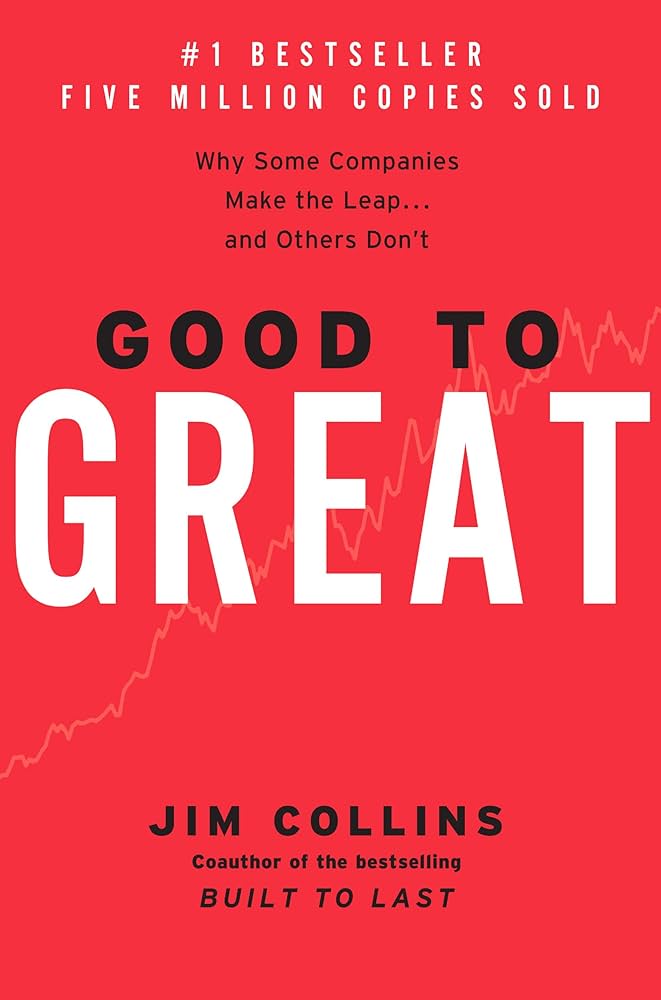
Good to Great by Jim Collins
Jim Collins’ Good to Great is one of the most useful business books ever written because it attacks a quiet problem most leaders tolerate: being good enough. Collins argues that greatness is not a personality gift, a lucky market position, or a breakthrough idea. It is built through disciplined people, disciplined thought, and disciplined action. That matters. Especially if you lead a business that has become comfortable.
The Core Idea
Good is the enemy of great.
That line is the whole book. Many companies never become great because good performance gives everyone permission to stop pushing. The business is profitable. Customers are satisfied. The team is busy. The leader looks successful.
But comfort can be dangerous.
Collins and his research team studied companies that made a sustained leap from average results to exceptional results. They compared them with similar companies that never made the leap. The findings became a set of practical leadership principles: Level 5 Leadership, First Who Then What, Confront the Brutal Facts, the Hedgehog Concept, a Culture of Discipline, Technology Accelerators, and the Flywheel.
Level 5 Leadership
Great companies are often led by people who combine deep humility with fierce professional will. They are not weak. They are not soft. They simply care more about the institution than their own ego.
That is rare.
A Level 5 leader gives credit to others when things go well and takes responsibility when they do not. They build successors. They make hard calls. They do not need to be the smartest person in the room.
Ask yourself this: are you building something that can thrive without you, or are you quietly making yourself indispensable?
First Who, Then What
Collins makes a powerful point: great leaders do not begin with strategy. They begin with people.
Get the right people on the bus. Get the wrong people off the bus. Then decide where to drive.
This sounds simple until you have to do it. Many leaders tolerate the wrong people because they are loyal, technically competent, or hard to replace. But one wrong person in a key seat can drain energy, weaken standards, and confuse the culture.
People come first. Strategy follows.
Confront the Brutal Facts
Great companies face reality without losing faith.
Collins calls this the Stockdale Paradox: you must maintain absolute faith that you can prevail while also confronting the most brutal facts of your current reality. His site identifies this as one of the major Good to Great concepts.
This is where leadership gets uncomfortable. You cannot improve what you refuse to name. Weak margins. Bad hires. Customer churn. Poor accountability. A stale product. A tired culture.
The truth will not hurt your business nearly as much as avoiding it will.
The Hedgehog Concept
The Hedgehog Concept asks leaders to find the intersection of three things: what you are deeply passionate about, what you can be best in the world at, and what drives your economic engine. Collins describes it as a “simple, crystalline concept” that comes from understanding those three circles.
This is not branding language. It is strategic discipline.
Many companies chase too many opportunities. They confuse motion with progress. The Hedgehog Concept forces focus. It asks: what should we stop doing because it distracts from what we can truly do best?
That question can change a business.
A Culture of Discipline
Great companies do not need layers of bureaucracy because disciplined people do disciplined things.
This is an important distinction. Discipline does not mean control for control’s sake. It means clarity, standards, ownership, and consistency. The right people do not need to be managed tightly. They need a clear direction and the freedom to execute.
Weak cultures create rules to compensate for poor judgment. Strong cultures build judgment.
Technology Accelerators
Collins does not dismiss technology. He puts it in its proper place.
Technology accelerates momentum. It does not create greatness by itself. Great companies use technology when it fits their Hedgehog Concept. They do not chase every new tool because everyone else is doing it.
That lesson feels even more relevant today.
The question is not, “What technology should we adopt?” The better question is, “What are we already committed to becoming great at, and which technology helps us get there faster?”
The Flywheel
The flywheel is one of Collins’ most helpful images. Greatness rarely comes from one dramatic breakthrough. It comes from repeated effort in the same direction until momentum builds.
Push. Push again. Keep pushing.
At first, progress feels slow. Then the flywheel begins to turn. Eventually, the organization gains force, and outsiders mistake years of disciplined work for sudden success.
That is how durable success usually works. Quiet effort compounds.
Why This Book Matters for Business Leaders
Good to Great challenges the leader’s ego. It says greatness does not come from charisma, slogans, acquisitions, technology, or heroic speeches. It comes from disciplined choices made consistently over time.
That is both encouraging and demanding.
You do not need to be flashy. You do need to be honest. You do not need every opportunity. You need the right few. You do not need more noise. You need more discipline.
Reflection Questions
- Where has “good enough” become acceptable in your business?
- Do you have the right people in the most important seats?
- What brutal fact are you currently avoiding?
- What can your company realistically become best at?
- What activities should you stop doing because they dilute focus?
- Are you using technology to accelerate strategy or to avoid making hard decisions?
- What flywheel are you pushing every day?
Media, Talks, and Related Content
Jim Collins’ official site offers videos and audio clips on many of the book’s key ideas, including Level 5 Leadership, First Who Then What, the Hedgehog Concept, and the Flywheel. These are useful refreshers for leadership teams that want to discuss the concepts together.
About Jim Collins
Jim Collins is a business researcher and author known for studying what makes organizations endure and outperform. His books include Built to Last, Good to Great, How the Mighty Fall, and Great by Choice. He began his research and teaching career at Stanford Graduate School of Business and later built an independent management laboratory focused on long-term organizational performance.
He has earned his place because he does not just offer opinions. He studies patterns. Then he turns them into tools leaders can use.