
The Power of Peers
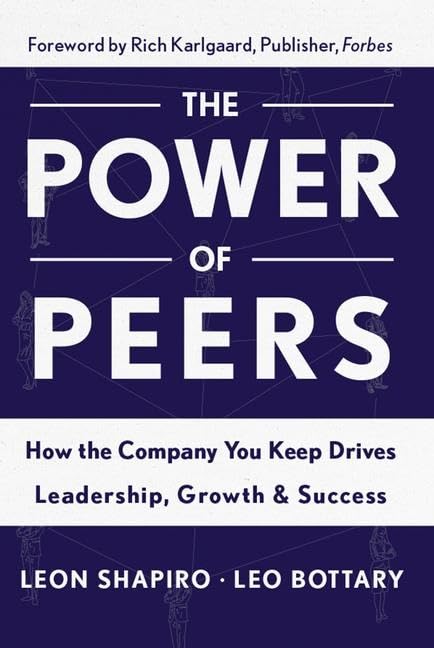
The Power of Peers
Why the right group changes everything
Most leaders think growth comes from better strategy, better hires, or better execution.
Those matter. But this book makes a different claim.
Who you surround yourself with will shape every decision you make.
And most leaders get this wrong.
The Core Idea: You Don’t Think Alone
We like to believe our decisions are independent. They’re not.
Your thinking is shaped—quietly, constantly—by the people around you. Their standards become yours. Their blind spots become yours too.
That’s the game.
The authors argue that a well-structured peer group becomes a force multiplier:
- It sharpens your judgment
- It challenges your assumptions
- It raises your standards
- It gives you a perspective you cannot generate alone
Not occasionally. Consistently.
I’ve seen this play out over decades.
The right room changes people. Fast.
What Makes a Peer Group Actually Work
Most groups fail. Not because the idea is bad, but because the structure is wrong.
The book is clear on this.
1. Psychological Safety Comes First
If people don’t feel safe, they won’t tell the truth. And if they don’t tell the truth, nothing improves.
Real peer groups create an environment where you can say:
- “I don’t know.”
- “I screwed that up.”
- “I’m stuck.”
That’s where the work begins.
No safety. No value.
2. Diversity of Perspective—Not Background
You don’t need people from your industry.
In fact, that can hurt you.
What you need are people who:
- Think differently
- See patterns you don’t
- Challenge your default assumptions
Sameness feels comfortable. It also keeps you stuck.
3. Structured Candor
Good peer groups don’t rely on casual conversation.
They use discipline:
- Clear agendas
- Defined time for each member
- Rules for feedback
And one critical principle: Advice is earned, not given casually.
The best groups ask better questions before offering answers.
4. Accountability That Actually Sticks
Most leaders don’t lack ideas.
They lack follow-through.
Peer groups solve this by creating visible accountability:
- You say what you’re going to do
- You report back next time
Simple. Powerful.
People perform differently when others are watching.
5. A Skilled Facilitator Matters
This is where many groups break down.
Without strong facilitation:
- Loud voices dominate
- Safe conversations replace hard ones
- Meetings drift
A good facilitator does three things:
- Keeps the conversation honest
- Balances participation
- Pushes when needed
They protect the integrity of the room.
The Hidden Value: Better Decisions Under Pressure
This is where the book gets practical.
Leadership is judgment under uncertainty.
You don’t get clean data. You don’t get perfect timing. You don’t get easy calls.
A strong peer group gives you:
- Pattern recognition from others’ experience
- A place to test your thinking
- A check on your blind spots
You still make the decision. But you make it sharper. Faster. With fewer mistakes.
What This Means for You
Let me make it simple.
If you’re leading without a peer group, you are:
- Carrying too much alone
- Missing perspective, you can’t see
- More exposed than you realize
That’s not a knock. It’s reality.
The question is direct:
Who is challenging your thinking at a high level, consistently?
If the answer is “no one,” that’s a problem.
A Few Lines That Stick
“We are influenced more than we realize by those around us.”
“The right peers don’t just support you—they push you.”
“Better thinking leads to better decisions.”
That’s the chain.
Reflection Questions
- Who are the five people shaping your thinking right now?
- Where are you not being challenged enough?
- Do you have a space where you can be fully candid—no filters?
- When was the last time someone pushed back on your thinking in a meaningful way?
- Are you surrounding yourself with comfort or growth?
- What decisions would improve if you had sharper input?
- If you built your ideal peer group, who would be in the room?
Author Background
Leon Shapiro and Leo Bottary come out of deep work in peer advisory and leadership development. Bottary, in particular, spent years studying and building peer-group environments through organizations such as Vistage.
They’re not theorists.
They’ve watched, up close, how leaders behave in the room—and what separates groups that work from those that don’t.
That experience shows in the writing.
Final Thought
Most leaders think leverage comes from capital, talent, or strategy.
It doesn’t. It comes from better thinking.
And better thinking rarely happens alone.
Build the right room.
Stay in it long enough.
Let it change you.
It will.
