
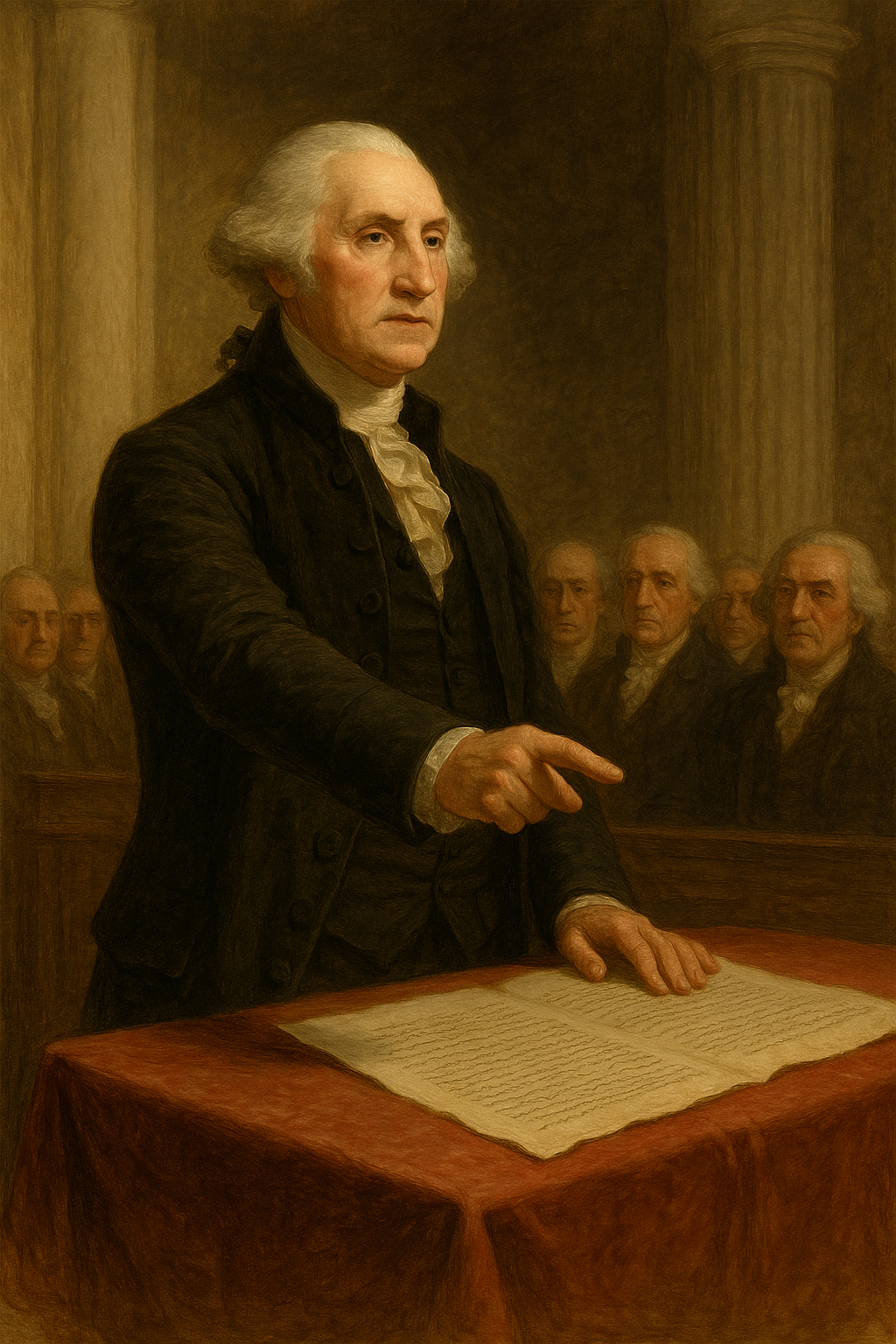
“Example, whether it be good or bad, has a powerful influence.” — George Washington
The Meeting
The fire crackled gently as wind whispered against the windows. The room, though quiet, felt alive with something deeper than sound—history, perhaps. Or wisdom waiting patiently to be heard. It was warm and still, the kind of atmosphere where important conversations begin with reverence.
Across from me sat George Washington.
His presence filled the room, not with grandeur, but with gravitas—the kind that comes from bearing a nation’s birth in your bones. Dressed plainly, as always, his eyes held both the weight of battles fought and the quiet humility of a man who never asked for the power he wielded.
Me: General Washington… I want to begin by saying how deeply honored I am. Your leadership shaped not only the foundation of a country but also how we understand character, restraint, and duty. I come not just to ask questions but to listen and learn—from your experiences, your values, and your example.
He inclined his head gently, his eyes softening.
Washington: You honor me with such kindness. But remember—what you call legacy was once just a series of uncertain days, filled with difficult choices and little rest. I led because the moment required someone to stand and stay steady—not to be remembered, but to be responsible.
Defining Leadership and Power
Me: Before we go further, I’d like to ask you plainly—how would you define leadership? What is it, at its core?
Washington: (Without hesitation.) Leadership is service under pressure. It is the quiet, consistent act of placing the mission above your comfort, the people above your pride, and the long-term good above short-term gain. It is not about having followers—it is about earning their belief through sacrifice.
He leant forward slightly, voice even.
Washington: Leadership begins with self-command. If you cannot govern your own emotions, your appetites, your ego, you are unfit to govern others. That is why I studied men like Cato and Marcus Aurelius, why I read sermons and moral reflections: to form the internal strength that outward influence depends upon.
Me: And what of power? You held more of it than most men in history. How did you think about its use?
Washington: Power is a tool. Like fire, it can warm or destroy, depending on how it is used. The danger is not in power itself but in the belief that it exists for your benefit.
Washington: I always believed power should be constrained by principle. That’s why I stepped down after two terms. Not because I couldn’t lead—but because I believed no one man should ever be seen as indispensable. True power is revealed in your willingness to let go of it.
Why He Volunteered for the Cause
Me: You stepped forward early in the cause of independence—before the outcome was certain, before the nation even truly existed. What compelled you to do so? What made you believe you were the right man to lead the troops?
Washington’s eyes grew solemn—not proud, but resolved, as if recalling the weight of a burden he never sought but willingly shouldered.
Washington: It was not ambition that led me—it was necessity. I did not crave command. In fact, I expressed my reluctance to Congress when they appointed me. But I believed deeply in the cause of liberty. I saw clearly that if we did not resist early, we would be ruled completely. And I knew that if no one stepped forward with conviction, others would hesitate.
He folded his hands slowly, as though still weighing the moment.
Washington: As for why me—I asked myself that many nights. I was not the most experienced general. Others had greater education, more political sway. But I knew war. I had fought in the wilderness, seen how fragile life and victory can be. I knew the terrain, the people, the stakes. And above all, I could be trusted. That matters more than most think. In times of upheaval, people don’t just need strategy—they need steadiness.
Me: So your decision wasn’t based on confidence alone—it was responsibility.
Washington: Precisely. I believed someone had to carry the burden who would not seek to keep it for himself. That is why I stepped forward—and why I eventually stepped away. I did not want the crown. I wanted the country to stand.
The Power of Example
Me: You’ve often said that example matters more than command. Why is that so foundational to leadership?
Washington: Because men—and I suspect your teams today are not so different—will test the truth of your words by the life you live. I could issue orders all day, but the army took its cue from how I showed up: whether I rose early, whether I worked harder, whether I bore the hardship alongside them.
He paused, eyes reflecting the firelight.
Washington: That sense was shaped in me early. I was not born to greatness. My father died when I was eleven. I had no formal university education. But I devoured what I could—books on agriculture, surveying, war, and philosophy. I studied Addison’s Cato, whose depiction of Roman honor and sacrifice moved me deeply. I absorbed the lessons of the Stoics: temperance, fortitude, and virtue. I tried to live those principles—not just quote them.
Me: It’s powerful to hear that. Today, many leaders chase the next big idea or management guru. But you’re pointing us back to something older—something rooted in character.
Washington: Because leadership is not innovation—it is integrity, practiced day after day. The old virtues endure. If you master your impulses, speak with care, and act with consistency, people will follow. Not because they must, but because they want to.
Staying Grounded in Humility
Me: You carried titles and authority no one had before. Commander-in-Chief. Mr. President. And yet your humility never seemed to waver. How did you keep from being consumed by your own legend?
Washington: (Smiling faintly.) Because I never believed the legend. I knew my flaws. I lost battles. I misjudged people. I wasn’t the most eloquent speaker, nor the most bookish. But I surrounded myself with capable men—Hamilton, Knox, Lafayette. I deferred when they knew more. And I kept close to the land. Farming reminded me that nature does not care for titles. A man must plant, tend, and wait. Humility grows best in soil tilled by hard work and silence.
Me: Did any particular writings or people help you shape that humility?
Washington: I kept a book of Rules of Civility, copied by hand when I was a teenager. Most were mundane—don’t scratch yourself in public—but some stayed with me: “Labor to keep alive in your breast that little spark of celestial fire called conscience.” I often returned to that phrase. I also read sermons—preachers like Samuel Davies—and was deeply influenced by classical histories. Men like Cincinnatus of Rome, who laid down power to return to his plough, inspired my own departure after the war.
Restraint as Strength
Me: You’re known for your composure. It’s something many modern leaders admire, but struggle to maintain. How did you develop such strong self-restraint?
Washington: Through hardship—and through error. I was not born calm. I had a temper. I once leapt into a fistfight over a horse trade. But during the French and Indian War, I learned the cost of unguarded emotion. Men died because I misread the moment. That marked me.
Washington: Later, in the Revolution, when Congress second-guessed my every move and supplies ran thin, I learned that anger—though justified—rarely moved the mission forward. I found it more effective to let others exhaust their noise while I preserved my energy for action. It was not easy. But Marcus Aurelius said, “You have power over your mind—not outside events.” I repeated that often.
Me: In my world, restraint sometimes looks like passivity. How do you show calm strength without appearing disengaged?
Washington: By anchoring your silence in presence. Be in the room. Listen actively. Ask questions you don’t already know the answers to. Let others feel your attention, even when you’re withholding judgment. Restraint is not absence—it is poised readiness. It says, “I’m here. I’m watching. And I will act when it truly matters.”
Emotional Intelligence and Self-Awareness
Me: May I ask something more personal? You carried immense pressure—both visible and invisible. How did you manage your internal emotions without letting them distort your leadership?
Washington: That is a worthy question. Many assume I was calm by nature. The truth is, I trained myself to be so. When I felt anxious, I rode my horse. When I felt wounded by a colleague’s betrayal, I wrote in private. I did not pretend the feelings didn’t exist—I simply did not permit them to govern me.
Washington: I once said, “Be not hasty to believe flying reports to the disparagement of any.” That principle kept me from reacting to every rumor, every insult. Emotions are signals—not commands. A leader must learn to feel fully but respond wisely.
Delegation and Trust
Me: One challenge many leaders often face is delegation. They want things done a certain way—and sometimes it’s just easier to do it themselves. But we know that limits growth. How did you build trust in others while still protecting the mission?
Washington: You speak the truth of many leaders—especially those who lead with care. But remember, doing everything yourself may create efficiency in the short term but dependency in the long term.
Washington: When I appointed Hamilton to lead financial strategy or Knox to manage artillery, I didn’t choose men who would mimic me—I chose men who could think independently and act decisively. I gave clear expectations, then stood back. Micromanagement signals fear. Trust, extended wisely, creates growth.
Me: But what if they fail?
Washington: Then guide them. But let them fail small and early, while the stakes are low. That is the seedbed of wisdom.
On Selecting Talent and Facing Betrayal
Me: May I ask about something that’s difficult for many leaders today—how to select the right people, and what to do when someone you’ve trusted turns against you. You placed great confidence in Benedict Arnold once, and he betrayed that trust. How do you lead forward after something like that?
Washington’s jaw tightened slightly, the only visible sign of old pain. He folded his hands slowly, as if giving the moment its due weight.
Washington: Arnold was brilliant in battle. He was bold, daring, and capable—many even saw him as heroic. I recognized his potential early. But I also saw signs: impatience, vanity, and a hunger for recognition above principle. I believed, perhaps foolishly, that purpose would temper those flaws. I was wrong.
He looked me directly in the eyes.
Washington: The lesson? Talent alone is never enough. Do not confuse performance with character. The most dangerous individual in your circle is not the loudest critic—it is the talented person who places ego above mission. Benedict Arnold taught me that.
Me: Did you question your judgment after that? I know many leaders lose confidence in themselves after betrayal.
Washington: I questioned everything. I blamed myself. I asked whether I had missed signs, whether my loyalty had blinded me. And perhaps it did. But betrayal does not mean your leadership is broken. It means your discernment must sharpen. It means you must grieve, learn, and lead again—with greater clarity.
He paused, then added:
Washington: You must also resist bitterness. If betrayal hardens your heart, you lose twice—once to the traitor and again to your own cynicism. I wept in private when I learned of Arnold’s treason. But I did not let that pain poison the mission. The cause was bigger than my wound.
Me: So, how do you rebuild trust in others after someone so close lets you down?
Washington: By remembering that trust is a process, not a guarantee. You test it, watch it, stretch it—and when it proves durable, you expand it. But you must never stop seeking it. No leader succeeds alone. And no betrayal, however painful, justifies isolation.
On Endurance Through Setbacks
Me: Let’s talk about the struggles of leadership, General. The war you led—eight long years, under-supplied, underfunded, often doubted—it would have broken many. What allowed you to endure it all? To keep leading, even when everything seemed to go wrong?
Washington leant back slightly, his expression shifting into something quieter—more inward. He was no longer just recalling history; he was remembering it.
Washington: Endurance is not the absence of weariness—it is the mastery of it. There were days I wanted to quit. Days I felt abandoned by Congress, outmaneuvered by the enemy, and betrayed by my own officers. But I had made a vow—to the men, to the cause, and to God—that I would not abandon the fight unless the fight abandoned me.
He paused.
Washington: At Valley Forge, I watched barefoot men leave blood on the snow. I saw hunger, fever, death—and yet I also saw courage I can scarcely describe. My strength came from them. If they could suffer for liberty, how could I not lead through mine?
Me: But it wasn’t just physical struggle, was it? The doubts, the failures… they must have worn you down emotionally.
Washington: They did. I questioned myself more often than you might imagine. But I reminded myself: just because something is hard does not mean it is wrong. Many leaders give up too soon, not because the cause isn’t worthy, but because they confuse discomfort with failure. I made peace with difficulty. I accepted that progress might come inch by inch, not in grand moments.
Me: Did anything in particular help you sustain that long-term resolve?
Washington: Faith. Reflection. The wisdom of history. I read accounts of Hannibal crossing the Alps, and of Frederick the Great overcoming impossible odds. And I turned often to Providence—to believe that if I remained faithful to the cause and to conscience, we might prevail. Not because we were entitled to victory—but because we refused to yield.
Me: So what would you say to a modern leader who feels worn down—who’s facing setback after setback and wonders if the fight is worth it?
Washington: *I would say this: If your cause is just and your conscience is clear, then press on. Not every day will feel like progress. Some will feel like defeat. But if you persist with principle, time will often redeem the struggle.
Handling Criticism and Public Scrutiny
Me: You were criticised—harshly and often. Some questioned your military strategy, others your motives. How did you handle public scrutiny without letting it harden or discourage you?
Washington: I will not deny that some words wounded deeply. But I reminded myself: the criticism was often more about fear than fact. People lash out when anxious. Leaders must absorb more than they deflect.
Washington: I received a letter once from a congressman accusing me of being power-hungry. It burned in my hand. But I waited. I did not respond in anger. Time revealed that the man’s own ambition had clouded his judgment. My restraint revealed his character.
Me: So you let time be the judge?
Washington: Indeed. When in doubt, let your conduct defend you. That is the quietest and most enduring rebuttal.
On Ambition and Knowing When to Walk Away
Me: Twice you walked away from power—after the war and again after the presidency. What helped you resist the temptation to hold on longer?
Washington: Philosophy. Faith. And a clear memory of tyranny. I’d seen what kings could become. I had no desire to become what we had just defeated.
Washington: I read histories—Plutarch, Livy. I studied how republics rise and fall. And I knew that one man clinging to power could ruin the balance. So I chose to leave—not because I was weary, though I was—but because others needed to learn to lead.
Washington: A leader must never see himself as irreplaceable. Legacy is not what you hold onto. It’s what you let go of, for the sake of what must endure.
On Slavery and the Contradiction of Freedom
Me: (Carefully, with deep respect.) General, may I ask you something difficult—something that weighs heavily today? You spoke so passionately about liberty, restraint, and the dignity of every voice. And yet… You owned slaves. How do you reconcile that with the principles of freedom and democracy?
Washington’s expression shifted. His shoulders lowered slightly, and he held my gaze—not defensively, but deliberately.
Washington: You do right to ask. And I do not shy away from it. This is one of the great contradictions of my life. I believed in liberty. I fought for it. I spoke of it often. And yet I participated in a system that denied it to others. That tension haunted me—particularly in my later years.
He looked into the fire, then back at me.
Washington: Understand—at the time, slavery was woven into the economy, the law, and even the culture of honor. But that does not excuse it. I began to question it more deeply as the war ended. I stopped selling enslaved people. I prohibited the separation of families. And in my will, I freed those under my direct ownership and provided for their education and care.
Me: Do you believe you should have done more?
Washington: Yes. I do. I believe I waited too long. My fear of division—of tearing the fledgling nation apart—often muted my convictions. I hoped gradual change would come, but I failed to press hard enough. And I fear that silence gave others permission to delay what conscience should have demanded.
He paused, then added quietly:
Washington: A leader must do more than balance politics. He must wrestle with truth. My greatest regret is that I did not do so sooner or more publicly. If I had, perhaps more would have followed. Perhaps healing would have begun earlier.
Me: Thank you for your honesty. I know it’s not easy to face something like that head-on.
Washington: No. But real leadership faces the uncomfortable, or it forfeits its moral authority. May your generation do better than mine. May you honor liberty not in name only—but in practice, for all.
On the Constitution and the Spirit of Democracy
Me: Before we end, I feel compelled to ask about something foundational—your thoughts on the Constitution and the spirit of democracy. You helped shape its very framework. How do we protect that spirit today, especially when leadership can so easily become about control, image, or personal agenda?
Washington: (His expression turning thoughtful, almost reverent.) The Constitution is not perfect—but it is principled. It is not rigid—but resilient. It was not meant to bend to the will of one man, but to elevate the collective wisdom of a free people. My role was never to shape it in my image but to serve under its boundaries and model submission to the rule of law—even when it was inconvenient.
He placed a hand gently on the arm of the chair, as if steadying both himself and his words.
Washington: You asked how to protect the spirit of democracy—begin by remembering that liberty is not passed down in speeches. It is passed down in restraint. In refusing to take shortcuts, even when expedience is tempting. In respecting the dignity of every voice, even when disagreement feels uncomfortable.
Washington: I relinquished power not to showcase humility, but to make a statement: No one is above the system we agreed to build. That principle, if honored, will carry your democracy forward. But once it is compromised in the name of efficiency or fear, it will begin to unravel—not in a roar, but in a whisper.
Me: So our duty is to model faith in the system—not just wield influence within it.
Washington: Yes. Lead with deference to what is larger than yourself. That is the true mark of a democratic leader.
The Final Exchange
Me: If you could give just one piece of advice to modern leaders—those who don’t lead armies or countries, but companies, teams, and families—what would it be?
Washington: Lead as if your every word and action will be studied by those who come after you—because they will. Maybe not in books. But in culture. In tone. In trust. You are not building an organization. You are shaping how people treat one another under pressure.
Me: That’s sobering—and inspiring.
Washington: Good. Let it be both. Let the weight of leadership make you thoughtful—not timid. And never forget: your daily example is the most lasting message you’ll ever deliver.
The Farewell
The fire had burned low, glowing softly in the hearth. The wind outside had settled into silence, as if the night itself were paying respect.
Washington stood. No ceremony. No flourish. Just the quiet grace of a man who had done his part and was content to walk away.
Washington: You have asked well. And more importantly, you have listened well. That gives me hope—for your leadership and for the generations that follow. Remember, you do not need to be perfect. But you must be principled.
He extended his hand, strong and steady.
Washington: Now go. Lead with conviction. Govern with conscience. And when the moment comes to pass the torch—do so gladly, knowing you have shaped something worthy.
I rose to my feet, moved beyond words.
Me: Thank you, General. For your time, your wisdom—and most of all, your example. I will carry it forward with humility and resolve.
He nodded once—graciously, quietly—and then turned towards the door. The echoes of his boots were soft but somehow final. And just like that, the conversation was over.
But the lessons remained—etched not only in history, but now, in heart.