
Growth, Profit, and the Balancing Act: What the Rule of 23 and Rule of 40 Mean for Your Business
Every business needs to have a growth plan and have something tangible to base it on.
Small business owners are constantly walking a tightrope. Every decision feels like a trade-off: Should I invest in hiring or hold the cash? Should I pour into sales and marketing, or focus on tightening my operations? Should I grow aggressively, or make sure I’m still turning a healthy profit?
That’s why I believe in using simple tools that help clarify complex decisions. Two of the best I’ve found are the Rule of 40 (popular in the software world) and the Rule of 23 (a practical benchmark for traditional service businesses).
But before we talk formulas, let’s ground this in reality:
What’s a Healthy Growth Rate for a Small Business?
One of the most common questions I hear from business owners is, “How fast should we be growing?” The answer depends on your industry, business model, and maturity—but here are general benchmarks that apply across sectors:
| Growth Rate | What It Means |
| 5–7% | Minimum required to offset inflation and rising operational costs. A sign of a stable business—but not gaining ground. |
| 10–15% | Solid, above-average growth. You’re likely outpacing many competitors and reinvesting wisely. |
| 15–25% | Fast growth. You’re taking market share or expanding quickly—often with growing pains to manage. |
| 35%+ | Hyper-growth. This is impressive but can be risky without solid systems, capital, and team infrastructure. |
For startups, especially in tech or high-scale ventures, 50%+ annual growth may be necessary in the early years. But even the fastest-growing companies eventually need to balance growth with discipline.
Know Your Industry Growth Rate—And Compare Yourself to It
Here’s something every serious business owner needs to understand:
You should know your industry growth rate. Period.
Not a guess. Not a gut feel. Actual benchmark data. Because without it, you have no way to measure whether you’re truly outperforming—or just keeping pace with the market.
Let’s break it down:
- Growing at the same pace as your industry means you’re holding steady. That’s not bad—but it’s not remarkable either. You’re moving with the tide.
- Growing faster than your industry means you’re gaining traction. You’ve built a competitive advantage. Maybe it’s your pricing, service quality, team, or branding. Whatever it is—protect it.
- Growing slower than your industry means you’re riding coattails. That’s dangerous. If the market slows down, you’re likely to fall behind even faster.
But here’s what gets overlooked:
It’s not just about growth. Sometimes your market is shrinking.
When the economy contracts or demand softens, the question becomes:
Are you performing better than the rest of your industry during a downturn?
Because that is where true leadership shows up. It’s easy to grow when everything’s up. But can you hold your margins, your customer base, and your strategy when the pressure hits? That’s what makes a resilient business.
Where to Find Industry Growth Data
You’ve got more tools than you think:
- Your Commercial Banker – Start here. Banks assess risk by sector, and most have access to benchmarking tools you don’t. Ask for reports—they often have growth and profitability norms at their fingertips.
- Risk Management Association (RMA) – A goldmine of financial ratios and industry-specific data, widely used in lending and valuation.
- Vertical IQ – Easy-to-digest insights on hundreds of industries: revenue trends, customer challenges, financial metrics, and forecasts.
- IBISWorld, Statista, CSIMarket – Useful for macroeconomic trends and niche verticals.
- NAICS-based industry tools and trade associations – Excellent for specialized benchmarking.
- Peer groups and networks – Conversations with other owners often reveal changes before the data does.
The bottom line: Don’t just look inward. Know the environment you’re operating in—and whether you’re leading it, trailing it, or holding steady.
Introducing Two Simple Scorecards: Rule of 40 and Rule of 23
Once you understand your industry context, you need a way to assess your own balance of growth and profitability. That’s where these two formulas come in. They’re simple, powerful tools that help you quickly gauge whether you’re building a sustainable business—or just chasing growth or margin in isolation.
The Rule of 40: Lessons from the SaaS Playbook
In the software-as-a-service (SaaS) world, growth is often prioritized over short-term profits. Companies invest aggressively in sales, marketing, and development to acquire users and build market share. But eventually, both investors and operators want to know: Is this growth sustainable?
That’s where the Rule of 40 comes in:
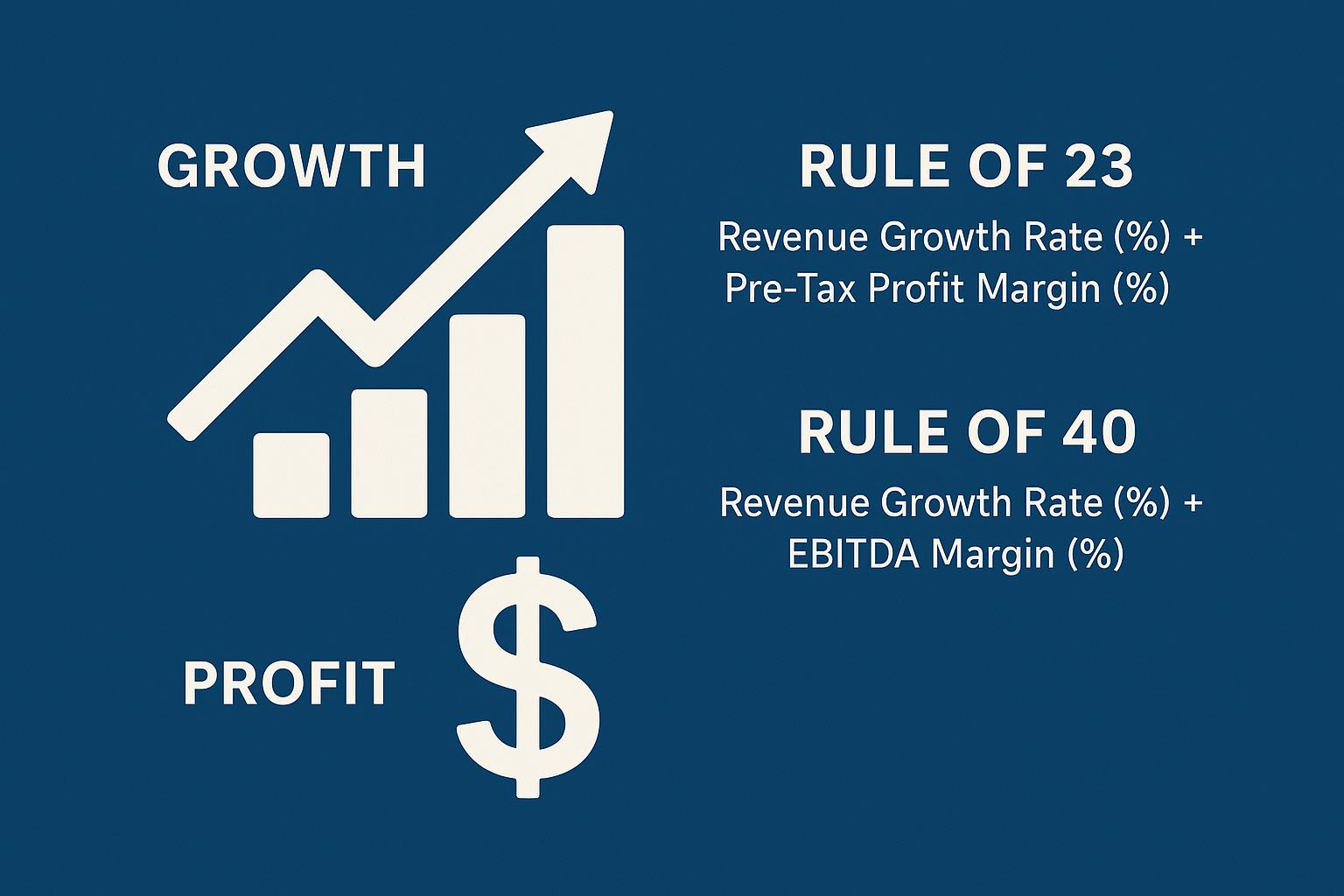
Rule of 40 = Revenue Growth Rate (%) + EBITDA Margin (%)
If the total equals or exceeds 40%, the company is generally seen as financially healthy and operationally balanced.
Why This Matters
The beauty of the Rule of 40 is that it recognizes the trade-off between profitability and growth. You don’t need to be perfect in both areas—you just need to manage the relationship between them wisely.
Example Scenarios:
- A company growing 25% YoY with an 18% EBITDA margin would have a Rule of 40 score of 43%. That’s healthy.
- Another company growing 60%, but with a -20% EBITDA margin, would also score 40%. Even though it’s not profitable, the growth rate justifies the investment—for now.
- A more mature company with 10% growth and a 30% margin also gets to 40%—a strong, efficient operation.
This benchmark is especially popular among private equity and venture capital investors because it’s fast, clear, and highlights whether a business is scaling wisely. And if you’re a business owner in the tech space, it’s one of the easiest ways to see how you stack up in the eyes of capital providers.
How Investors Use the Rule of 40
- Screening and Benchmarking – Helps quickly identify attractive investment candidates with scalable models.
- Valuation – Companies with higher Rule of 40 scores often command better valuation multiples.
- Strategy and Trade-offs – Guides capital allocation: Do we double down on growth? Or tune for margin?
- Portfolio Management – A simple score investors can track over time across their holdings.
Even if you’re not a SaaS company, this way of thinking—“Am I earning enough to justify my pace of growth?”—is worth internalizing.
The Rule of 23: The Real-World Scorecard for Service Businesses
Now let’s bring it back to Earth—where most small and mid-sized business owners live and breathe. In service-based businesses, growth doesn’t come from subscriptions or digital scale. It comes from labor, tools, logistics, and physical work.
That’s why the Rule of 23 exists. It’s a more grounded framework, designed for the realities of local and labor-intensive businesses.
Rule of 23 = Revenue Growth Rate (%) + Pre-Tax Profit Margin (%)
If your combined score is 23% or higher, you’re likely on solid ground.
Why 23%?
Because service companies:
- Aren’t as scalable as tech businesses. More revenue usually means more staff and equipment.
- Carry more capital costs, including vehicles, tools, insurance, and office space.
- Often operate with tighter margins due to competitive pricing, commoditized offerings, and labor intensity.
- Have less predictable revenue, especially in project-based models.
The Rule of 23 reflects these challenges while still pushing for a healthy balance.
Example Scenarios:
- A company growing 13% YoY with a 10% pre-tax margin scores 23%. That’s healthy.
- Another company growing 8% with a 7% margin scores 15%. That’s a sign to investigate pricing, customer acquisition, and cost structure.
How Private Equity Uses the Rule of 23 in Service Industries
While less formalized than the Rule of 40, investors still use Rule-of-thumb benchmarks like the Rule of 23 to:
- Filter Opportunities – Quickly identify companies worth deeper diligence.
- Assess Efficiency – A strong score means you’re running lean and converting sales into profit effectively.
- Monitor Post-Acquisition Performance – Helps guide improvement priorities: grow the top line, optimize the bottom line, or both.
- Compare Across Portfolios – Useful for benchmarking similar companies by segment or region.
Whether you’re looking to raise capital or not, this is a tool you can use to drive smarter decision-making internally.
The Real Value in Both Rules
Both formulas simplify the complexity of business performance. They tell you in plain terms whether your business is balanced—or leaning too far in one direction. And they help you answer these questions:
- Am I growing fast enough to justify my reinvestment strategy?
- Am I profitable enough to survive if growth stalls?
- Am I ignoring one side of the equation at the cost of long-term sustainability?
In a world full of noise and complexity, these two scorecards give you clarity and control.
Conclusion: Growth Alone Isn’t Enough—Balance Is Everything
Let’s be honest—growth gets all the attention. It’s what people talk about in headlines, pitch decks, and conference stages. But here’s the truth: growth without context can be dangerously misleading.
You might be growing—but is it enough to outpace rising costs? Are you growing faster than your peers? Are you growing profitably? Are you growing in a shrinking market?
And then there’s the flip side: you might be highly profitable—but if your growth has stalled, you’re setting yourself up to be overtaken.
That’s why we need simple, smart frameworks like the Rule of 23 and the Rule of 40. These aren’t abstract theories—they’re practical scorecards for everyday leadership:
- The Rule of 23 gives service-based businesses a way to evaluate if they’re growing fast enough and profitably enough, given their capital and labor constraints.
- The Rule of 40 gives SaaS and scalable-model companies a clear bar for balancing high-growth ambition with financial discipline.
But these scores are only part of the story.
You also need to know how you stack up against your industry.
Growth is relative. If your industry is growing at 20% and you’re growing at 12%, you’re falling behind—even if your top-line looks good on paper. On the other hand, if your industry is shrinking and you’re flat, you might actually be winning.
Here’s the leadership mindset shift:
- Know your internal numbers—your revenue growth, your margins, your score.
- Know your external environment—your industry’s growth rate, trends, risks, and benchmarks.
- Lead with both lenses in view.
Growth by itself isn’t the goal. Sustainable, balanced growth that outperforms your market and strengthens your business foundation—that’s the win.
“You’re not in business just to stay busy. You’re in business to build something that lasts.”
So the next time you’re reviewing the numbers:
- Don’t just ask, “Did we grow?”
- Ask, “Did we grow smarter? Did we grow better than our market? And are we building momentum we can actually sustain?”
That’s where strategy starts. That’s where leadership lives.
