
Theme: Managing Different Generations in the Workplace
Introduction
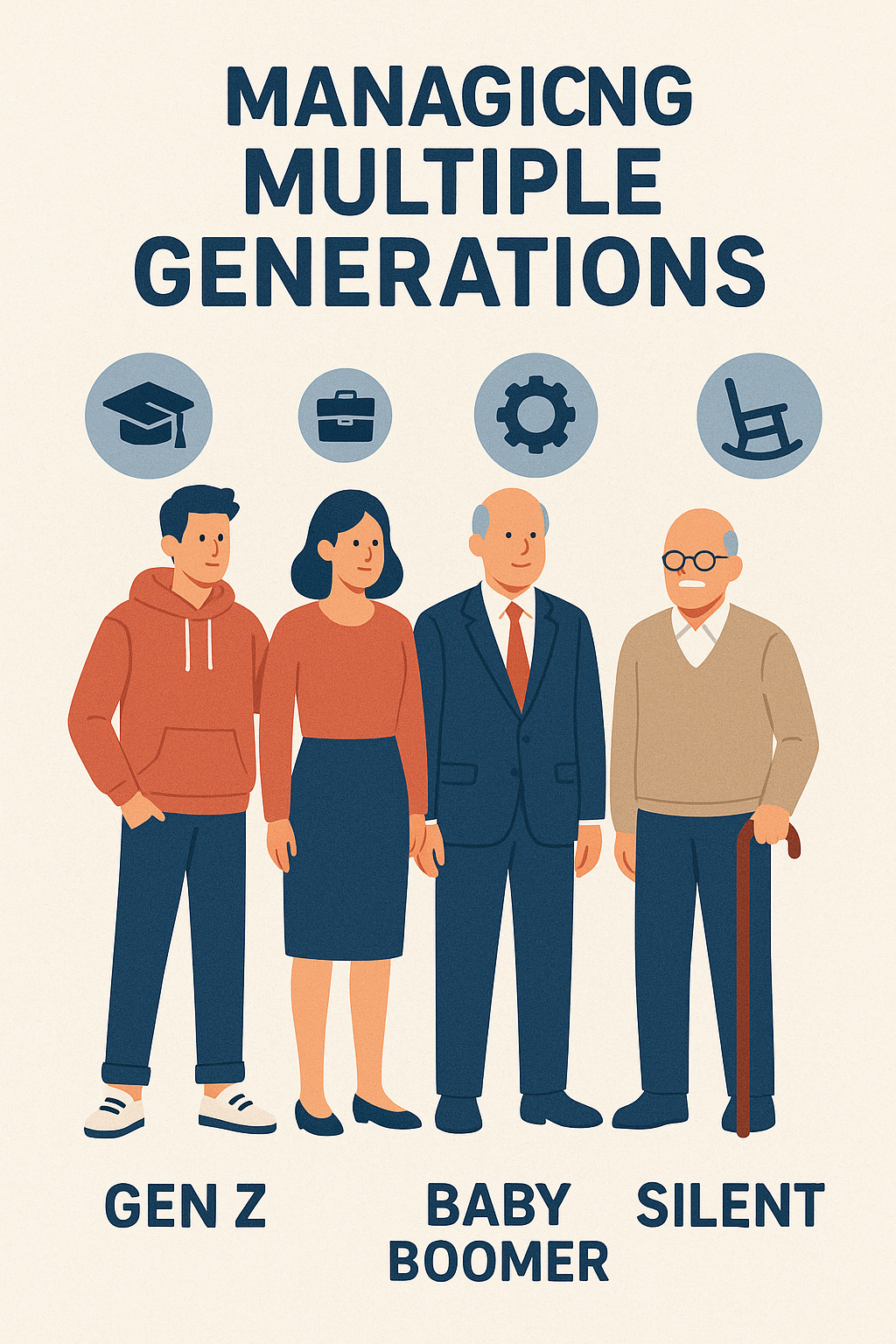
For the first time in history, businesses are managing five different generations within the same workforce. Each generation has unique experiences, values, and expectations that shape their approach to work. While these differences can lead to misunderstandings, they also offer a wealth of diverse perspectives that, when properly managed, can result in increased innovation, engagement, and performance.
This document explores how businesses can effectively lead, motivate, and retain employees across multiple generations. Key themes include leadership strategies, communication preferences, work ethic, technology adoption, and accountability structures. By understanding generational differences and implementing best practices, business leaders can foster a cohesive and productive work environment.
Key Themes
1. Understanding the Generations
Each generation brings unique strengths, challenges, and expectations. Successful leadership requires recognizing these differences and leveraging them for greater organizational effectiveness.
Traditionalists (Born before 1946)
- Value loyalty, discipline, and respect for hierarchy.
- See work as a duty and prefer structured, long-term employment.
- Appreciate face-to-face communication and formal leadership.
Baby Boomers (1946–1964)
- Defined by a strong work ethic, loyalty, and teamwork.
- Motivated by titles, promotions, and recognition of experience.
- Expect structured leadership and formal communication such as emails and meetings.
- Tend to prefer stability and are less adaptable to change than younger generations.
Generation X (1965–1980)
- The first independent, self-sufficient generation, having grown up with working parents.
- Skeptical of authority, preferring merit-based advancement over tenure.
- Value work-life balance and results over presence.
- Prefer direct communication, whether in person or through email.
- Comfortable with technology but adapted to it rather than growing up with it.
Millennials (1981–1996)
- Tech-savvy and purpose-driven, valuing careers that provide meaning and impact.
- Expect continuous feedback and coaching, rather than annual reviews.
- Prefer collaboration, teamwork, and open communication.
- Thrive in flexible, innovation-driven environments.
- Motivated by career development, mentorship, and social responsibility.
Generation Z (1997–2012)
- The first true digital natives, growing up with social media, smartphones, and instant connectivity.
- Expect immediate feedback, flexibility, and career agility.
- Value diversity, inclusion, and social impact in the workplace.
- Prefer autonomy with structure, requiring leaders to balance guidance with freedom.
- Can be skeptical of corporate structures, seeking transparent leadership.
By understanding these differences, organizations can create work environments where each generation thrives and contributes effectively.
2. Leadership Strategies for a Multigenerational Workforce
Managing multiple generations effectively requires leadership that adapts to diverse expectations.
Best Practices for Leading Across Generations
- Personalized Leadership:
- Different generations respond to different leadership styles.
- Baby Boomers and Gen X prefer structured, experience-based leadership, while Millennials and Gen Z respond better to coaching and collaboration.
- Flexible Work Arrangements:
- Traditionalists and Baby Boomers expect structured office environments, while Millennials and Gen Z prefer hybrid or remote work options.
- Companies must balance flexibility with accountability.
- Knowledge Transfer Programs:
- Create mentorship opportunities where Baby Boomers and Gen X share expertise with Millennials and Gen Z.
- Implement reverse mentoring so younger employees teach older generations about technology and modern trends.
- Clear and Transparent Communication:
- Older generations appreciate formal meetings and emails, while younger employees prefer instant messaging and real-time collaboration.
- Leaders should establish clear expectations around workplace communication.
- Motivation Through Purpose:
- Millennials and Gen Z want work that aligns with their values.
- Leaders should connect individual roles to the company’s mission and provide opportunities for impact.
2. Communication Preferences and Conflict Resolution
One of the biggest challenges in managing a multigenerational workforce is overcoming differences in communication styles and expectations.
Common Communication Challenges
- Technology Adoption:
- Baby Boomers and Gen X are digital immigrants who adapted to technology.
- Millennials and Gen Z are digital natives who expect instant, technology-driven communication.
- Older employees may see technology as a distraction, while younger employees see it as essential.
- Feedback and Expectations:
- Older generations prefer structured feedback in formal settings.
- Younger generations want continuous, real-time feedback and career coaching.
- Collaboration Styles:
- Boomers and Gen X prefer independent problem-solving.
- Millennials and Gen Z thrive in team-based, collaborative settings.
Conflict Resolution Strategies
- Encourage open conversations about workplace expectations.
- Establish team norms that incorporate different communication styles.
- Promote mutual respect by fostering intergenerational mentorship programs.
4. Accountability and Retention Strategies
Younger generations, particularly Millennials and Gen Z, want accountability but expect fairness, clarity, and career development in return.
Retention and Accountability Best Practices
- Clearly Defined Expectations:
- Set measurable goals that allow for autonomy while ensuring results.
- Establish transparent performance metrics.
- Career Growth Opportunities:
- Millennials and Gen Z expect ongoing learning and upward mobility.
- Offer mentorship, leadership development programs, and structured career progression paths.
- Recognition and Engagement:
- Baby Boomers and Gen X value monetary rewards and formal recognition.
- Millennials and Gen Z respond to real-time feedback and purpose-driven rewards.
- Culture of Inclusion and Flexibility:
- Offer hybrid work options, mental health support, and diversity programs to engage younger employees.
- Create cross-generational project teams to foster collaboration and knowledge sharing.
Major Takeaways
- Generational diversity is an asset, not a challenge.
- Companies that embrace cross-generational collaboration benefit from broader perspectives, stronger problem-solving, and improved performance.
- One-size-fits-all management doesn’t work.
- Leadership styles must be adapted to different generations’ expectations.
- Younger employees prioritize purpose, flexibility, and learning opportunities.
- Career progression, skill development, and work-life balance are key retention factors.
- Older generations bring stability and experience, but must adapt to change.
- Reverse mentoring can help bridge digital and cultural gaps.
- Clear accountability structures drive engagement.
- Employees across all generations perform best when expectations are transparent and measurable.
- Retention strategies must evolve to accommodate changing workforce priorities.
- Millennials and Gen Z are more likely to leave organizations that lack career growth and flexibility.
- Technology is a unifier and a divider.
- Leaders should balance efficiency with inclusivity, ensuring all employees are comfortable with workplace technologies.
Relevant Quotes
- “We need to remember across generations that there is as much to learn as there is to teach.” – Gloria Steinem
- “For the first time in history, we have five generations in the workforce. We must view generational diversity not as a problem to overcome, but as an opportunity to embrace.” – Lindsey Pollak
- “The best way to predict the future of work is to create it with the people who will be working in it.” – Jacob Morgan
Assessment Questions
- How does your organization currently address generational differences in the workplace?
- What strategies are in place to foster collaboration between younger and older employees?
- Are your leadership and communication styles adaptable to the needs of multiple generations?
- How effectively does your organization balance flexibility with accountability?
- What are the main sources of generational conflict in your company, and how are they addressed?
- Does your performance evaluation system align with the expectations of younger employees?
- What steps are taken to ensure knowledge transfer between experienced and younger employees?
- Are mentorship programs in place, and do they facilitate mutual learning?
- How does your company attract and retain younger employees while maintaining stability for older generations?
- What actions can you take to improve cross-generational teamwork and engagement?
Recommended Action Items
- Implement mentorship programs that pair younger employees with seasoned professionals for mutual learning.
- Adapt communication methods to cater to different generational preferences.
- Redefine productivity metrics to accommodate both traditional and flexible work styles.
- Establish clear career progression pathways with multiple growth opportunities.
- Encourage cross-generational projects to bridge workplace culture gaps.
- Provide continuous learning opportunities tailored to different generational needs.
- Leverage technology responsibly, ensuring proper training and inclusion for all employees.
- Develop structured but flexible accountability systems that reinforce high performance while respecting individual work styles.
- Offer personalized retention strategies that balance traditional benefits with modern incentives like flexible work and meaningful roles.
- Foster an inclusive culture that values generational differences as strengths rather than obstacles.
Conclusion
Managing a multigenerational workforce requires a strategic, flexible, and inclusive approach. By understanding the differences between generations, embracing their strengths, and adapting leadership styles accordingly, businesses can foster an environment where all employees thrive.
The key to success lies in communication, accountability, and purpose-driven leadership. When generations learn from each other—leveraging experience, innovation, and adaptability—the workplace becomes more resilient, engaged, and productive.
Appendix: Research Highlights
- The Growing Impact of Generational Diversity in the Workforce
- According to AARP, over 80% of global leaders agree that having a multigenerational workforce is necessary for growth, but less than 50% actively consider it when discussing diversity.
- A Johns Hopkins study projects that by 2030, Generation Z will make up around 30% of the workforce, further shifting workplace dynamics.
- Employee Engagement Trends by Generation
- Gallup research reveals that since 2020, Baby Boomers have increased their engagement levels, while Millennials and Gen X have seen a decline in engagement.
- Older Millennials (1980–1988) saw the sharpest decline, dropping from 39% to 32% engaged, with 17% now actively disengaged.
- Gen Z and younger Millennials (born 1989 or later) have also seen engagement drop, from 40% to 35%, signaling increasing detachment from employers.
- Work Preferences and Productivity Across Generations
- A Gensler study found that Gen Z and Millennials spend three times more time learning and socializing at work than Baby Boomers.
- Baby Boomers spend 70% of their time at the office, while Gen Z and Millennials split their work between the office (50%) and other locations (30%).
- Deloitte research indicates that 63% of Gen Z and 66% of Millennials prefer remote or hybrid work arrangements, compared to only 27% of Baby Boomers.
- Retention and Recruitment Insights
- Gen Z is the most likely to leave their employer, with 32% higher turnover rates than Millennials, 2x the turnover of Gen X, and nearly 3x the turnover of Baby Boomers (Great Place to Work Report).
- Flexibility is key to retention: 75% of Gen Z workers cite flexible work arrangements as their top priority (FlexJobs).
- Pay transparency matters: 53% of Gen Z workers won’t apply for a job unless salary ranges are included in the posting (Symplicity Study).
- Speed matters in hiring: 60% of Gen Z job seekers expect a job application process to take 15 minutes or less, and nearly 20% expect a job offer within a week of their first interview (Fast Company).
- Workplace Conflict and Communication Gaps
- Different generations perceive productivity differently:
- Baby Boomers equate productivity with visibility—if they don’t see employees working, they assume they aren’t working.
- Gen X focuses on efficiency—as long as the job is done well, they don’t micromanage.
- Millennials and Gen Z prioritize results over hours worked, expecting flexible schedules.
- Preferred communication styles differ:
- Boomers and Gen X prefer emails and formal meetings.
- Millennials and Gen Z rely on instant messaging and video calls.
- Generational differences in feedback expectations:
- Boomers prefer structured annual reviews.
- Gen X wants direct but infrequent feedback.
- Millennials and Gen Z expect continuous, real-time feedback.
- Leadership, Mentorship, and Development Insights
- Traditional mentorship models are becoming outdated:
- Gen Z prefers peer learning and reverse mentorship, whereas Boomers expect top-down mentoring.
- Companies with structured mentorship programs see a 23% increase in retention among younger workers (Retention Partners Study).
- Managers play a crucial role in engagement:
- 70% of managers report they have not been trained on how to manage a hybrid workforce, leading to disengagement and burnout (Gallup).
- Organizations that invest in leadership development see a 32% improvement in generational collaboration.
- Gen Z and Millennials demand career growth opportunities:
- 76% of Gen Z employees want more time to learn new skills, and 61% want more responsibility and career progression (LinkedIn Well-Being Report).
- Companies that provide structured development plans reduce Gen Z turnover by 30%.
