
The Elephant and The Flea
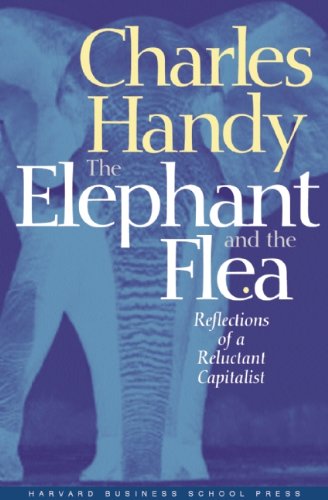
The Elephant and The Flea
Charles Handy’s The Elephant and the Flea is a very different kind of business book. It’s not a framework book. It’s a reflection—personal, honest, and a little uncomfortable if you’re paying attention.
Handy is asking a deeper question: What does it really mean to build a life of work today? Not just a career. A life.
What the Title Really Means
The “elephant” is the large organization—stable, powerful, structured. The “flea” is the individual—small, independent, and self-directed.
For most of the last century, people aimed to become part of the elephant. That was the path to security.
Handy makes it clear: that world is fading.
More people are becoming fleas—by choice or by force. Independent workers. Portfolio careers. People are stitching together meaning, income, and identity across multiple roles.
It sounds freeing. It is.
It’s also harder than most admit.
Work Is No Longer a Safe Container
Handy doesn’t romanticize independence. He lived it.
When you leave the elephant—or are pushed out—you lose structure. No one tells you what matters. No one defines success for you.
You have to decide.
That’s where most people struggle. Not with capability. With clarity.
I’ve seen this repeatedly. Very capable leaders step out on their own—and stall. Not because they lack skill. Because they’ve never had to define their own game before.
The Portfolio Life
One of Handy’s central ideas is the “portfolio life.”
Instead of one job, you build a mix:
-
Paid work
-
Work for purpose
-
Learning
-
Relationships
It’s a more complete life. But it requires discipline.
You have to manage your time. Your energy. Your relevance.
No one is doing that for you anymore.
Identity Becomes the Real Work
Inside the elephant, identity is often borrowed:
“I’m a VP.”
“I work at X company.”
Outside of it, that disappears.
So who are you now?
Handy pushes this strongly. Harder than most business books. Because this is where the real shift happens—not in structure, but in identity.
If you don’t answer that question, you drift.
Money, Meaning, and Enough
One of the most grounded parts of the book is Handy’s focus on “enough.”
Not more. Enough.
He challenges the idea that success is always tied to accumulation. More income. More status. More scale.
At some point, adding more stops does not add value.
That’s a hard idea for driven people. Especially leaders. We’re wired to push.
But it’s the right question:
What is enough for you?
If you don’t define it, you’ll never reach it.
The Freedom Trade-Off
Independence gives you freedom. It also gives you responsibility, uncertainty, and risk.
Handy doesn’t sell a fantasy. He shows the trade-off.
-
Freedom vs. security
-
Autonomy vs. structure
-
Meaning vs. predictability
You don’t get one without giving up some of the other.
So the real question becomes:
Which trade-offs are you willing to live with?
A Few Lines That Stay With You
“We are all becoming portfolio people.”
“The future is not what it used to be.”
Simple. True. Still playing out.
Reflection Questions
-
Are you still relying on the “elephant” for your identity?
-
If your current role disappeared tomorrow, what would remain?
-
What does your ideal “portfolio” actually look like?
-
Have you defined what “enough” means for you—or are you chasing more by default?
-
Where are you trading freedom for security—and is it worth it?
-
Are you building a life… or just maintaining a career?
Sit with these. They cut deeper than they look.
Author: Charles Handy
Charles Handy was one of the most influential thinkers on work and organizations. A former executive at Shell and a professor at London Business School, he stepped away from traditional corporate life early—long before it became common.
That gives this book weight.
He’s not theorizing about independence. He lived it. Built it. Struggled through it. And reflected on it with clarity.
That’s why this book feels different. It’s not telling you what to do.
It’s asking you to think.
Final Thought
Most people don’t choose their path. They inherit it.
Handy is asking you to stop. Look at it. And decide if it’s actually yours.
Because in this new world, no one is assigning you a life.
You are.
Make it deliberate.
