
The Four Disciplines of Execution
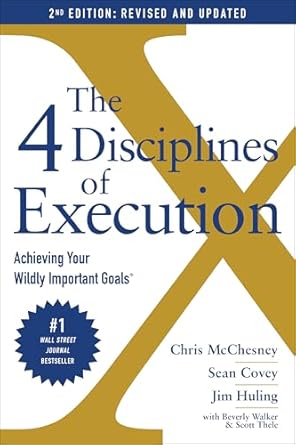
The 4 Disciplines of Execution (4DX)
by Chris McChesney, Sean Covey, and Jim Huling
Close the gap between goals and results.
Ideas are cheap; execution is the hard part. The 4 Disciplines of Execution gives leaders a simple, repeatable system to move the few things that matter most—especially when the day-to-day whirlwind tries to steal your focus.
Why this book matters now
Most teams drown in priorities, meetings, and metrics that don’t change outcomes. 4DX shows you how to narrow your aim, track the signals that actually predict success, make progress visible, and build a weekly rhythm of follow-through. It’s practical, fast to deploy, and built for real businesses—not just boardroom theory.
What you’ll learn
-
Focus on the few: Choose a small set of “must-win” goals and state them so anyone can tell if you hit them.
-
Measure what moves the needle: Identify leading indicators you can influence today—not just lagging results you can only explain later.
-
Make progress visible: Use a simple, player-owned scoreboard so the team always knows if they’re winning.
-
Install accountability you can feel: Run short, consistent check-ins where people make and keep commitments.
Who it’s for
-
Owners and CEOs who need consistent execution across departments and shifts.
-
General managers and ops leaders responsible for throughput, quality, and deadlines.
-
Sales and service teams that live by pipeline, response times, and customer outcomes.
-
Project leaders driving cross-functional work with tight timelines.
What’s inside
-
Discipline 1: Focus on the Wildly Important — pick fewer, better goals and write them in clear, measurable language.
-
Discipline 2: Act on Lead Measures — find the controllable activities that predict the result and commit to them.
-
Discipline 3: Keep a Compelling Scoreboard — design a one-glance view owned by the team, not just leadership.
-
Discipline 4: Create a Cadence of Accountability — a weekly 20–30 minute meeting where commitments are made, reported, and adjusted.
How to use this book
-
Name 1–2 must-win goals for the next 6–12 months. Write them with a baseline and a finish line.
-
Pick 2–3 lead measures per goal. Define exactly how they’ll be tracked daily or weekly.
-
Build a simple scoreboard that any team member can update and read in seconds.
-
Run a weekly commitment meeting (30 minutes max): review the scoreboard, learn from last week, make 1–2 new commitments.
-
Rinse and repeat until the results move—and then lock in the new standard.
Field-ready tools (grab-and-go)
-
Goal statement template: From X to Y by When.
-
Lead-measure worksheet: Behavior → Owner → Frequency → Evidence of completion.
-
Team scoreboard: A single page with goal line, current pace, and lead-measure trends.
-
Commitment log: Who | What | Due | Status | Blockers.
Common execution traps (and fixes)
-
Too many priorities → Choose fewer goals; sequence the rest.
-
Vague metrics → Put a number and a date on every goal.
-
Reporting without learning → In weekly reviews, ask “What did we learn?” before “Who’s to blame?”
-
Leader-owned dashboards → Shift ownership to the team; if they don’t update it, it isn’t a scoreboard.
-
Inconsistent cadence → Protect the weekly meeting like revenue—short, sharp, never skipped.
Why it stands apart
-
Clarity over complexity: Four habits you can teach in an afternoon and sustain all year.
-
Behavioral focus: Changes what people do this week, not just what they know.
-
Works in any setting: Equally effective on a shop floor, in the field, or at headquarters.
Ready to turn ambition into outcomes?
Pick one goal. Choose two lead measures. Build a scoreboard. Run your first 30-minute commitment meeting this week.
