
What Really Works
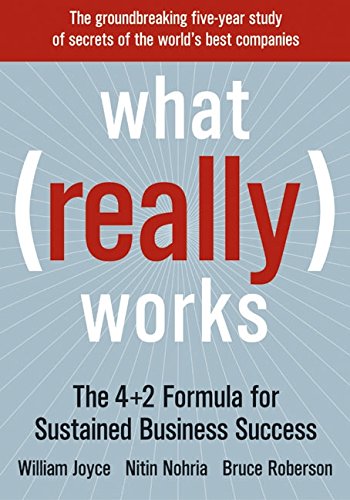
What Really Works
Execution, discipline, and the truth most leaders avoid
Most business books offer ideas.
What Really Works by William Joyce, Nitin Nohria, and Bruce Roberson does something different. It looks at what companies actually did—over time—and asks a harder question:
What consistently separates high-performing companies from the rest?
Not once. Not in theory.
But over sustained periods.
The answer is less exciting than most people want.
And more demanding.
There Is No Silver Bullet
The book cuts through one of the biggest myths in business:
There is no single strategy, structure, or innovation that guarantees success.
No magic formula.
No shortcut.
Instead, performance comes from a combination of disciplines executed well and consistently over time.
That’s harder to sell.
But it’s closer to the truth.
Strategy Matters—But Only If It’s Clear
The research points to strategy as one of the core drivers of performance.
But not strategy in the abstract.
Clear strategy.
That means:
-
Knowing where you will compete
-
Understanding how you will win
-
Aligning resources behind it
Most companies have something they call strategy.
Fewer have clarity.
And without clarity, execution weakens.
Execution Is the Difference
This is where the book becomes direct.
Good companies know what to do.
Strong companies actually do it.
Execution shows up in:
-
Consistency
-
Follow-through
-
Accountability
Not in presentations.
Not in planning sessions.
In daily behavior.
That’s where most organizations fall short.
They decide well.
Then drift.
Culture Is Not a Slogan
The authors highlight culture as a key driver—but not in the way it’s usually discussed.
Not posters.
Not values statements.
Culture is behavior.
What gets rewarded.
What gets tolerated.
What gets repeated.
If those don’t align with the strategy, performance suffers.
Always.
Structure Supports or Undermines Everything
Another key point: structure matters.
How the organization is set up—roles, responsibilities, and decision rights—either supports execution or creates friction.
You’ve seen both.
Clear structure:
-
Speeds decisions
-
Reduces confusion
-
Improves accountability
Poor structure:
-
Slows everything down
-
Creates overlap
-
Avoids ownership
This isn’t theoretical. It’s operational.
Talent Is a Leadership Responsibility
The book reinforces something many leaders underestimate:
You cannot build a strong company without strong people.
That includes:
-
Hiring well
-
Developing talent
-
Making tough calls when needed
Average talent produces average results.
Consistently.
And leaders who avoid talent decisions usually pay for it later.
Leadership Is the Integrator
At the center of all of this is leadership.
Not as a concept—but as behavior.
Leaders connect:
-
Strategy
-
Execution
-
Culture
-
Talent
If those elements are not aligned, performance breaks down.
That alignment does not happen on its own.
It is created.
Maintained.
Reinforced.
By leadership.
The Real Issue
This book doesn’t give you something new to chase.
It forces you to look at what you already know—and ask if you’re doing it well.
That’s uncomfortable.
Because most organizations don’t fail from lack of knowledge.
They fail due to a lack of discipline.
They know what works.
They just don’t sustain it.
So the real question becomes:
Are you missing the strategy—or missing the follow-through?
Reflection Questions
-
Is your strategy clear enough for your team to act without you?
-
Where is execution breaking down—and why?
-
What behaviors are actually being rewarded in your organization?
-
Does your structure support speed—or create friction?
-
Are you building strong talent—or tolerating mediocrity?
-
Where are you inconsistent as a leader?
-
What do you already know that you are not doing?
Media & Related Content
There are no film or TV adaptations tied to this book.
The ideas are rooted in research from Harvard Business School and have influenced:
-
Executive education programs
-
Strategy and leadership frameworks
-
Organizational performance studies
Its value comes from evidence—not storytelling.
About the Authors
William Joyce, Nitin Nohria, and Bruce Roberson are researchers and business thinkers with strong ties to Harvard Business School. Their work focuses on identifying patterns of sustained business performance across companies.
This book reflects large-scale research into what actually drives results—not opinion or theory alone.