
Glad We Met
Introduction: The Power of Effective 1:1s Using Simple Conversations
So much of leadership is wrapped up in big things—budgets, strategies, growth plans, new technology. Yet what often separates great leaders from average ones isn’t the grand vision, it’s the small, intentional moments of connection. Few things are more powerful than sitting down with a team member one-on-one and saying, “Let’s talk. I’m here for you.”
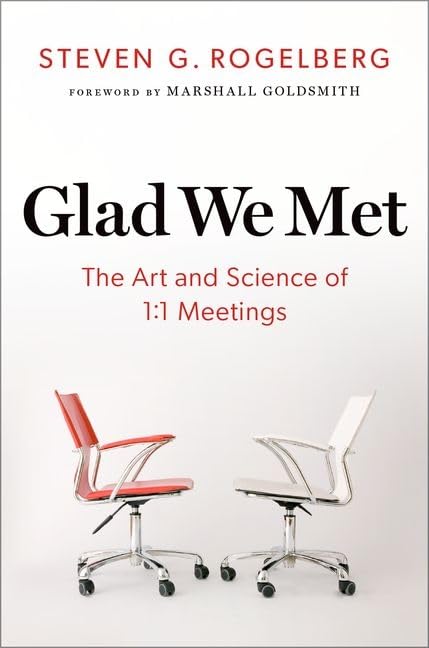
Steven Rogelberg’s book Glad We Met reminds us that while hundreds of millions of one-on-one meetings (1:1) happen every single day, nearly half are rated as ineffective by employees. Even more telling, most leaders think they’re doing a better job at these meetings than their people actually experience. That gap is where trust is lost, where opportunities slip away, and where leadership falls short.
The good news? Closing that gap doesn’t require some massive reorganization. It comes down to being intentional with the time we already have. 1:1s aren’t just meetings—they’re leadership in action. And if you want to build trust, loyalty, and performance in your business, you can’t afford to wing it.
Why 1:1s Are Not Optional
Rogelberg puts it bluntly: 1:1s aren’t an add-on to a manager’s role; they are the job. These meetings are the engine that drives strong working relationships. They create space for employees to share challenges, surface ideas, and feel genuinely supported.
Think about it: in a team meeting, the loudest voice often dominates. In casual hallway conversations, depth is lost. An open-door policy only works if people feel safe enough to walk in. But a consistent, private, intentional 1:1? That’s where the real work gets done.
These meetings:
- Increase engagement and job satisfaction.
- Strengthen inclusion and belonging.
- Boost growth, development, and retention.
And they’re not the same thing as performance reviews. Reviews summarize; 1:1s shape performance. They are the conversations that prevent surprises down the road, because issues and opportunities are discussed in real time.
Designing 1:1s That Actually Work
Cadence Matters
If you only meet when you feel like it, you’re sending a subtle signal: “This isn’t important.” The most effective leaders schedule weekly or at least monthly 1:1s. Consistency builds trust. Canceling them frequently, on the other hand, communicates that your people are expendable.
You also need to think about how you structure them. Clustering your 1:1s on one day might help you stay in the right mindset and reduce constant task-switching. But no matter how you schedule them, never treat them as interruptions. They are the work.
Location Counts
Your office works, sure—but it isn’t the only option. Sometimes a walk-and-talk opens people up. A coffee shop might set a lighter tone. Virtual meetings, now more accepted than ever, can be just as effective if handled with care. The point is, space sends signals. Choose settings that encourage openness and minimize distractions.
Agendas Without the Trap
Here’s the mistake many leaders make: they turn 1:1s into status update sessions. That’s not leadership—it’s bookkeeping. Rogelberg suggests using shared agendas. Both manager and employee contribute to what will be discussed.
That ensures balance. It also prevents the “just checking in” routine that leaves people disengaged. Some conversations should be tactical, sure. But many should be about growth, development, and removing roadblocks.
Carrying Out the Meeting
Rogelberg lays out a simple four-part structure that makes sense:
- Pre-Start – Come prepared. Review notes, get into the right mindset, and respect the time.
- Start – Ease in with lighter topics. Then move into roadblocks or feedback.
- The Heart – This is the real meat of the meeting: clarifying, problem-solving, setting next steps, and adjusting along the way.
- End – Close with gratitude, clarity on commitments, and finish on time.
Along the way, five relational behaviors matter most:
- Listen with empathy.
- Be authentic and transparent.
- Involve your employee in the process.
- Show kindness.
- Demonstrate appropriate vulnerability.
That last one matters more than most leaders think. Vulnerability isn’t weakness—it’s humanity. Saying, “I don’t have all the answers, but I want us to figure this out together,” builds more trust than pretending you’re bulletproof.
The Employee’s Role
Here’s something leaders often overlook: 1:1s are not a one-way street. Employees also have responsibilities in making these meetings effective. They need to come prepared, ask for feedback, receive it with openness, and communicate their needs.
That means asking for help when stuck, bringing ideas to the table, and not waiting for the manager to drive every conversation. In healthy organizations, 1:1s are a partnership.
After the Meeting: Follow-Through Builds Trust
What happens after the 1:1 is just as important as what happens during it. Nothing undermines trust faster than walking out of a meeting, agreeing on action items—and then watching nothing happen.
That’s why follow-through is everything. Leaders should document takeaways, check in on commitments, and show that words translate into action. Employees should do the same.
And don’t assume the meeting went well just because you felt good about it. Ask: “How are these conversations working for you? What could I do differently?” Leaders often overestimate how well their 1:1s land. It’s the employee’s perception that counts.
Special Topics: Skip-Levels and Meeting Overload
Two important side notes Rogelberg makes:
- Skip-Level 1:1s – Occasionally, meeting with your employees’ direct reports gives you insight from the ground level. Done well, they build cross-level trust. Done poorly, they look like micromanagement. The key is transparency—always tell your managers why you’re doing it and set the right tone.
- Meeting Overload – Cutting meetings entirely isn’t the answer. Instead, reduce low-value ones and pour energy into the meetings that matter most. Trim a 60-minute meeting to 50. Tighten agendas. Make meetings shorter, sharper, and more impactful.
Conclusion: Glad We Met
Here’s the real takeaway: 1:1s are a reflection of your values as a leader. If you cancel them, rush them, or treat them as box-checking exercises, you’re telling your people they don’t matter. If you show up prepared, listen with empathy, and follow through, you’re telling them the opposite: “You are a priority. You matter to me. I’m invested in your success.”
That’s why Rogelberg’s title hits the mark. A successful 1:1 ends with both people leaving the room thinking, “I’m glad we met.”
As small business owners and leaders, we can’t always compete on resources. But we can always compete on relationships. And relationships are built one conversation at a time.
So ask yourself: Do my 1:1s send the message I want to send? Do they build trust, clarity, and energy—or do they leave people drained and second-guessing? The answer to that question might just determine whether your people stay, grow, and thrive—or quietly disengage.
If you want to build a stronger, more committed team, don’t just schedule 1:1s. Elevate them. Make them moments of real leadership. And make sure your people walk away saying, “I’m glad we met.”
Leadership Action Steps:
- Schedule 1:1s weekly or monthly and rarely cancel them.
- Co-create agendas with your employees.
- Balance tactical updates with future-oriented discussions.
- Show up with empathy, kindness, and authenticity.
- Follow through on commitments—every time.
- Ask for feedback on the meeting itself.
- Use skip-levels wisely to gain ground-level insight.
- Trim unnecessary meetings to make room for high-impact ones.
Reflection Questions for Leaders
- Do I treat 1:1s as an obligation or as an opportunity?
- How consistently do I keep my commitments to these meetings?
- Are my 1:1s balanced between tactical updates and long-term growth conversations?
- Do I invite my employees to co-create agendas—or do I control them entirely?
- How well do I listen with empathy, versus just waiting to respond?
- Do I close every 1:1 with clarity, gratitude, and follow-through?
- What signals am I sending my people about their value by how I run (or cancel) these meetings?
- Have I asked my team for feedback on the quality of our 1:1s?
- Do I leverage skip-level conversations to gain broader perspective without undermining my managers?
- If someone walked away from a 1:1 with me today, would they say, “I’m glad we met”?
