
Communication Catalyst
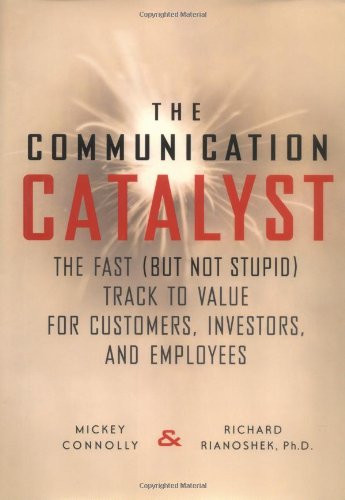
Communication Catalysts
Most leaders think they communicate well.
They don’t.
Communication Catalysts by Mickey Connolly and Richard Rianoshek is a direct challenge to that assumption. It doesn’t focus on presentation skills or polished messaging. It focuses on what actually drives alignment, trust, and execution inside organisations—and where communication quietly breaks down.
I’ve seen this pattern for years. Leaders talk. Teams nod. Then nothing changes. This book explains why.
What This Book Is Really About
At its core, Communication Catalysts is about closing the gap between what leaders say and what actually happens.
The authors argue that communication is not an event—it’s a system. A set of behaviors, habits, and expectations that either move work forward or stall it out.
And most breakdowns aren’t dramatic.
They’re subtle.
They’re repeated.
That’s what makes them dangerous.
The Core Ideas That Drive the Book
1. Communication Is Measured by Results
Leaders tend to judge communication by delivery.
Clear slides. Strong message. Good meeting.
The book flips that.
Communication is only successful if it produces shared understanding and aligned action. If people walk away interpreting things differently, you didn’t communicate—you broadcast.
That’s a hard truth. It’s also accurate.
2. The Hidden Cost of Misalignment
One of the strongest ideas in the book is this: misalignment is expensive.
Not just financially. Operationally. Culturally.
When people interpret goals differently, you get:
-
Rework
-
Frustration
-
Delays
-
Quiet disengagement
And none of it shows up immediately. It compounds.
The authors make it clear that most organizational problems are communication problems in disguise.
3. Conversations Are the Real Work
We tend to treat conversations as secondary to “real work.”
They’re not.
Conversations are the work.
Every commitment, decision, expectation, and accountability structure lives inside a conversation. If those conversations are unclear, incomplete, or avoided, execution suffers.
Simple. Not easy.
4. The Power of Clear Agreements
One of the most practical contributions in the book is the focus on agreements.
Not a vague understanding. Not implied expectations.
Clear agreements.
-
Who is doing what
-
By when
-
With what standard
-
And what happens next
Without this level of clarity, teams drift. With it, they move.
I’ve watched this change entire organizations.
5. Listening as a Strategic Skill
Most leaders underestimate listening.
The authors don’t.
They position listening as a core leadership discipline—one that shapes understanding, trust, and decision quality.
If you’re not listening well, you’re making decisions on incomplete data. That’s a risk most leaders don’t see until it’s too late.
6. Accountability Without Clarity Fails
You can’t hold people accountable for what was never clearly defined.
This shows up everywhere.
Leaders push for accountability. Teams push back. Friction builds.
The root issue? Lack of clear communication upfront.
Accountability is not enforcement. It’s clarity followed by follow-through.
7. Communication Drives Culture
Culture is not posters on a wall.
It’s how people talk to each other.
What they avoid.
What they tolerate.
What they reinforce.
The book makes this connection explicit: improve communication, and you improve culture.
Ignore it, and culture drifts—usually in the wrong direction.
Practical Takeaways You Can Use Immediately
-
Define agreements clearly. Every time.
-
Check for understanding—don’t assume it.
-
Treat conversations as execution, not preparation.
-
Slow down to speed up. Clarity saves time.
-
Address misalignment early. It only gets worse.
None of this is complicated.
But it requires discipline.
Reflection Questions
Let’s make this useful.
-
Where is your team most misaligned right now—and have you actually clarified it?
-
Do people leave your meetings clear on next steps, or guessing?
-
What conversations are you avoiding that are costing you performance?
-
How often do you confirm understanding instead of assuming it?
-
Are your expectations explicit or implied?
-
Where is rework happening, and what communication caused it?
-
If your team rated your clarity, what would they say?
Sit with those.
Why This Book Matters
There are a lot of books on communication.
Most stay at the surface.
Communication Catalysts goes deeper. It connects communication directly to execution, accountability, and results. That’s what makes it valuable—especially for leaders running real organizations with real pressure.
It’s operating discipline.
Get this right, and everything improves—alignment, trust, performance.
Miss it, and nothing else quite works.
That’s the truth.
About the Authors
Mickey Connolly and Richard Rianoshek are co-founders of The MAC Group (now part of Accenture) and have spent decades working with senior leaders to improve organizational performance. Their work focuses on execution, alignment, and the role communication plays in driving results.
They’ve seen where organizations break.
And more importantly, why.
