
The Pen and the Republic – A Leadership Conversation with Thomas Jefferson
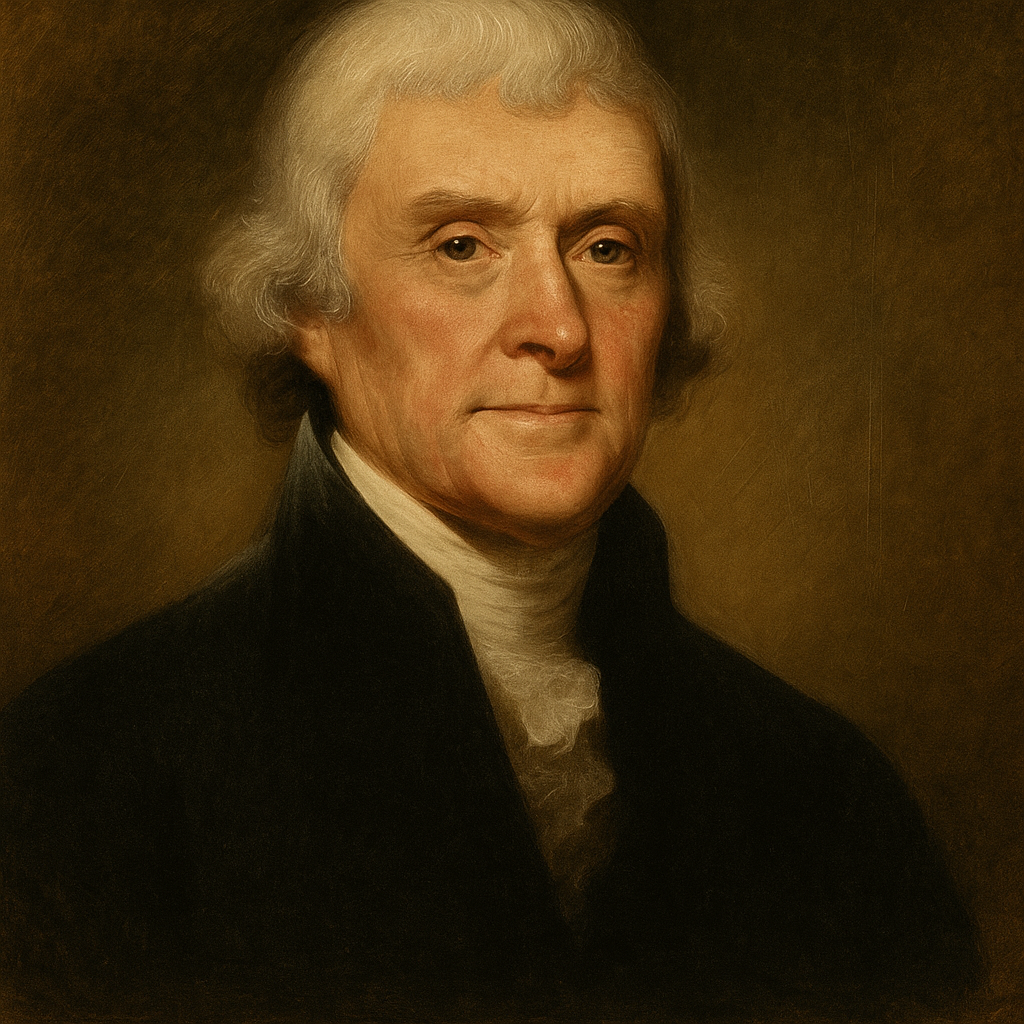
My interview with Thomas Jefferson in a continuing series of fictional exchanges with historical figures.
The Setting
Monticello, 1824.
The view from Jefferson’s mountaintop estate stretches beyond the Virginia hills, past orchards and gardens. Inside his library, books are stacked on tables, instruments rest on shelves, and letters lie in mid-draft. Thomas Jefferson, now 81, sits near a large globe, cane resting by his chair. Though age bends his body, his mind moves quickly.
He welcomes you with a warm but measured smile—more philosopher than politician now. He gestures to the chair across from him, ready to reflect on a life shaped by revolution, contradiction, and a ceaseless pursuit of knowledge.
I. Revolution and the Power of Ideas
On Writing the Declaration of Independence
Me: You drafted the Declaration of Independence at only 33. What did that task mean to you?
Jefferson:
It was both duty and danger.
The colonies needed a voice that would echo across time. I tried to capture eternal truths in clear, enduring words. “All men are created equal…”—those words were both aspiration and indictment. I hoped they would ring louder in the future than they did in the moment.
On the Meaning of Liberty
Me: What is liberty, to you?
Jefferson:
It is the right to think freely, speak boldly, and act without fear—so long as we respect the same in others.
Liberty is not lawlessness. It is the self-mastery of an informed, virtuous people. Without education, liberty is fleeting. Without character, it is dangerous.
On the Power of the Pen
Me: You are remembered more for your writing than for battlefield command. Was that intentional?
Jefferson: (Smiling.)
Yes. I chose the pen because it carves through centuries.
The sword wins the day. But ideas win the age. I believed deeply that the written word—precise, principled, persuasive—could do more for freedom than a thousand cannons.
II. Diplomacy, Governing, and the Challenge of Power
On His Time in France
Me: How did your time as ambassador to France shape your views?
Jefferson:
It taught me to admire reason—and to fear decadence.
The French people were spirited and brilliant. I loved their art, their salons, their philosophy. But I also saw the rot beneath royal grandeur. The hunger, the hierarchy, the unsustainable arrogance.
I returned more convinced that liberty must be grounded in simplicity, education, and civic virtue—not ceremony.
On the Presidency and Use of Power
Me: How did you approach executive power during your presidency?
Jefferson:
With restraint—until circumstance demanded otherwise.
I believed in small government. I campaigned on it. Yet the Louisiana Purchase presented a dilemma: constitutional hesitation or generational opportunity? I chose the latter.
Leadership requires the humility to hold principles—and the courage to bend them when the nation requires it.
On the Louisiana Purchase and Lewis & Clark
Me: Was the Louisiana Purchase your proudest achievement?
Jefferson:
It was certainly the boldest.
We doubled the size of the nation—peacefully. But it was the Lewis and Clark Expedition that gave it meaning. I wanted more than land. I wanted knowledge—geography, botany, native cultures, trade routes.
Their journey was my dream of America made manifest: curious, ambitious, prepared to meet the unknown with open eyes and scientific purpose.
On Keeping Elites in Check
Me: How do you prevent democracy from being overtaken by elites?
Jefferson:
By dispersing power and elevating the common mind.
I believed in a strong citizenry of farmers, teachers, and tradesmen—not centralized power. The republic depends not on aristocracy but on education, participation, and the constant renewal of civic spirit.
Power must be accountable—or it will become a monarchy in disguise.
III. Friendship, Rivalry, and Reflection
On His Relationships With the Other Founders
Me: You had complicated relationships with Hamilton, Adams, and Washington. How do you view them now?
Jefferson: (With calm fondness.)
With respect—and perspective.
Hamilton and I disagreed on almost every principle, yet we shared a passion for nationhood. His energy built structures I might never have dared.
Adams was stubborn, brilliant, and fiercely principled. We quarreled. Then, we healed. Our letters became a testament to mutual love for the republic.
Washington? He was the indispensable man. Our political visions diverged—but I never questioned his character or his sacrifice.
On Leaders He Admired
Me: Were there any historical leaders you looked up to?
Jefferson:
I admired Cincinnatus, who left power behind. Locke, who gave us the philosophy of consent. Newton, who revealed the laws of nature. And Charlemagne, whose blend of sword and learning intrigued me.
I hoped to follow them not in power, but in principle.
On His Intellectual Curiosity
Me: Your interests ranged from architecture to astronomy to gardening. What drove that breadth?
Jefferson:
Curiosity. I wanted to understand the world—not just govern a part of it.
I designed buildings, experimented with crops, and studied fossils. I believed knowledge dignifies a free society. Monticello itself was my canvas—part home, part laboratory, part classroom.
To lead well, a man must be a lifelong student.
On His Struggle With Ego
Me: Did you struggle with pride or self-righteousness?
Jefferson: (Quietly.)
Yes. I often preferred writing to confrontation—and I sometimes mistook caution for virtue.
I believed I was right more often than I should have. Ego is the shadow of principle. It follows even the most enlightened. I struggled to act with conviction—and reflect with humility.
IV. Slavery, Legacy, and Moral Reckoning
On Slavery and Hypocrisy
Me: You wrote that all men are created equal. Yet you owned slaves. How do you reconcile that?
Jefferson: (Somberly.)
I cannot fully.
I spoke against slavery. I wrote against it. Yet I failed to end it in my own life. I inherited a system and lacked the will—or the courage—to dismantle it.
It is my greatest contradiction. One that history must judge honestly, and future generations must correct thoroughly.
On Regret
Me: What do you most regret?
Jefferson:
That I did not do more to align my actions with my ideals, especially on slavery. And that, in striving to serve liberty, I sometimes allowed principle to become rigidity.
But I do not regret the struggle for independence, or the trust we placed in the people. America’s journey is unfinished—but it is worthy.
V. Legacy and Farewell
On How He Hopes to Be Remembered
Me: What should your legacy be?
Jefferson:
Let them remember me as the author of:
- The Declaration of Independence,
- The Virginia Statute for Religious Freedom, and
- The founder of the University of Virginia.
Not for power held—but for truth pursued. Not for office—but for ideas.
On Advice to Future Leaders
Me: What counsel would you give to those who govern today?
Jefferson:
Educate the people. Respect their judgment. Fear concentrated power. And question everything—even your own certainty.
Lead with reason, not rage. Serve not for glory—but for posterity.
Remember: a republic is not inherited. It is earned—every day.
The Farewell
A breeze stirs the papers on his desk. Jefferson rises slowly, gazing out towards the hills he once surveyed and the country he helped to launch.
Thomas Jefferson:
I have seen liberty declared, tested, and debated. I leave its defense to you now.
Let your words be thoughtful—and your deeds truer still.
